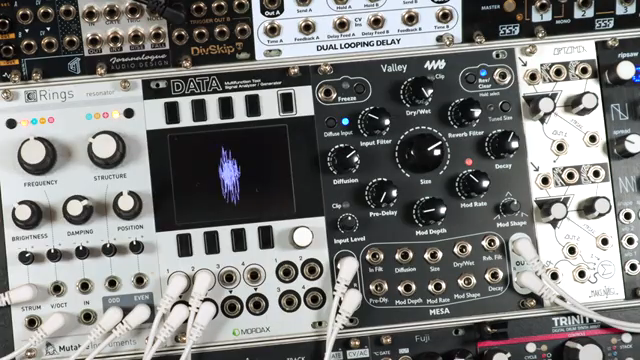
Rings in, Mesa out to the mixer: DivKid doesn't need a complicated patch for his little reverb lesson. In his video published on November 19, 2026, he takes an excerpt from his longer Mesa demo and focuses on sound shaping. The appealing moment comes when he first strips the reverb down: shorter decay, no pre-delay, no diffusion. Suddenly, it's less about spaciousness and more about the question of what remains of an attack.
Two Ways to Soften the Edges
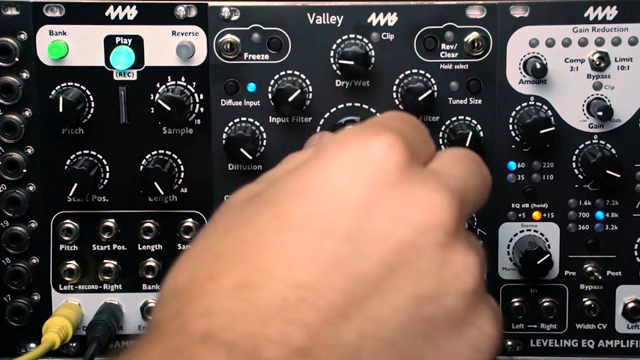
© Screenshot: DivKid (YouTube)
“You can hear that kind of haze, that bloom of reverb.”
© Quote: DivKid (YouTube)
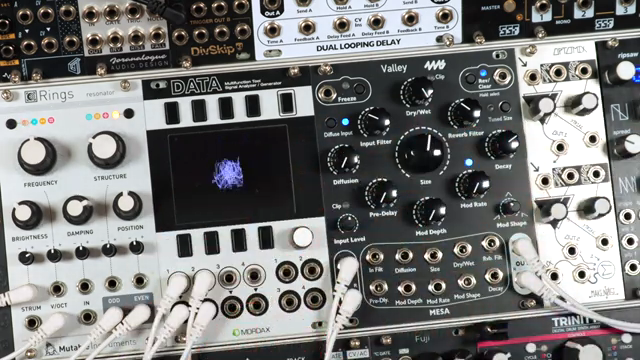
On the stereo reverb from 4ms and Valley Audio, DivKid distinguishes two interventions that are easily lumped together. Diffuse Input softens the sharp transients from Rings: he describes a slower attack, a softer onset. The actual diffusion control, on the other hand, processes the reverb itself. With higher values, the individual echoes or delay lines become less pronounced.
For further comparison, he removes the modulation and switches off input diffusion. This allows you to follow what increasing the reverb diffusion alone does. This is the strongest didactic move of this demonstration: not making everything prettier at once, but exposing a single change. DivKid describes it like this:
4MS Mesa – Amazon keyword search
Search for this product on Amazon →
This link opens an Amazon keyword search. Depending on availability, other results may be shown.
Advertising – affiliate link. If you buy through this link, we may earn a commission – at no extra cost to you.
Darker In or Darker Out?
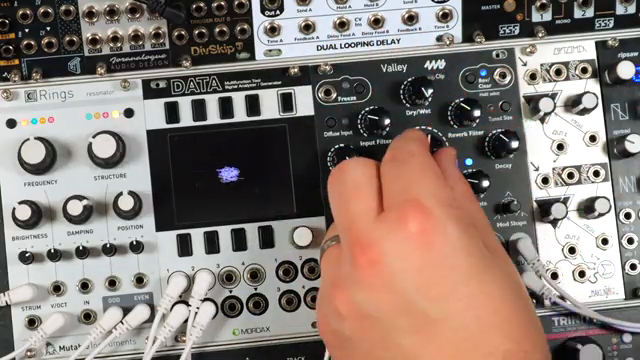
DivKid's handling of the two filters is similarly enlightening. With the lowpass in the reverb path, he points out that in the fully wet signal, the early reflections are still present, while the reverb tail is significantly dampened. With the highpass, he shifts the energy of the reverb tail upwards: the bass fades quickly, while higher components are allowed to continue flowing.
The musical decision thus concerns not just brightness, but also the course of the decay. The input filter acts earlier. It determines which material excites the reverb at all—in DivKid's demonstration, the more drastic intervention. Feeding a room with darkness is not the same as darkening its reverb tail:
© Screenshot: DivKid (YouTube)
“The input filter is much more drastic, as that will affect the input before the reverb, so it's really tailoring what's coming into the reverb here.”
© Quote: DivKid (YouTube)
When the Room Plays Back
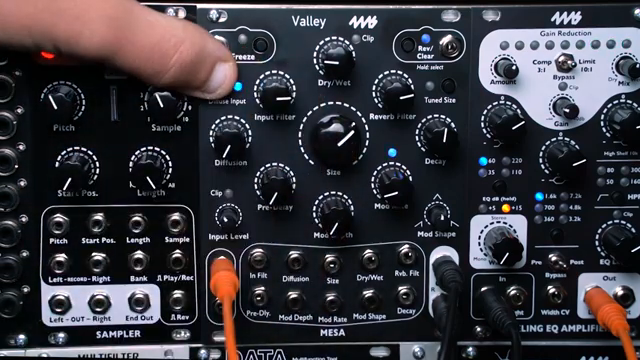
© Screenshot: 4ms Company (YouTube)
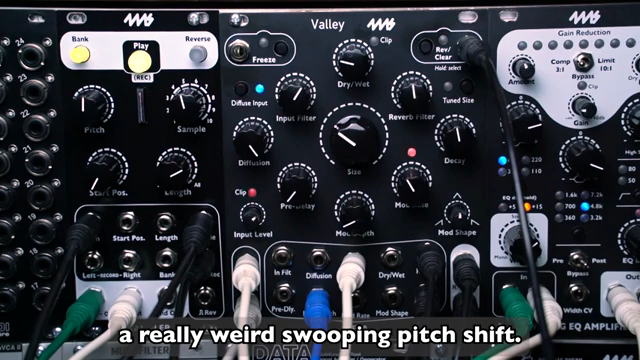
“In addition to this scattering caused by low diffusion, there's also a pre-delay control here, which is an entire delay buffer before the signal ever even hits the reverb.”
© Quote: 4ms Company (YouTube)
DivKid then makes the reverb smaller and shorter and adds pre-delay. Without delay, the effect sits directly on the percussive Rings notes; with distance, it takes on a rhythmic role. Large size values and little diffusion in his later demonstration again lead to scattered, almost multitap-like echoes. A smooth reverb pad is just one possibility here, not a necessity.
A concrete musical application is provided by the Superbooth segment from sonicstate on May 8, 2026: The interview partner introduced as Ross first demonstrates a chopped vocal sample and then sets pre-delay to a beat. He explicitly speaks only of a rough tempo adjustment. In the manufacturer tutorial from November 5, 4ms Company explains the signal path:
Even a Pad Can Duck
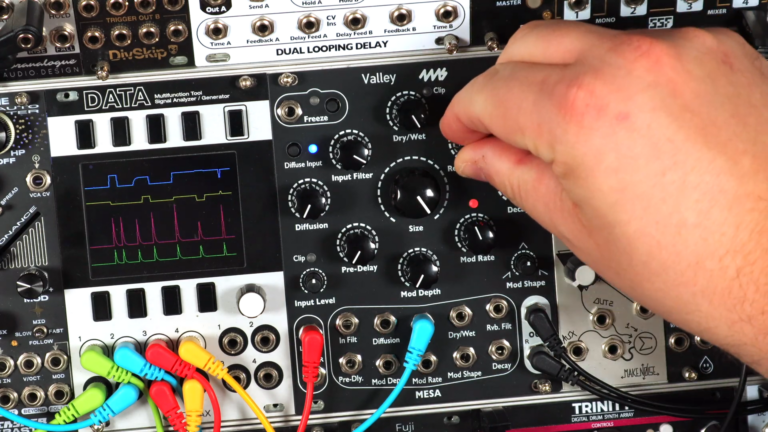
4ms doesn't stop at the distance between note and reverb onset in the tutorial. In another patch, an ambient sample lies over a groove while Mesa's space ducks rhythmically. For this, the manufacturer uses a negative envelope on dry/wet and decay. Here, not only the timbre is shaped, but also the space the atmosphere occupies in the arrangement:
© Screenshot: 4ms Company (YouTube)
“Sending a negative envelope into dry/wet and decay can make the ambient element of a patch duck and pump.”
© Quote: 4ms Company (YouTube)
DivKid finally brings his scattered echoes back into a dreamy pad with modulation, decay, filter, and diffusion. This return path is particularly enlightening: the big reverb is not an endpoint that every control must strive for. Sometimes, the more interesting musical decision lies where the space still gives individual answers.
4MS Mesa – Amazon keyword search
Search for this product on Amazon →
This link opens an Amazon keyword search. Depending on availability, other results may be shown.
Advertising – affiliate link. If you buy through this link, we may earn a commission – at no extra cost to you.
Videos for this article
All other articles featuring the 4MS Mesa
All YouTube videos featuring the 4MS Mesa
Primary – main topic (8)
 Learn about REVERB & MESA in under 10 minutes // 4ms & Valley Audio
 Mesa Tutorial
 A MASSIVE Guide to a MASSIVELY Flexible Reverb // MESA from 4ms & Valley
 The 4ms/Valley Reverb Mesa Reaches Higher Ground
 Plateau Reverb in Eurorack / 4ms & Valley Mesa
 4ms: Mesa Reverb + Levelling EQ Amp - Superbooth 2026
 10 Best TUBE Guitar Amps for Metal | Marshall, Mesa, Orange, Bogner & MORE!
 Gibson Buys Mesa!!