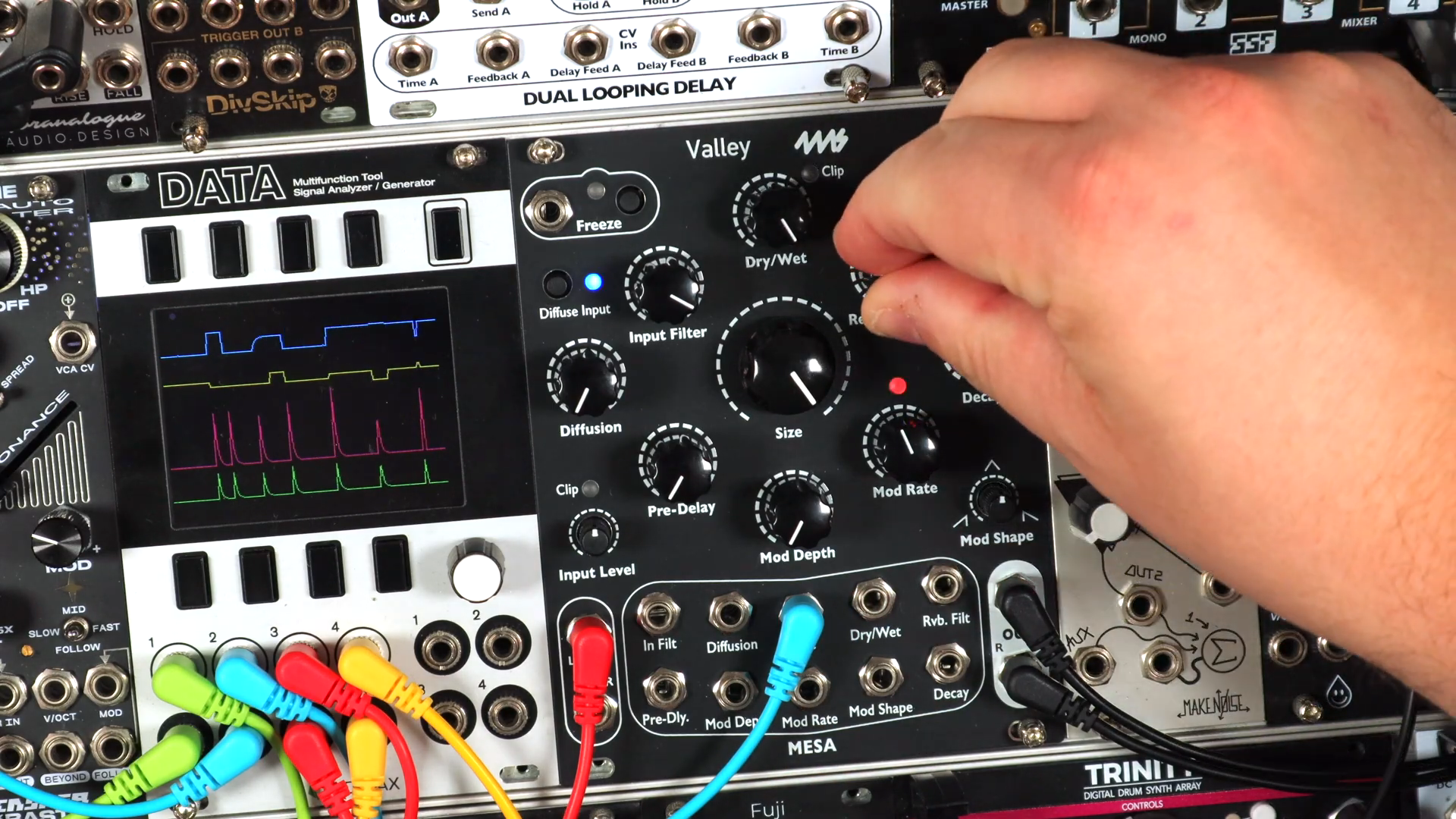
DivKid actually wants to pull a snare backwards into the beat. But Mesa doesn’t always deliver the expected reverse: sometimes it’s just a short burst of reverb. Instead of forcing it, he freezes the reverb and lets it swell in with a rising envelope. In his Mesa guide, published November 5, 2026 and sponsored by 4ms, a detour becomes the real discovery: this reverb can be played like sound material.
A Cloud in Reserve
“So exploring the freeze function further, here's the idea of a kind of crude sampler using reverb as a sampler, and using the frozen reverb and the way that you can keep adding into that buffer to create and freeze a chord tone.”
© Screenshot/Quote: DivKid (YouTube)
DivKid first introduces Mesa as a 20HP Eurorack version of Valley Audio’s VCV Rack reverb Plateau. More interesting than its origin is how he handles frozen reverb: a five-step envelope pattern rhythmically fades in the captured cloud. Alongside the original clap, this creates an additional percussion voice. The reverb tail is no longer just an accompaniment to an attack; it becomes the material for new sounds itself.
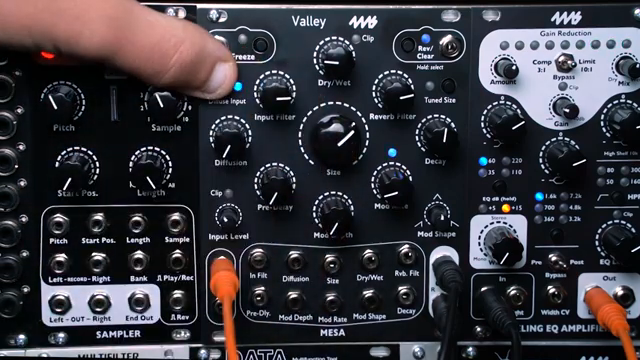
He then develops the idea further. He lowers the level of a wavetable source, uses Mesa’s input level control to dose individual notes into the freeze, and layers higher notes on top. Two downstream lowpass gates make the held sound playable as percussion. Here, the inconspicuous input level control takes on a musical role: it determines what gets added to the already captured sound.
How Much Attack Should Remain?
Metamyther, in “The 4ms/Valley Reverb Mesa Reaches Higher Ground,” also pays attention to practical control details. He highlights the center detent of the dry/wet knob, where both signals are equally strong. Such orientation points are welcome when an effect becomes a playable voice. Not every interesting decision, however, is found in a large knob range.
When switching Diffuse Input, he describes a galloping character without input diffusion, but more smeared contours when the function is activated. DivKid demonstrates the same distinction on Rings: input diffusion softens the attacks, while the separate diffusion knob thickens the reverb itself. For a percussive voice, that’s essential: a softer attack and a denser decay are two different musical decisions.
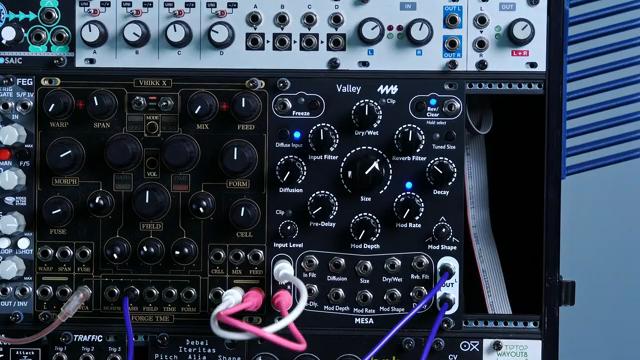
“The diffuse input is really, really subtle.”
© Screenshot/Quote: Metamyther (YouTube)
Clearing Is Part of Playing
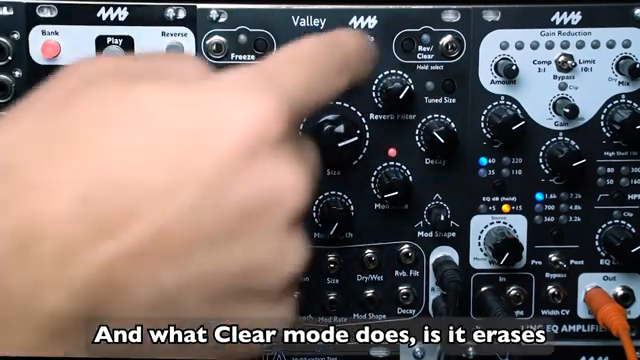
“And what clear mode does is it erases basically the reverb tail and resets it. This is very useful for doing things like gated reverb.”
© Screenshot/Quote: 4ms Company (YouTube)
Holding is only half the story. In the “Mesa Tutorial,” 4ms Company shows a groove from their own sampler, whose start, shaped by a downward envelope, gives the impression of a record speeding up. The same envelope controls Mesa’s size and modulation depth; a gate rhythmically clears the reverb via Clear. Source and space move together, while clearing sets clear breaks.
Clear is more than just turning down the output: according to the manufacturer, the reverb tail is erased and reset. DivKid even gets something he describes as a counter-melody out of it. A quarter-note pulse empties the reverb; depending on which notes fall in between, different ones are briefly sustained. The pauses become part of the composition.
Size Becomes Pitch
DivKid demonstrates the most striking role change with Tuned Size. According to his explanation, this mode shortens the internal delay times into the audio range and reverses the polarity of the size CV input for normal pitch tracking. A short impulse at the audio input excites this network. Size now sets the tuning, decay the note length, and the reverb filter shapes the sound. More diffusion, in his demonstration, brings in dissonant, metallic components.
DivKid then pursues the bass aspect of this voice: he offsets the pitch sequence downward and varies the strength of the exciting impulses. Little modulation gives vibrato, more diffusion produces the tortured dissonance he explicitly highlights. Then the quarter-note kick and sidechain pumping return. This patch is refreshingly far from any attempt at realistic room simulation.
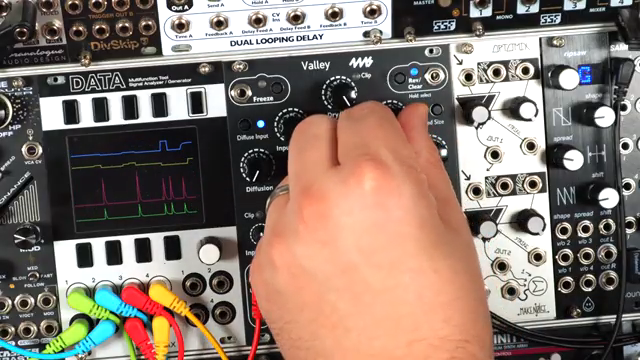
“And that's a reverb cosplaying as a spooky bass line generator.”
© Screenshot/Quote: DivKid (YouTube)
Still, DivKid’s initially stubborn reverse snare remains the strongest discovery. Ironically, the effect that doesn’t reliably fit leads him to a new way of playing. Mesa becomes an instrument where he no longer just searches for the right space, but decides what material stays, when it sounds, and when it must disappear.
Videos for this article
All other articles featuring the 4MS Mesa
All YouTube videos featuring the 4MS Mesa
Primary – main topic (7)
 Mesa Tutorial
 A MASSIVE Guide to a MASSIVELY Flexible Reverb // MESA from 4ms & Valley
 The 4ms/Valley Reverb Mesa Reaches Higher Ground
 Plateau Reverb in Eurorack / 4ms & Valley Mesa
 4ms: Mesa Reverb + Levelling EQ Amp - Superbooth 2026
 10 Best TUBE Guitar Amps for Metal | Marshall, Mesa, Orange, Bogner & MORE!
 Gibson Buys Mesa!!