Expert Sleepers brings a classic bucket-brigade delay vibe to the Disting NT with the new Little Spacey algorithm in firmware 1.16. Based on their own 2009 VST, this effect brings dark, analogue-style echoes—with all the quirks and tweaks you’d expect—straight to your Eurorack. The video walks through stereo and mono operation, hands-on parameter control, and a few modulation tricks that show just how far this digital BBD can stretch in a modular setup.
16. September 2026
MILES
Expert Sleepers Disting NT: Little Spacey BBD Delay Lands in Firmware 1.16
A Bucket-Brigade Classic Goes Eurorack
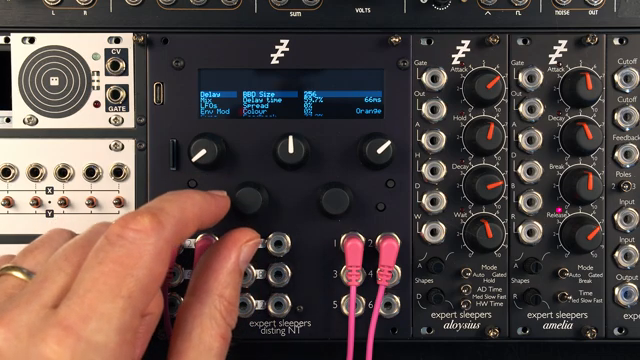
With the release of firmware v1.16, Expert Sleepers has ported their Little Spacey bucket-brigade delay effect to the Disting NT module. Originally a VST plugin from 2009, Little Spacey now makes its analogue-inspired delay tones available for Eurorack users, giving the Disting NT a new role as a versatile, characterful delay unit. The effect operates happily in both mono and stereo configurations, with the video demoing a stereo drum loop to show off its capabilities. For those who appreciate the murky, filtered nature of classic BBD delays, this addition is firmly aimed at you.
"Being a bucket brigade delay, it has a tendency to be rather dark and analogue and filtered, and that's the joy of it really."
© Screenshot/Quote: Expertsleepersltd (YouTube)
Feedback, Buckets, and Clock: The Core Controls
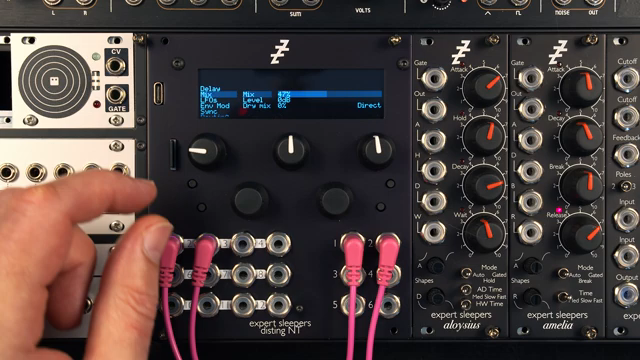
"You can set the bucket brigade size in terms of number of taps, and then you've got a range of possible delays by changing the clock frequency."
© Screenshot/Quote: Expertsleepersltd (YouTube)
Little Spacey’s key parameters revolve around the basic mechanics of a bucket-brigade delay: feedback, tap count, and the interplay between delay length and clock frequency. Adjusting the feedback parameter allows users to dial in anything from subtle repeats to runaway echoes, always with that slightly decaying, analogue edge characteristic of BBDs.
The ability to set the bucket brigade size in terms of the number of taps directly influences the maximum achievable delay time. Changing the clock frequency adjusts the delay’s range from snappy slapbacks to much longer echoes, with the actual delay time displayed on the Disting NT. The emulation even allows for an impractically large number of buckets, pushing into delay lengths that would be a serious engineering headache (and wallet drain) in real hardware.
Colour, Spread and LFOs: Sculpting the Delay
Disting NT’s Little Spacey doesn’t just stop at basic delay lines; it adds several parameters for shaping the effect’s tonal and spatial footprint. The ‘Colour’ parameter alters the feedback path topology, subtly shifting the character of the repeats—filtering and darkness can be tweaked by ear, while an additional feedback path option allows users to choose between tighter, brighter inner circuits or a more diffuse, filtered sound.
Stereo imaging is handled by the ‘Spread’ control, which offsets delay times between the two channels for a pseudo-stereo effect. For modulation, two LFOs are onboard: one modulates delay time directly, while the second can modulate the first, creating evolving, non-static movement. There’s even the option for different LFO rates per channel, making for wide, animated delays that drift and swirl—ideal for adding width to synths or processed samples.
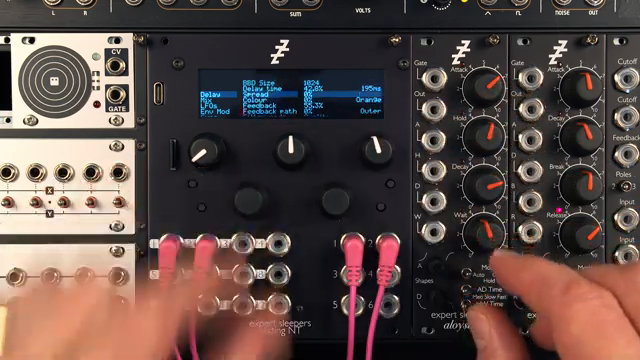
"If you're in stereo mode, then that changes the delay time of one of the channels to be slightly different, or very different, which gives you a nice kind of pseudo stereo thing going on."
© Screenshot/Quote: Expertsleepersltd (YouTube)
Envelope Ducking and Clock Sync: Delay That Listens
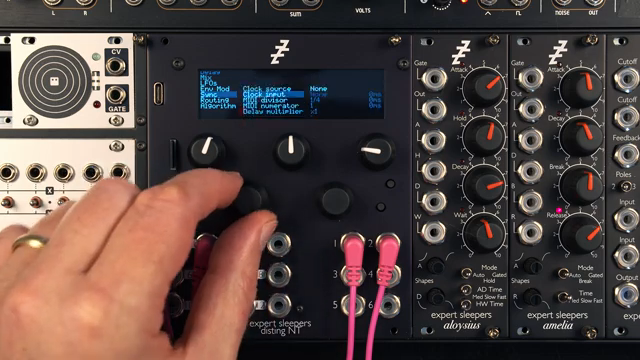
"This feature here wasn't in the original VST. This lets you tempo sync the delay to a clock."
© Screenshot/Quote: Expertsleepersltd (YouTube)
To round out the feature set, Little Spacey includes an envelope follower for ducking effects—a practical tool for keeping delays out of the way when the dry signal is present, then letting them bloom in the gaps. The envelope can also interact with the LFOs, allowing for dynamic modulation tied to the input level, which adds a responsive element to the sound design palette.
A final addition, not present in the original VST version, is the ability to tempo-sync the delay to an external clock—whether that’s analogue, another Disting NT source, or MIDI. This brings the effect squarely into modular territory, allowing for precise rhythmic integration. As with most Expert Sleepers gear, mono operation is available to conserve CPU and memory for simpler setups, ensuring the effect can flexibly fit into a range of Eurorack systems.
This article is also available in German. Read it here: https://synthmagazin.at/expert-sleepers-disting-nt-little-spacey-bbd-delay-in-firmware-1-16/
More articles about these products:
 Expert Sleepers disting NT: Detuning and Microtonal Power with Temporal Freeze
 Expert Sleepers Disting NT: Layering Evolves with Temporal Freeze
 Expert Sleepers’ disting NT: The Swiss Army Knife at the Heart of Simon Kirby’s Modular Rig
 Expert Sleepers’ disting NT: A Swiss Army Knife for the Modular Age
 Expert Sleepers disting NT: At the Heart of Simon Kirby’s Modular Mindset
 Expert Sleepers Disting NT: Spectral Conquest – FFT Mayhem in Modular
 Expert Sleepers Disting NT: Continuous Calibration for Drifty VCOs
 Expert Sleepers Disting NT: Looping in Layers, Modular Style
 Expert Sleepers Disting NT: Modular Freedom in a Single Module
 Expert Sleepers disting NT: Mapping Mayhem in the Modular Realm
Watch on YouTube:
Latest articles
Watch on YouTube:
Visit the channel:
https://www.youtube.com/ExpertSleepersLtd
https://www.youtube.com/ExpertSleepersLtd
Links from ExpertSleepersLtd:
Sponsored links:
If you purchase via these links, we may earn a small commission – at no extra cost to you. The link opens an Amazon keyword search, and results may vary depending on availability.
Expert Sleepers disting NT
🔗 Check price on Amazon
🔗 Check price on Amazon