Befacosynth’s ARK module isn’t just about modular synthesis—it’s a fully hybrid creative workstation, and this video dives deep into its digital sampling engines. From the speed-focused standard sampler to a microSD-powered library, slicer magic, and granular wizardry, Befaco’s latest tutorial reveals how ARK handles audio in detail. We explore workflow, file management, and the unique personalities of each engine, with a critical eye on what’s shown—and what’s left for future exploration.

A Quartet of Sampling Engines
Befacosynth’s ARK module expands its sonic palette with a suite of four distinct sampling engines: the standard sampler, SD sampler, slicer, and granular. Unlike traditional synth voices, these engines are designed to manipulate and recontextualize pre-recorded audio, offering a range of workflows from tight, latency-free playback to generative, textural soundscapes.
Each engine brings a different philosophy to sample-based work. The standard sampler is all about speed and direct access, the SD sampler caters to massive libraries, the slicer is rhythmically inclined, and the granular engine dives into micro-level manipulation. This structural diversity allows ARK to serve everything from drum-based sequencing to experimental sound design, all within a Eurorack-sized workflow.
Loading Samples and the Standard Sampler’s Speed
Loading your own audio into ARK is a process grounded in the sample pool—a dedicated RAM buffer capable of holding up to 16 files at a time. Audio must be in WAV format, 16-bit, 44.1 kHz, and can be mono or stereo, with strict filename and folder conventions to ensure smooth operation. Once loaded, samples are instantly selectable for use in the standard sampler, with playback modes ranging from one-shot and gated to looping and ping-pong, all tweakable with attack, decay, and pitch controls.
The key advantage here is near-zero playback latency thanks to RAM-based operation. ARK’s interface provides direct access to the sample pool via device configuration, making it easy to swap or audition sounds mid-session. This focus on responsiveness positions the standard sampler as the go-to for performance-critical and melodic applications, especially where timing is paramount.
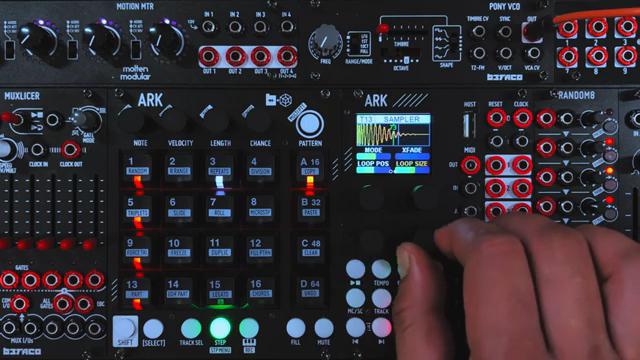
"The main advantage of the standard sampler is that samples are loaded into RAM, providing near zero latency and responsive playback."
© Screenshot/Quote: Befacosynth (YouTube)
SD Sampler: Depth Over Speed
"The SD sampler is particularly useful when working with longer audio files that exceed the available RAM, or when you need access to more than 16 different sound sources in a project."
© Screenshot/Quote: Befacosynth (YouTube)
For users who crave expansive sample libraries or the ability to work with lengthy audio files, the SD sampler offers an alternative workflow. Here, samples are streamed directly from the microSD card, bypassing RAM limitations and unlocking access to ARK’s full eight-bank, 128-sample-per-bank library. The trade-off is a slight increase in playback latency, making it less suitable for applications where immediate response is required across multiple tracks.
The SD sampler shines in large projects or installations where more than 16 unique sound sources are needed simultaneously. Its control set includes bank and sample selection, pitch, start position, amplitude, decay, and a bipolar filter for tonal shaping. For most day-to-day work, Befaco recommends sticking with the standard sampler unless the project explicitly demands SD streaming’s extended reach.
Slicer Engine: Rhythmic Reshaping
The slicer engine turns any audio file into a playground for rhythmic experimentation. By dividing a sample into user-defined slices—typically 4, 8, 16, or 32 sections—the engine enables intricate rearrangement and step-sequenced triggering, perfect for drum loops and groove-centric material. The workflow encourages precise loop trimming and thoughtful slice counts to match the underlying rhythm.
Playback modes in the slicer range from sequential to random, with parameters for starting slice, pitch, envelope, and filtering. This engine’s design makes it easy to inject variation and unpredictability into patterns, offering both control and creative chaos for users who thrive on manipulating rhythmic motifs in real time.
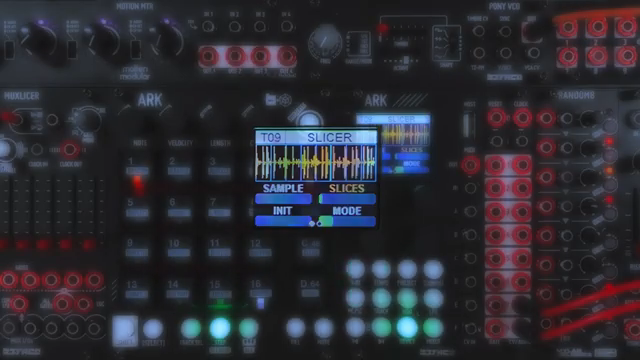
"It's particularly useful for working with drum loops and other rhythmic material."
© Screenshot/Quote: Befacosynth (YouTube)
Granular Synthesis: Microsonic Exploration
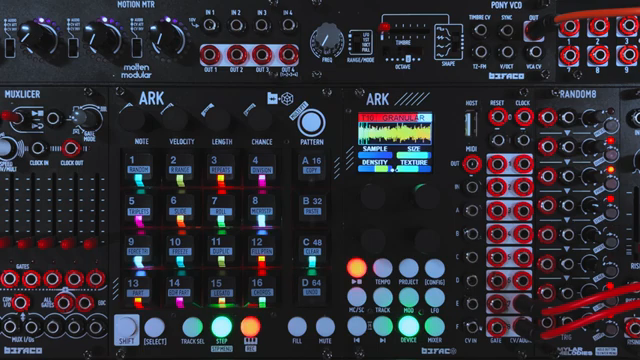
"These grains are played independently, allowing you to reorganize the original audio in time and create completely different textures."
© Screenshot/Quote: Befacosynth (YouTube)
ARK’s granular engine dissects audio at the smallest scale, breaking samples into grains whose size, density, texture, and position can all be manipulated for radical sonic transformation. Like the standard sampler and slicer, it draws from the 16-sample RAM pool, using these fragments as raw material for everything from smooth time-stretching to glitchy, evolving atmospheres.
Controls for grain size and density set the temporal framework, while texture, attack, and decay shape each grain’s character. The position parameter determines the sample area being mined, and spray introduces stochastic movement—ideal for generating organic, shifting soundscapes. The engine follows pitch and timing data from the sequencer, supporting both melodic and abstract applications.
In practice, this means users can morph recognizable phrases into swirling pads or use granular techniques to create percussive clusters and evolving drones. The workflow shown is straightforward, though deeper exploration will be needed to assess its full creative depth and interface integration.
This article is also available in German. Read it here: https://synthmagazin.at/befacosynth-ark-sampling-engines-im-detail/
More articles about these products:
Watch on YouTube:
Latest articles
Watch on YouTube:
Visit the channel:
https://www.youtube.com/Befacosynth
Links from Befacosynth:
website: https://www.befaco.org
shop: https://shop.befaco.org
instagram: https://www.instagram.com/befacosynth
facebook: https://www.facebook.com/befacosynth
twitter: https://x.com/Befaco
linktree: https://linktr.ee/Befaco
Sponsored links:
If you purchase via these links, we may earn a small commission – at no extra cost to you. The link opens an Amazon keyword search, and results may vary depending on availability.
Befaco ARK
🔗 Check price on Amazon