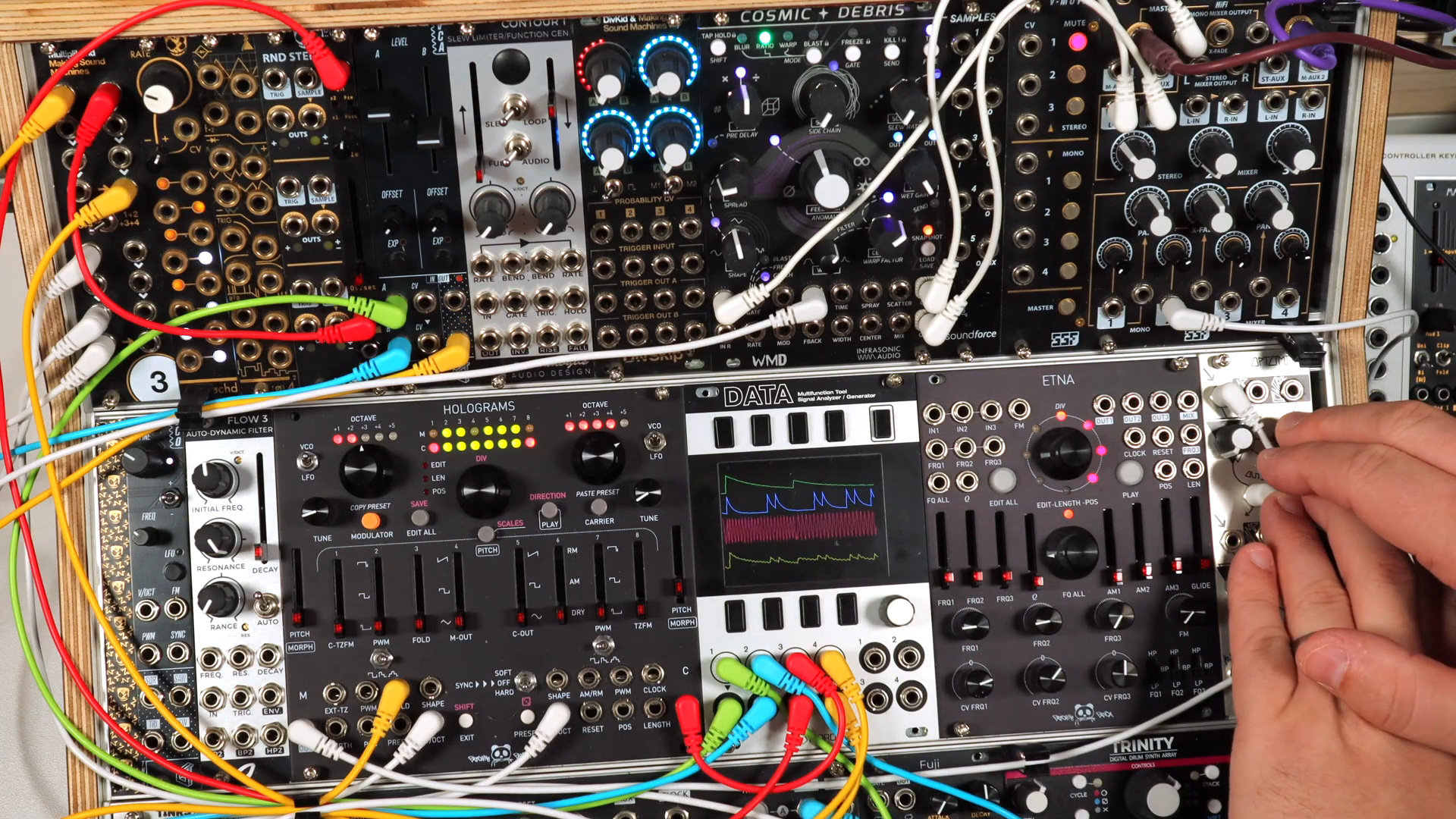
DivKid starts one of his patches with an external kick drum and a clock. He pans the two Holograms outputs hard left and right; a stereo VCA lets them pump to the kick. Then he builds an eight-step sequence with the faders. That’s all it takes for his techno riff to get going. But in his video published on November 26, 2026, he also shows just how far this principle can be taken from a straight groove. The feature is sponsored by Patching Panda.
Seven against eight
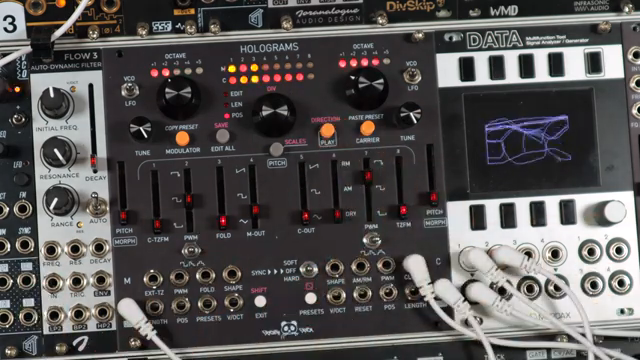
© Screenshot: DivKid (YouTube)
“So different clock divisions, different step lengths, but the same core melodic material.”
© Quote: DivKid (YouTube)
After DivKid’s introduction, Holograms connects two analog oscillator cores and analog sound shaping with digital control. In stop mode, you have direct access to tuning and sound parameters. Once started, their settings can be organized per step. The sequencer thus distributes not only pitches: it shapes how the sound changes within a phrase.
DivKid demonstrates how musical this can get by starting with deliberately simple sounds. Both sides receive the same eight-step melody. Then he shortens the modulator to seven steps while the carrier keeps all eight. Next, he divides the carrier’s clock by two and the modulator’s by three. The external lowpass gates are still triggered in the original rhythm. This means the trigger grid and melodic movement are no longer the same.
DivKid draws an association to Steve Reich for this. What matters here is less the label than the audibly traceable intervention: he doesn’t invent a second melody, but lets existing material run under different temporal conditions.
Patching Panda Holograms – Amazon keyword search
Search for this product on Amazon →
This link opens an Amazon keyword search. Depending on availability, other results may be shown.
Advertising – affiliate link. If you buy through this link, we may earn a commission – at no extra cost to you.
The wish for sofa techno
The desire for a compact, immediately playable system already appears in Patching Panda’s Sonicstate Superbooth feature from 2019. There, Luis from Patching Panda explains during a walkthrough of the percussion modules that they aim for a system to make techno on the sofa. This isn’t a retroactively invented company philosophy, but a quite concretely formulated musical wish.
At that time, however, Luis speaks of a triple VCO with two modulators and one carrier. This architecture is different from the dual oscillator in DivKid’s current video. The older trade show feature therefore doesn’t prove today’s functions, but it does provide an interesting perspective on the musical intent behind the devices.
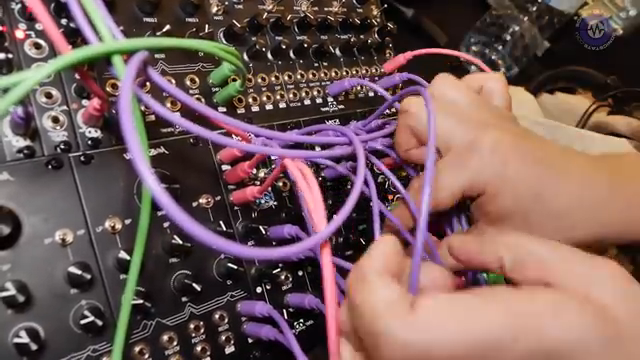
© Screenshot: sonicstate (YouTube)
“we want to make a compact system where you take to the sofa and then just make a really nice techno”
© Quote: sonicstate (YouTube)
Getting wild, dialing it back
In the current video, playing also means taming the results. After a randomization, DivKid’s first stereo patch quickly becomes messy and intense, as he himself notes. Later, he shows that randomness by no means has to rearrange the whole module: in the randomization menu, he specifically limits which parameters and value ranges are affected. First, he changes only the pulse width, then adds waveform and octaves.
Equally important for this workflow is Edit All. With it, a single fader movement overwrites the relevant parameter on all steps of the selected side or both sides. DivKid demonstrates this as a way to, for example, remove wavefolding from an overloaded patch. It’s a powerful intervention, not a cautious overall offset.
Being playable on its own here doesn’t mean a complete groovebox. Kick, VCAs, lowpass gates, and effects come from outside depending on the example. Precisely because DivKid names and repeatedly removes these ingredients, Holograms’ role in his patches is easy to follow.
Two faders change the character
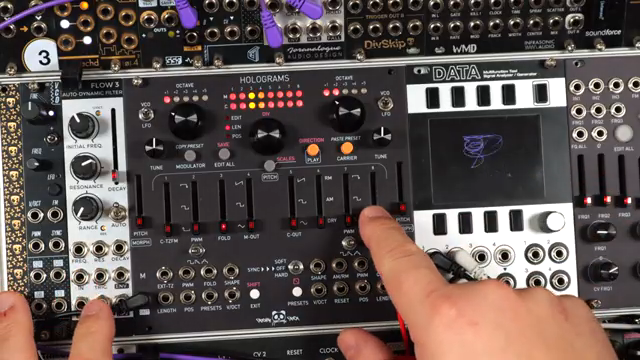
© Screenshot: DivKid (YouTube)
“and simply if I press edit all and push up those morph controls, the outer two sliders,”
© Quote: DivKid (YouTube)
The most striking role change then needs no additional modulation source. DivKid takes a running eight-step parameter sequence and divides its clock internally by 16. He then activates Edit All and raises the two outer morph faders.
In play mode, these controls don’t just create gliding pitches. According to his explanation, they also interpolate between the sound parameters of neighboring steps. The transition time depends on the step duration; at full setting, the transition takes up a whole step. Clearly separated states thus become a slow movement of sound.
DivKid first demonstrates this without the big reverb, then adds reverb and joint pitch control of both oscillators via keyboard. The drone is thus not created by the effect unit alone. Its movement is already embedded in the slowed, blending sequence.
In these demonstrations, Holograms is at its most exciting not when as many modulation types as possible are running at once, but when a small decision shifts the musical role of the entire patch: one step less, a different division, a longer transition. The next idea here doesn’t necessarily have to be a new melody.
Patching Panda Holograms – Amazon keyword search
Search for this product on Amazon →
This link opens an Amazon keyword search. Depending on availability, other results may be shown.
Advertising – affiliate link. If you buy through this link, we may earn a commission – at no extra cost to you.


