Monotrail Tech Talk ditches the modular hand-holding and gets right to the meat: how to actually get clever with your patching, not just survive it. This video is a brisk, sharp, and occasionally savage run through the real steps of going from “I know what a VCA does” to “I can make this box scream and cry in new languages.” Expect practical ideas, bad jokes about failed patches, and a solid reminder that the only real rule is: keep twisting. If you want the same five ‘modular basics’ rehashed, you’re in the wrong rave bunker.

12. August 2026
SPARKY
Patch Like a Pro: Monotrail Tech Talk’s Streetwise Modular Guide
Modular Mindset: Dive Deeper or Go Home
Monotrail Tech Talk doesn’t waste time explaining what a filter does. Instead, he jumps straight to the point: once you know your basics, the real fun starts when you get bold (and sometimes weird) with your modular patches. Forget the safety wheels – you only grow by pushing your modules beyond their polite factory presets and into new territories. The advice is clear: don’t just accept what your gear offers at face value, dig deep, and be willing to try things that sound awful until you find that one sweet spot.
The video opens with a dose of honesty – yes, some steps are obvious, but if you stick with it, you’ll pick up something genuinely new. According to Monotrail, the trick is to experiment relentlessly, not to get discouraged when patches sound rubbish, and to keep a mental (or literal) notebook of discoveries. The message is simple: attitude trumps manuals. If you treat every patch as an adventure, the complex stuff will come naturally – as long as you keep experimenting and don’t give up after the first patch sounds like a dying robot.

"A lot of patches and ideas will initially be weird, sound crap or lead to bad results."
© Screenshot/Quote: Monotrailtechtalk (YouTube)
Systematic Chaos: Experiment Like You Mean It
"Listen to the raw waves of an oscillator, resonant feedback of a filter, sounds of an effect module and make notes about preferences."
© Screenshot/Quote: Monotrailtechtalk (YouTube)
Monotrail’s process isn’t just random cable spaghetti – there’s a method to the madness. Start with the basics: compare raw waveforms across modules, sniff out those subtle differences, and don’t trust the marketing hype. He’s all about pushing things past their intended limits, like abusing LFO ranges with external offsets and turning looping envelopes into drone machines. Even the most vanilla oscillator can become a chaos module with a few creative mispatches.
The real fun comes when you ignore the manual’s polite suggestions and just see what happens. Patch envelopes at audio rates, modulate your delay with noise, or use a sample & hold to mess with filter cutoff. Monotrail’s advice is to treat every CV input as an invitation to try something stupid – because sometimes stupid is genius. He even admits learning new things about his own gear just by diving in. The bottom line: don’t just do what you’re told, do what’s never been tried.
Self-Patch and Abuse: Where Weird Gets Wonderful
Once you’re bored with ‘normal’ patching, it’s time to fold signals back on themselves and process the unexpected. Self-patching, according to Monotrail, is the modular world’s answer to talking to yourself – sometimes you get nonsense, sometimes you get genius. The video’s packed with examples: sub-oscillator outputs modulating their own FM, LFOs triggering their own patterns, and envelopes folding in on themselves. Even if the first attempt sounds like a toaster-fight, you’ll stumble on tricks worth saving.
And don’t stop at audio – Monotrail pushes for processing everything: envelopes, LFOs, even random voltages. Got a wave folder? Feed it a reverb tail. Have a quantizer? Try using it as a bit crusher. The point is, in modular land, voltage is voltage – there are no sacred cows. Processing the ‘wrong’ signal often leads to the most original results. If you want every detail of his favourite patches, you’ll have to join his Patreon or, better yet, actually watch the video – some sounds just don’t translate to words.

"Because in a modular all signals are just analog voltages you can explore processing all sorts of different signals even the ones that you're not really supposed to."
© Screenshot/Quote: Monotrailtechtalk (YouTube)
Stack, Modulate, Repeat: Chain Effects for Sonic Mayhem
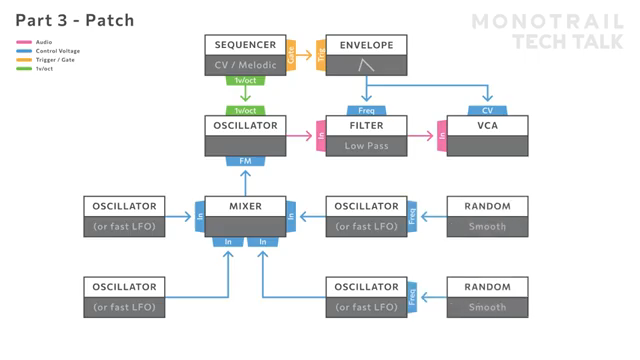
"Now you're chaining ideas and truly getting creative with your patches and modules."
© Screenshot/Quote: Monotrailtechtalk (YouTube)
Monotrail isn’t shy about chaining effects and modulation sources until the patch looks like spaghetti junction. He’s got no patience for ‘one trick per module’ thinking. Instead, he throws everything at the wall: oscillators modulating random sources, delays turned into waveshapers, and clock signals wrangled from LFOs and sub oscillators. The modular playground is about stacking effects and letting the chaos evolve.
The fun explodes when you start cross-modulating – using random voltages to mess with oscillator pitch, or clocking envelopes with granular bursts. These aren’t just advanced techniques; they’re how you make your patches sound like a sentient rave bunker. Monotrail’s message: don’t get precious about clean signal paths. Life’s too short. Jam effects, modulate everything, and let the patch mutate. For the real sonic mayhem, you’ll want to see (and hear) the video – words alone can’t do justice to the resulting carnage.
Your Patch, Your Rules: Take the Guide and Run
In classic Monotrail style, the video closes by tossing the rulebook out the window and encouraging viewers to find their own path. The steps outlined aren’t gospel; they’re starting points for your own mad science. Whether you’re after happy accidents or controlled chaos, the real secret is to keep exploring and never settle for the first patch that works. If you want to become a true patching pro, you’ll need to get your hands dirty and invent a few toaster-fights of your own.
This article is also available in German. Read it here: https://synthmagazin.at/patch-wie-ein-profi-monotrail-tech-talks-kompromissloser-modular-guide/
Watch on YouTube:
Latest articles
Watch on YouTube:
Visit the channel:
https://www.youtube.com/MonotrailTechTalk
https://www.youtube.com/MonotrailTechTalk
Links from MonotrailTechTalk:
Patreon: https://patreon.com/monotrail
Instagram: https://instagram.com/monotrail/
Sponsored links:
If you purchase via these links, we may earn a small commission – at no extra cost to you. The link opens an Amazon keyword search, and results may vary depending on availability.
ONA oscillator
🔗 Check price on Amazon
🔗 Check price on Amazon