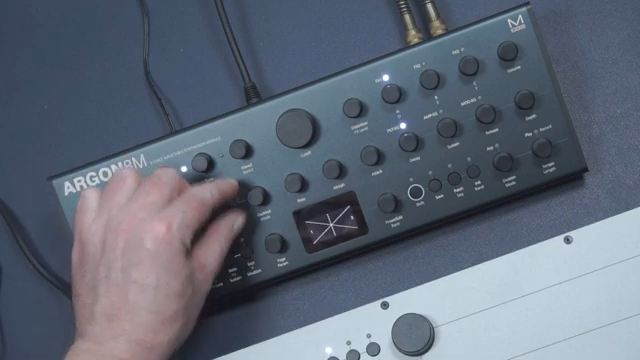
Modal Electronics steps into the ring with three visually similar yet architecturally distinct polysynths: ARGON8, COBALT8, and CARBON8. In this deep-dive video, Modal puts their synthesis philosophies under the microscope, dissecting how wavetable, extended virtual analog, and experimental digital engines push each model toward unique sonic territory. With a consistent interface and workflow across the trio, the real question becomes: which synthesis approach aligns with your sound design ambitions? We break down what’s actually different—under the hood, in your hands, and in the musical results.
17. October 2026
LYRA
Modal Electronics: Engineered Diversity – ARGON8, COBALT8 & CARBON8 Compared
Three Engines, One Chassis: Modal’s Divergent Paths
The video opens with a direct challenge: given that ARGON8, COBALT8, and CARBON8 share the same physical chassis, layout, and core performance features, what truly sets them apart? Modal Electronics addresses the confusion head-on, clarifying that the shared interface is just surface-level. Underneath, each synth engine is a different beast—wavetable, extended virtual analog, and experimental digital.
The host underscores that while navigation and programming approaches are consistent, the oscillator, filter, and modulation architectures diverge to match each engine’s philosophy. This means that once you learn one device, you can leverage that skill across the range—yet each model’s core sound generation tools are uniquely tailored. The video promises to unpack these differences, showing how each synth’s sonic identity emerges from its architecture rather than its appearance.
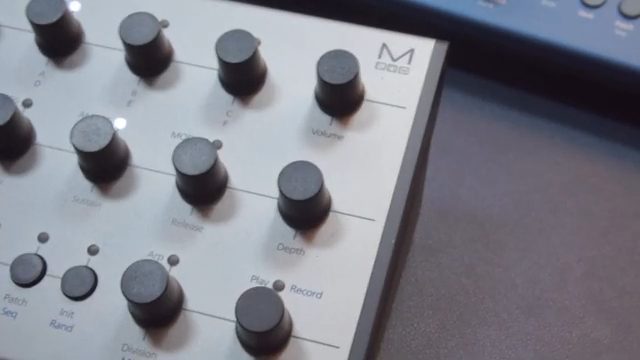
"The Argonate is built around wavetable synthesis, the Cobalt 8 takes an extended virtual analogue approach, and the Carbonate brings together digital algorithms, wavetables, and a range of waveform processing techniques."
© Screenshot/Quote: Modalelectronics (YouTube)
ARGON8: Evolving Textures via Wavetable Depth
"Wavetable morphing is only the starting point. It also has 32 static wavetable modifiers along with eight types of oscillator modifier."
© Screenshot/Quote: Modalelectronics (YouTube)
ARGON8’s identity is rooted in wavetable synthesis, offering 180 wavetables across 36 banks and morphing capabilities that allow users to move seamlessly between waveform shapes. This morphing isn’t a static selection; it’s a dynamic process that can be modulated, producing evolving timbres and complex harmonic changes even within a single note or chord.
What sets ARGON8 further apart is its suite of 32 waveform modifiers and eight oscillator modifier types—including phase, ring, and amplitude modulation, hard- and windowed-sync—enabling layers of transformation atop the morphing engine. The filter section provides eight modes with morphable and pre-filter drive options, while four animation lanes allow for live or sequenced parameter movements. ARGON8 is pitched as the go-to for atmospheric pads, animated digital leads, and any sound design scenario where evolution over time is central. Despite the depth, the interface remains structured, making advanced exploration accessible.
COBALT8: Virtual Analog, Supercharged
COBALT8 takes the virtual analog paradigm and amplifies it, with two oscillator groups providing up to 64 oscillators per patch and 40 algorithms covering both classic and experimental territory. Users can start with familiar analog-style sounds—think solid waveforms and straightforward filter envelopes—but quickly move into new terrain by swapping oscillator algorithms or tweaking algorithm parameters.
The filter section distinguishes COBALT8 further, offering 31 resonant filter types, including morphable, ladder, state-variable, and hybrid configurations. The result is a synth that excels at both bread-and-butter basses and leads as well as more adventurous harmonic constructions. The familiar Modal workflow means users don’t need to relearn the interface, but the sonic palette is unmistakably geared toward those who want analog warmth with digital flexibility and depth.
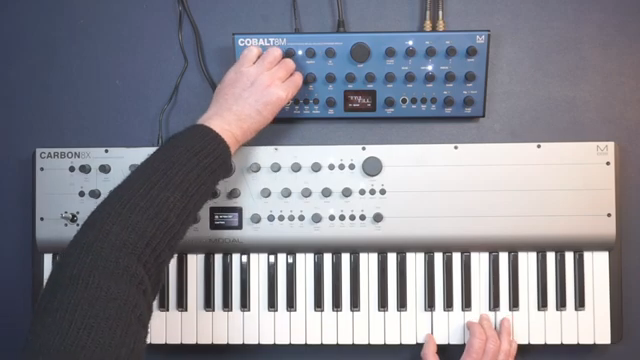
"These include conventional waveform generation, but also techniques such as pulse width, modulation, hard sync, ring modulation, waveform morphing, and bit crushing."
© Screenshot/Quote: Modalelectronics (YouTube)
CARBON8: Digital Experimentation Unleashed
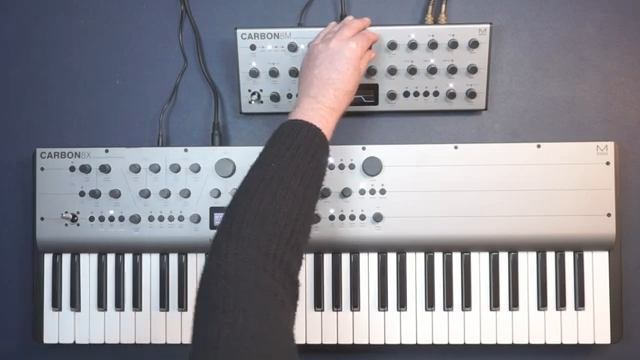
"These include wave shaping, wave folding and phase distortion."
© Screenshot/Quote: Modalelectronics (YouTube)
CARBON8 represents Modal’s most experimental digital offering, combining two independent digital oscillators with 56 core waveforms drawn from 18 digital algorithms and 38 wavetables. The true innovation lies in its waveform processing tools, including wave folding, phase distortion, and wave shaping—all integrated at the engine level rather than as end-of-chain effects.
This approach encourages deep sonic exploration: simple waveforms can be transformed into harmonically rich, metallic, or evolving textures through modifier intensity and parameter motion. The filter array is expansive, with 34 types including morphable and dual configurations, and a robust modulation matrix (three LFOs, three envelopes, 12 slots) supports intricate movement. CARBON8 is portrayed as ideal for those who crave digital timbral discovery—capable of both extreme and subtle results—offering a playground for sound designers willing to go beyond the analog comfort zone.
Unified Workflow, Divergent Soundworlds
Despite their contrasting synthesis engines, ARGON8, COBALT8, and CARBON8 all share Modal’s interface DNA: eight-voice polyphony, three envelopes, a built-in sequencer, arpeggiator, 12-slot modulation matrix, and three stereo effects slots. The video stresses that the real overlap is in programming ease and cross-compatibility of workflow—not in identical sound.
Each synth’s filter section is tailored to its engine, with the number and type of filters reflecting the needs of the underlying synthesis method rather than simply offering ‘more’ for its own sake. Modal’s approach allows users to transition between devices without retraining muscle memory, but with the reward of dramatically different sonic palettes. The editorial takeaway: owning more than one makes sense if you’re after distinct architectures, and the unified UI actually enhances this multi-engine approach rather than diluting it.
This article is also available in German. Read it here: https://synthmagazin.at/modal-electronics-engineered-diversity-argon8-cobalt8-carbon8-im-vergleich/
Watch on YouTube:
Latest articles
Watch on YouTube:
Visit the channel:
https://www.youtube.com/ModalElectronics
https://www.youtube.com/ModalElectronics
Links from ModalElectronics:
website: https://modalelectronics.com
twitter: https://twitter.com/ModalElectronic
instagram: https://instagram.com/modalelectronics
Sponsored links:
If you purchase via these links, we may earn a small commission – at no extra cost to you. The link opens an Amazon keyword search, and results may vary depending on availability.
Modal ARGON8
🔗 Check price on Amazon
🔗 Check price on Amazon
Modal CARBON8
🔗 Check price on Amazon
🔗 Check price on Amazon
Modal COBALT8
🔗 Check price on Amazon
🔗 Check price on Amazon