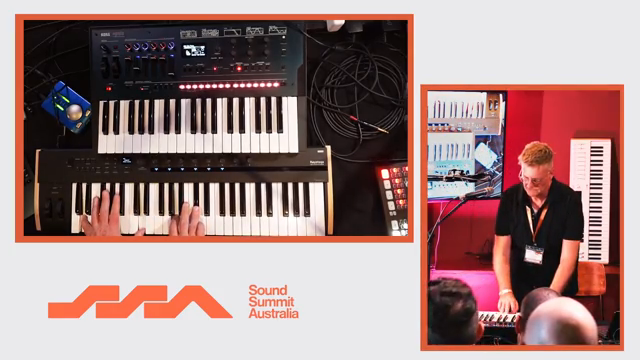
A low G, around 100 hertz, and a rising modulation level: In Noisegate’s video FM Synthesis Explained for Subtractive Synth Players, published on November 18, 2026, the presenter turns a basic FM experiment into a readable observation. He tracks the overtones in the spectrum analyzer; sonically, he assigns the result to the e-piano family. The opsix is not used as a preset machine, but as a learning tool: What does this one adjustment actually change?
A Ratio Gets a Sound
© Screenshot: Noisegate (YouTube)
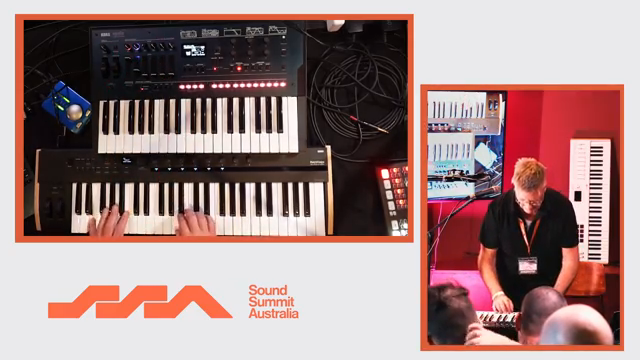
“As I raise the modulation level… This is for that one-to-one electric piano type of waveform.”
© Quote: Noisegate (YouTube)
The experimental setup is deliberately small: two operators, both with sine waves. The carrier provides the audible base signal, the modulator changes it. At 1:1, both run at the same frequency; at 1:2, the modulator oscillates twice as fast. Unlike a fixed vibrato, this ratio remains consistent when playing different notes.
His expressly subjective cheat sheet links 1:1 with e-piano, 1:2 with a hollow, square-like sound, 1:3 with acoustic guitar, and 1:3.5 with the classic FM bell. These are orientation points, not instrument guarantees. Even a different modulation level can shift the assignment. For the 1:1 example, he explains:
Korg OPSIX – Amazon keyword search
Search for this product on Amazon →
This link opens an Amazon keyword search. Depending on availability, other results may be shown.
Advertising – affiliate link. If you buy through this link, we may earn a commission – at no extra cost to you.
More Is Not Simply Brighter
It’s precisely this limitation that makes the presentation useful. The presenter does not sell his sound families as finished patches. He first wants to develop a feel for the consequences of individual decisions:
How necessary this is becomes clear in his further experiment with 1:1. When raising the modulation level, the fundamental tone becomes weaker in places. More modulation therefore does not simply mean the same sound with more highs. He demonstrates two ways back: move the level out of the weak spot or supplement the fundamental with another operator. The latter can also go wrong due to interference, he notes. A useful warning against reflexively reaching for the next sound building block.
© Screenshot: Noisegate (YouTube)
“The aim here is not to try and create a usable patch. It's just to kind of develop some intuition about what sort of waveforms you can expect to find.”
© Quote: Noisegate (YouTube)
Cuckoo Distributes the Work
© Screenshot: True Cuckoo (YouTube)
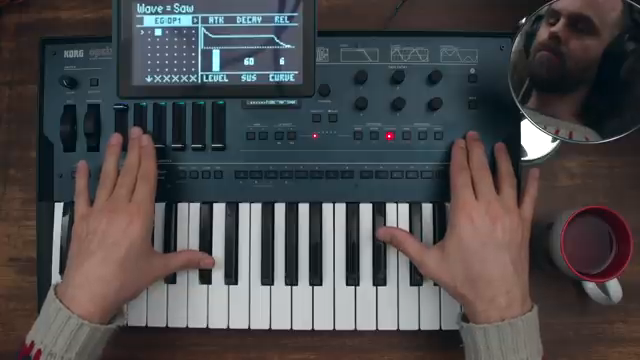
“First, I'm going to have one of that shimmering attack sounds and then I'm going to on the second and third chain, I'm going to have more of the body of the sound.”
© Quote: True Cuckoo (YouTube)
How such building blocks become an instrument is demonstrated by True Cuckoo in Korg Opsix Sound Design – Kinda Tutorial from 2020. For his e-piano, he looks for an algorithm with three separate FM chains. Not every chain has to be spectacular on its own: one takes care of the shimmering attack, two provide the body.
For the attack layer, he tries a modulator ratio value of 12 and makes it velocity-sensitive. He detunes the two body layers slightly against each other. Later, he constructs a short effect when releasing the key using an additional, negatively acting envelope. What’s interesting is not the number of parameters but the division of labor: attack, body, and release moment are designed separately. This also allows for targeted decisions about which part is still missing.
The Plan Can Change
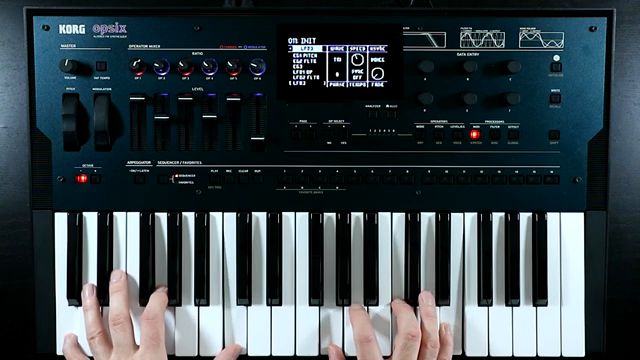
Oscillator Sink also begins his pad workshop from 2021 with manageable units. Algorithm five gives him three carriers, each with a modulator. At first, he works on just one pair, copies it, and changes the copy. The third pair remains free for an additional idea. An intelligent workflow: don’t start from scratch six times, but vary a building block you understand.
Then the design takes a turn. An immediately present, percussive extra layer gives him e-piano ideas. For its bell-like resonance, he finally sets the modulator to a fixed frequency instead of a tracking ratio. Here, the ratio is a tool, not a purity law. His reaction to the new direction:
© Screenshot: Oscillator Sink (YouTube)
“Now this has given me E piano vibes now, which wasn't where I was originally going to go with this patch, but I do like the idea.”
© Quote: Oscillator Sink (YouTube)
Apparently, understanding FM does not mean eliminating every surprise. It means being able to keep working after a surprise. Two operators are enough for initial orientation; more are worthwhile as soon as they musically contribute something of their own. Then, what seemed like a mystery becomes a shapeable sound idea.
Korg OPSIX – Amazon keyword search
Search for this product on Amazon →
This link opens an Amazon keyword search. Depending on availability, other results may be shown.
Advertising – affiliate link. If you buy through this link, we may earn a commission – at no extra cost to you.
Videos for this article
All other articles featuring the Korg OPSIX


All YouTube videos featuring the Korg OPSIX
Primary – main topic (83)
 FM Synthesis Explained for Subtractive Synth Players
 Moog Muse, Vector, opsix: Welche Synthesizer uns wirklich packen 😎 | SequencerTalk 287
 Korg opsix "Materials" Sound Pack: Presets for contemporary electronic music and film scoring.
 Korg OPSIX or Wavestate - Which Should You Buy?
 Korg opsix BIOSPHERE - Soundpack with Presets for Ambient and Techno
 The Alien World I Created with the Korg Opsix
 Korg Opsix 50 Sounds: Noisy Lead & Bass, Atmo Pad & Arp Demo
 Korg Opsix: Bass Bank of Presets. Sound Demo. No Talking
Show all (75 more)
 Korg Opsix: Lead/Solo presets. Vintage & Modern. Sound Demo
 Bad Gear - Korg OpSix
 Universal Audio UAFX Galaxy Sound Demo (no talking) with Korg opsix
 #Jamuary2023 - Day 23 - Korg opsix
 Red Panda Raster V2 Delay Sound Demo (no talking) with Korg opsix presets for Techno and Ambient
 WAVESTATE OPSIX MODWAVE | Back To Back Korg Synths | Best Presets
 Opsix Operator Level Keytrack? Multitimbral patches and more!
 Digital Synth Comparison - opsix, wavestate, modwave
 Korg opsix native Sound Demo (no talking) - Presets for Techno and Ambient: Habitat Sound Pack
 The KORG Opsix Sequencer, Arp & User Algorithm walkthrough tutorial
 Korg opsix - All Playing, No Talking Sound Demo
 Korg Opsix: 50 Arp Presets. Sound Demo, No Talking
 NEW Korg opsix Sound Pack: DRUMS AND PERCUSSION (all sounds demoed)
 NEW Korg opsix Sound Pack: FUTURE MEMORIES (all sounds demoed)
 Korg opsix Hardware vs Native Software: Which Should You Choose?
 Korg Opsix is a plugin now?
 Korg Opsix vs Vintage DX7 // The definitive comparison
 FM Synthesis Demystified // The Basics with Korg OPSIX
 KORG OPSIX Plugin - Playing Korg's Monster FM Synth At Last
 Korg Opsix Native - Opsix on you Desktop!
 Maybe you don't need an Analog Synth? [Opsix & Meet Maude Ambient]
 Korg Opsix // 5 Ambient Resonator Patches [no talking]
 Korg Opsix // 20 Ambient Patches [no talking]
 Meris Polymoon Sound Demo (no talking) with Korg opsix
 Korg opsix Explorations with Dean Walliss – Understanding Algorithms
 Korg opsix Explorations with Dean Walliss – Deconstruction of FM
 Korg opsix: Building a Physically Modelled String (plucking and bowing and resonating - oh my!)
 Patch of the Week 133: Beyond FM on the opsix - Wave Folder Mod for an Arpeggiated Plucked Harp
 Korg opsix Version 2.0 - Operator Modes in Depth: Effect Operator
 Exploring opsix 2.0 New Features
 Patch of the Week 132: Beyond FM on the opsix - User Algorithm & Virtual Patching Dubstep FM Bass
 Korg opsix: Building a Filterbank (Fake Vocoder, String Machine, Vox Humana and Talkative Robots!)
 Patch of the Week 130: Beyond FM on the opsix - New Algorithms for an Soft FM Pad.
 Korg opsix: Buiding a West-Coasty, Buchla Music Easel-esque patch using User Algorithms
 Korg OPSIX altered FM Synthesizer Overview (Summer Special)
 PlayGround3: KORG Opsix, Volca Kick & Beats, MS20m, Delta and ARP Odyssey mini
 Can you build a Juno inside the Opsix? (Yes, and User Algorithms are amazing)
 Korg Opsix - Operator Modes in Depth: Filter and Wavefolder
 Korg Opsix - Operator Modes In Depth: Ring Mod and Filter Mod
 Korg Opsix - Four Alien Soundscapes (+ patch downloads)
 Walrus Audio MAKO D1 Delay Sound Demo (no talking) with Korg opsix
 Korg Opsix - Operator Modes In Depth: FM Mode
 Korg Opsix - Sensitive FM Keys Presets (Demo/No Talking)
 Korg Opsix - Let's Build a "Broken" E-Piano from Scratch (sound design workflow)
 Korg Opsix - Let's Build a Pad from Scratch (sound design workflow)
 Podcast and Video Interview with Dean Walliss: Australian Sound Designer for KORG Opsix
 KORG opsix Sound Demo (no talking): Habitat Sound Pack with Ambient and Techno Presets
 Korg Opsix Altered FM Synthesizer
 opsix - a Sound Designer’s Perspective - with Richard Devine
 Korg Opsix - Cinematic Ambient Presets (Demo/No Talking)
 Wie funktioniert FM-Synthese - Korg Opsix Bass bauen (Quick & Dirty Teil II von II)
 TC Hall of Fame 2 Sound Demo (no talking) with Korg opsix
 Korg OPSIX - SonicLAB Review
 Korg OPSIX Altered FM Synthesizer | Playing Only!
 KORG OPSIX Review Part 3: Arp, Sequencer, Randomizer & Pros/Cons
 Korg OPSIX Altered FM Synthesizer - Taking Digital Synths to a Whole New Level
 KORG OPSIX Review Part 2: Altered FM Synthesizer Engine & New Sounds
 Harley Benton DNA FX Sound Demo with Korg Opsix and Cyclone TT-303 (no talking)
 Korg Opsix. First Cinematic Ambient Steps Demo (No Talking)
 Synth JAM - Korg OPSIX, Pittsburgh SV-1, Bluebox mixer and DrumBrute Impact
 FM Synth Comparison: Korg opsix and Elektron Digitone
 KORG OPSIX Review Part 1: Build Quality & FM Game-Changing Interface Design
 SYNTH NEWS 063: Korg OPSIX, Modor DR-2, Ableton Live 11, Trilian 1.5 & Black Friday Deals
 KORG OPSIX Yamaha DX7 Patch Support Tutorial & Sound Demo
 Andy and Luke from KORG explore and showcase the opsix
 First Look at the Korg Opsix | + Introduction To FM Synthesis | Thomann
 Korg Opsix - The Movie
 First Look: Korg opsix Altered FM Synthesiser
 Korg OPSIX Altered FM Synthesizer Demo — Daniel Fisher
 Korg opsix Sound Demo (no talking)
 Korg OPSIX Review, tutorial and 10 patch ideas // 250 presets played // FM synthesis explained
 Korg Opsix Sound Design - Kinda Tutorial
 KORG OPSIX FM Synthesizer Big Explorative Sound Demo (No Talking)
 KORG opsix Altered FM Synthesizer - First Look!
 Korg Opsix - All Presets (No Talking) | Thomann
Substantial coverage (13)
 Strymon BigSky MX Dual Reverb Demo with Synth (Korg opsix)
 Noisegate NAMM 2024 SYNTH Recap With HAYSIE pt. One
 Sinevibes x Korg Masterclass (drumlogue / minilogue xd / opsix) ft. Artemiy Pavlov
 Korg OPSIX SE — more than just an FM synthesizer!
 Korg Opsix SE FM Synth: The Ultimate SOUND Designer's Tool
 Behringer Price Drops, Wavestate Desktop?!, Next-Level MC-202, Hydrasynth 2.0 | SYNTH NEWS
 Why I sold my Waldorf Iridium (and what replaced it)
 Finegear The Dust Collector deeper Review (Christmas Special) - Drumbrute, Matrixbrute & Korg opsix
Show all (5 more)
 We have a huge synth giveway for you! | feat. Akai, Elektron, Korg, Moog, NI, Soma,Waldorf | Thomann
 Every Synth I Own ( And How Much I Paid )
 Moog Mother 32 & Subharmonicon Combo, Korg Opsix, Ableton Push 2 Jam (No Talking)
 Korg Synthesizer & Music is dead ? Stammtisch
 Molten Music Monthly - November 2020
Mentioned (7)
 Yamaha GS2, CE20 & CE25 FM Synthesizer deeper review incl. interview excerpts with Reinhold Heil
 Korg Multi/Poly review: "It's not a Mono/Poly... but it's an interesting take on some of its ideas"
 Bad Gear - Fail to the King
 Bad Gear - Serum in a Box???
 KingKorg NEO review: "The kinds of sounds you could create easily within a plugin"
 A 'Front End' for your Synths? // Elektron Analog Heat +FX
 First Look: Korg Modwave Wavetable Synthesizer