Expressive E, well-known for their focus on physical expressivity and MPE innovation, teams up with Acoustic Samples for Maestro Brass—a digital brass ensemble designed to bridge the gap between sampled realism and real-time performance nuance. In this official video, we get a guided tour through Maestro Brass’s instrument lineup, Smart Voicing technology, and the multi-layered architecture that empowers both plug-and-play musicians and deep tweakers alike. Whether you’re playing from Osmose, another MPE controller, or a classic MIDI keyboard, Expressive E aims to offer a convincing, customizable brass section for modern production and live use.
19. November 2026
LYRA
Expressive E Maestro Brass: Architectural Depth in a Digital Brass Ensemble
A Brass Section, Reimagined Digitally
Maestro Brass positions itself as an expressive, playable brass ensemble plugin, explicitly designed for musicians who crave both realism and nuanced control. Unlike traditional sample libraries that often feel static or locked to pre-recorded articulations, Expressive E sets out to deliver a more organic, responsive experience. The video introduces Maestro Brass as a tool that doesn’t just mimic brass timbres—it’s engineered to feel alive under your hands, leveraging the company’s expertise in gestural and MPE-driven workflows to push beyond the usual boundaries of virtual orchestration.
"Maestro Brass is an expressive brass ensemble developed by Expressive E in collaboration with Acoustic Samples."
© Screenshot/Quote: Expressivee (YouTube)
The Quartet: Sousaphone to Trumpet
At its core, Maestro Brass gives you access to four meticulously sampled instruments: sousaphone, bass trombone, trombone, and trumpet. Each instrument is built from rich, multi-layered recordings, capturing a variety of articulations and dynamic nuances that are critical for lifelike performance. The demonstration highlights how these samples are mapped for instant expressivity, so you’re not stuck flipping through key switches or menu diving during a performance.
The approach here is to maintain a balance between deep sampling detail and playability. Rather than overwhelming users with hundreds of mic positions or arcane articulation lists, the interface channels expressive power through streamlined controls. This means you can switch between the weighty gravitas of a sousaphone and the lyrical brightness of a trumpet without breaking your creative flow.
Smart Voicing: Algorithmic Ensemble Magic
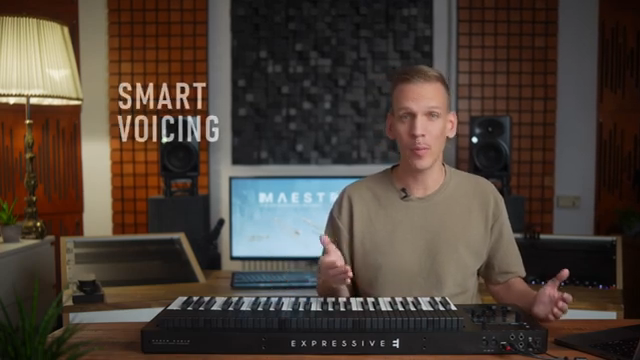
"Smart Voicing intelligently manages voicings for various ensemble sizes."
© Screenshot/Quote: Expressivee (YouTube)
Smart Voicing stands out as one of Maestro Brass’s architectural highlights. This technology automatically manages how notes are distributed across the ensemble, whether you’re playing an intimate four-piece or stacking up to eight players. Instead of forcing the user to manually assign parts or worry about awkward voice doublings, Smart Voicing interprets your chords and distributes them musically across the available instruments, adapting in real time to your playing style and the selected ensemble size.
Presets and Customization: From Instant Gratification to Deep Editing
The video showcases a variety of ready-to-play presets, covering everything from punchy film-score ensembles to more subtle, chamber-like arrangements. These presets are designed to sound compelling out of the box, letting you jump straight into composition or performance without technical setup.
For those who want to dig deeper, Maestro Brass offers extensive customization options. You can tweak everything from ensemble size and blend to detailed articulation and response characteristics, all within a clearly structured interface. The customization depth appears to allow for both quick adjustments and more granular sculpting, making it suitable for users who want to fine-tune their brass sound to fit specific musical roles or genres.
"Ready-to-play presets and deep customization possibilities."
© Screenshot/Quote: Expressivee (YouTube)
Flexible Control: MPE and MIDI Compatibility
A key strength of Maestro Brass is its broad compatibility: it works seamlessly with MPE-equipped controllers like the Osmose, but also supports standard MIDI keyboards. This means you don’t need to overhaul your studio setup to access its expressive capabilities. Whether you’re using polyphonic aftertouch, channel pressure, or just velocity and mod wheel, the engine adapts to let you shape dynamics and timbre in real time, maximizing workflow flexibility for both DAWless and in-the-box producers.
This article is also available in German. Read it here: https://synthmagazin.at/expressive-e-maestro-brass-architektonische-tiefe-im-digitalen-brass-ensemble/
Watch on YouTube:
Latest articles
Watch on YouTube:
Visit the channel:
https://www.youtube.com/ExpressiveE
https://www.youtube.com/ExpressiveE
Links from ExpressiveE:
Sponsored links:
If you purchase via these links, we may earn a small commission – at no extra cost to you. The link opens an Amazon keyword search, and results may vary depending on availability.
Expressive E Maestro Brass
🔗 Check price on Amazon
🔗 Check price on Amazon