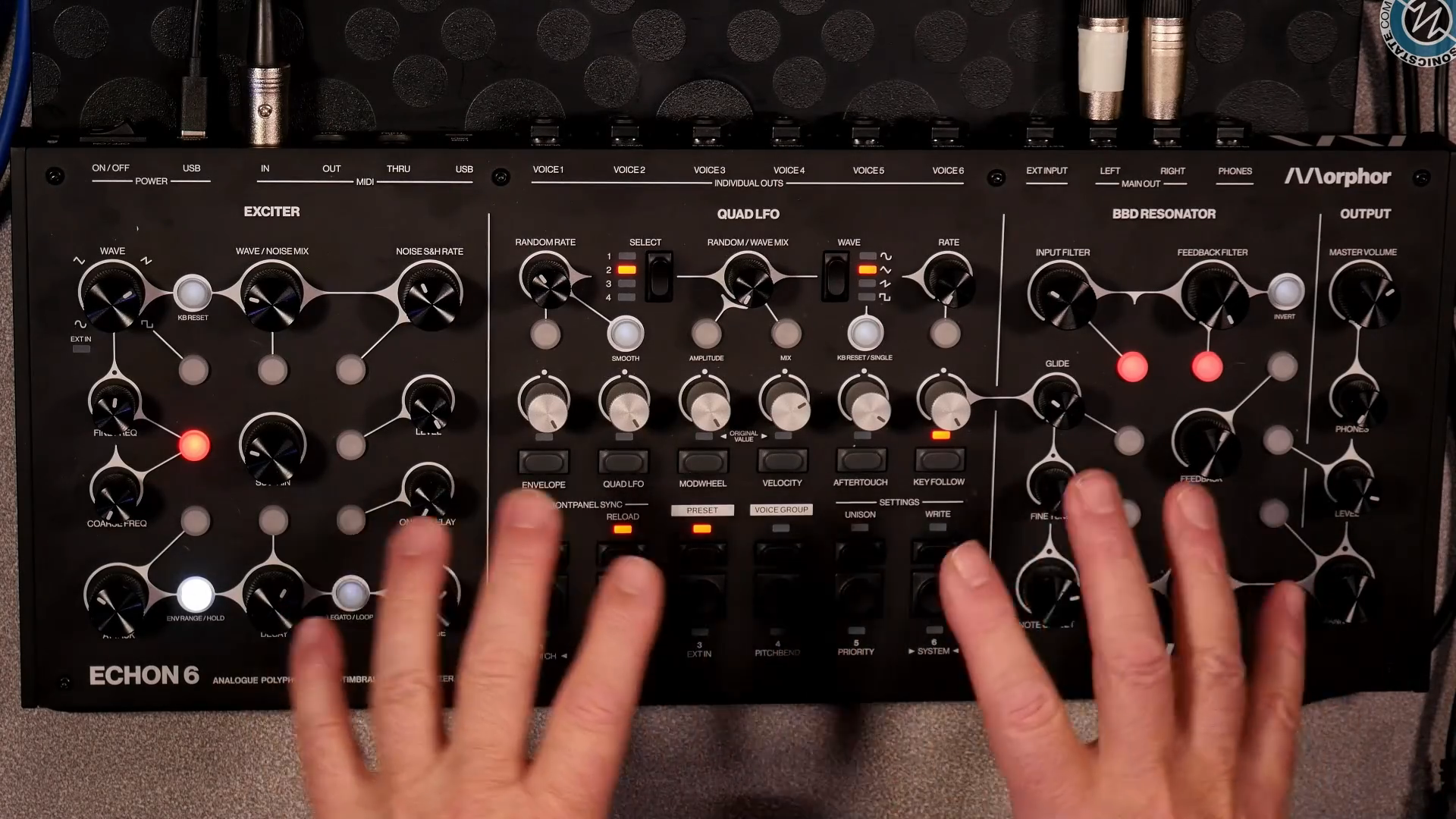
Sonicstate pulls down the level of the second voice group, revealing part of their patch. Then the other group gets its turn: two different sound programs from the same instrument. In the SonicLAB feature from November 6, 2026, the Morphor Echon 6 becomes less a conventional six-voice synth and more a small ensemble. What’s interesting isn’t just how many notes can play at once, but which role each one takes on.
Polyphony as a Question of Lineup
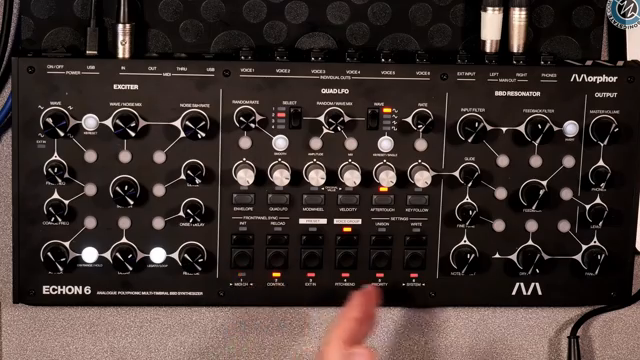
“so we can have six monos, or two threes, or a three, a two, and a one, or all variations,”
© Screenshot/Quote: sonicstate (YouTube)
As a foundation, the host describes each voice as an analog sound generator with a BBD resonator: a short, pitch-tunable delay line whose tuning follows incoming MIDI notes. The Voice Groups reorganize this pool. Instead of assigning all voices to one sound, they can be split into up to six groups with different sounds. The voices are divided, not multiplied.
In the two-group example, velocity affects the attack time of one sound, while an LFO moves its panorama. Even within a stereo patch, that’s more than just stacking. For separate processing, Sonicstate also points to six individual outputs. However, their demonstration of the two sound groups runs through the shared stereo output.
Not Every Voice Has to Do the Same Thing
Molten Music Technology approaches voice splitting in their review from September 15, 2026, with audible curiosity. The host first isolates a single voice, assigns a second to its own group, and compares sine and square waves. Then, they match the sounds and detune one voice slightly. The classic unison effect works—but it’s the differences that really intrigue them.
Eventually, they assign each voice to its own group. For separate parts, they also sketch out using different MIDI channels: for example, a four-voice resonator pad alongside two lead lines. This remains a conceptual application, not a fully demonstrated combination. For a keyboard split, an external controller would need to assign the desired note ranges to these MIDI channels. The immediate fun, though, is in the layer, whose components don’t all have to be tuned or shaped the same way.
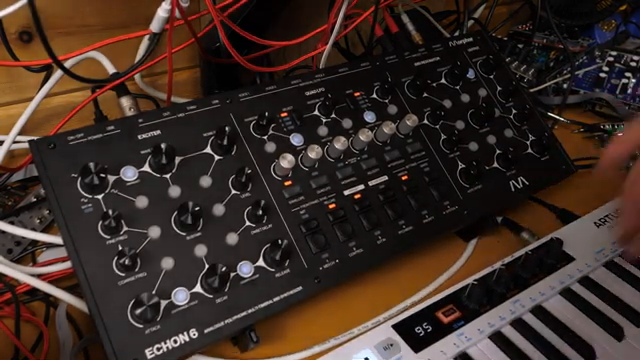
“but it's more interesting to do completely different things with each voice and tune them differently perhaps or affect them differently perhaps”
© Screenshot/Quote: Molten Music Technology (YouTube)
Wait, Which Group Was That?
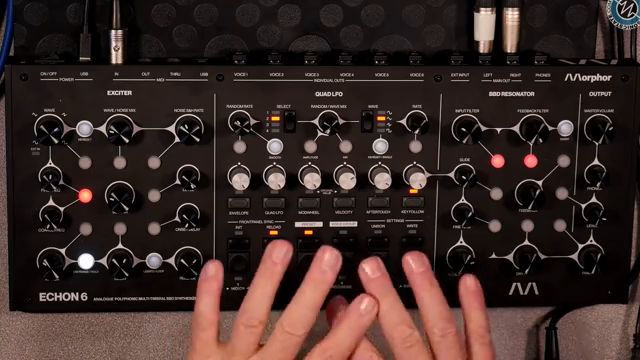
“I think also the choice of no display, while it's kind of nice to be able to deal with, you know, not having to do that, when you're in sort of complex voice group setups, it can be, you can get a little bit lost sometimes.”
© Screenshot/Quote: sonicstate (YouTube)
Sonicstate later demonstrates a unison sound with differently tuned and panned voices. The mod wheel controls dry/wet and input filter in the individual sound programs; external reverb is added. This is exactly where freedom becomes labor-intensive: if the host wants to apply the same change to several groups, they have to edit each one individually. They wish for global controls for dry/wet or envelope times, for example.
Their verdict on the interface is by no means entirely negative. Muting all modulation assignments at once and adjusting their strength via macros is found to be quick and practical. Things get complicated with differently configured groups. Molten experiences the catch quite concretely: when turning down the filter, they only affect the selected voice and first have to figure out which one is currently active.
Playing the Resonator, Not Just the Keys
So why engage with this architecture at all? Molten provides a great moment: they let an LFO raise the feedback and end up with a sound they describe as a kind of space saxophone—explicitly not created on purpose. This fits their view of the instrument: you have to actively guide, nudge, and modulate the resonator. Sound exploration becomes performance. Both they and Sonicstate are open about using external effects.
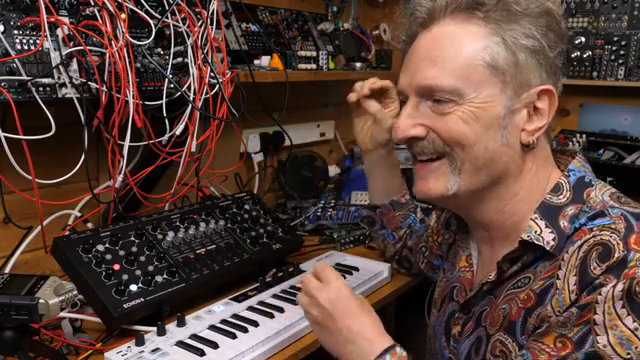
“But you end up having to ride the resonator. It's not going to behave nicely, necessarily.”
© Screenshot/Quote: Molten Music Technology (YouTube)
The interesting difference lies between two kinds of getting lost. Getting stuck on an unexpected overtone can be the start of a musical idea. Searching for the currently edited voice group, on the other hand, is simply an interruption. The Echon 6 inspires unconventional ensembles—but its operation demands a very attentive bandleader.
Videos for this article
All YouTube videos featuring the Morphor Echon 6
Primary – main topic (8)
 Morphor Echon 6 BBD Poly Synth - SonicLAB
 Morphor Echon 6 BBD Synthesizer Review
 Echon6 Samples and a FREE Auto Sample Tool for Decent Sampler
 The Strangest, Most Interesting Synth I've Played This Year (Morphor Echon6)
 Morphor: Echon 6 - Superbooth 2026
 Morphor Echon 6 - An Analog BBD Resonator Polysynth Like No Other | SynthFestFrance 2026
 Morphor - Echon 6 Polyphonic BBD Synth - Bristronica 25
 Morphor Echon 6, Plinky+, Tempera poly aftertouch and more SYNTH NEWS | Superbooth 2025