Forget your misty-eyed 90s nostalgia—AudioPilz is here to drag us kicking and screaming into the early 2000s with the Waldorf microQ, a synth that’s as yellow as a dodgy kebab van and twice as likely to upset purists. In classic Bad Gear fashion, Florian Pilz slices through the marketing guff and gets right to the digital meat, poking fun at the microQ’s quirks while unearthing its raw, aggressive charm. Expect hard truths, sharp wit, and a few sounds that could peel the paint off your nan’s living room. If you think synth history is all about analog warmth, this one’s a cold slap from the rave era. Grab your earplugs and dive in.
16. May 2026
JET
AudioPilz Digs Up the Waldorf microQ: The 2000s Are Back, Like It or Not
The Forgotten Yellow Box
AudioPilz kicks things off with his trademark irreverence, setting the scene for a synth that’s been left gathering dust in the shadow of 90s nostalgia. The Waldorf microQ, birthed at the dawn of the DAW revolution, is painted as a relic from an era when music tech execs were too busy flogging half-baked reissues to notice the digital tide rolling in. It’s a synth that was already a bit dated when it landed, but somehow escaped the reissue cash-grab that’s plagued every other decade.
What’s brilliant here is how AudioPilz skewers both Gen X ravers and trance-hungry zoomers, pointing out that no one’s lining up to throw their cash at this oddball. The microQ’s garish yellow shell might lure in the 90s diehards, but as the video makes clear, it’s the guts that matter. And those guts are weird, wild, and worth a closer look—even if the synth world would rather pretend the early 2000s never happened.

"This virtual analog synth was spawned into existence during the dawn of the DAW revolution of the early 2000s."
© Screenshot/Quote: Audiopilz (YouTube)
Oscillators, Wavetables, and a Matrix Maze
Digging under the hood, AudioPilz lays out the microQ’s architecture with a mix of admiration and side-eye. You get three oscillators, classic VA waveforms, and a couple of wavetables nicked from the original Q series. There’s even a sub-oscillator, but don’t expect hands-on knob-per-function action—this is all menu-diving and matrix wrangling, more like programming a microwave than jamming on a Minimoog.
Still, the microQ isn’t short on sonic options. FM, sync, ring mod, and noise are all on tap, if you’re willing to get your hands dirty. The mod section is a proper rabbit hole: four ADSRs that can get complex, three LFOs that’ll scream into audio rates, and a modulation matrix that’s as deep as a pub lock-in. If you’re the sort who likes your synths simple, this one’ll have you running for the hills. But if you want to mangle sound until it’s unrecognisable, you’ll feel right at home.
Filters with Bite (and a Chemical Aftertaste)
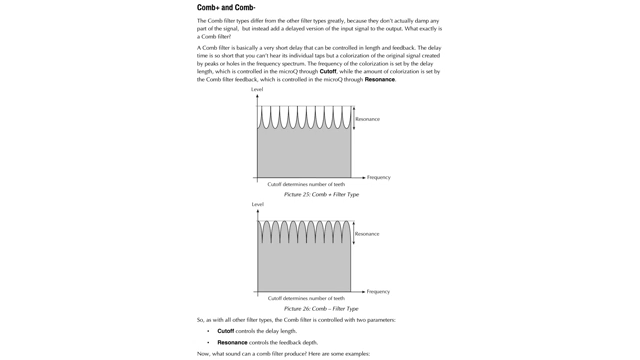
"Comb filter varieties, responsible for an increase in 21st century hearing aid sales."
© Screenshot/Quote: Audiopilz (YouTube)
Now, let’s talk filters—the bit where most virtual analogs fall flat on their faces. Not the microQ. AudioPilz points out its dual filter array, which can be run in serial or parallel but skips the fancy in-betweens of its bigger siblings. You get digital 12 and 24 dB models, plus comb filters that’ll have your ears ringing like you’ve just left a squat rave at 6am.
It’s not pretending to be analog, and frankly, that’s its charm. The filter sweeps have a chemical tang that sticks around long after the sound’s faded, and the top end is all snap and sizzle. If you want warmth, look elsewhere. But if you want a synth that’ll cut through a mix like a broken bottle through a pub brawl, the microQ’s your mate.
Jams from the Digital Dungeon
AudioPilz doesn’t just talk the talk—he puts the microQ through its paces with a series of jams that show off its strengths and quirks. From preset-maxxing rave stabs to downtempo grooves, the microQ spits out sounds that are unapologetically digital and gloriously brash. It’s not trying to be analog, and the result is a set of tones that feel both nostalgic and oddly fresh.
The drum sounds are a real surprise—punchy, weird, and perfect for anyone who likes their beats a bit left of centre. The microQ’s multi-timbrality and six outputs make it a secret weapon for layering chaos, and the presets are, as AudioPilz puts it, “unironically awesome.” You’ll want to hear these jams for yourself—the video’s where the real carnage happens.
Reissue Roulette: Will the 2000s Get Their Turn?
In true Bad Gear style, the finale isn’t just about the synth—it’s about the industry’s obsession with nostalgia and the endless parade of reboots. AudioPilz wonders aloud if the microQ, or anything from the early 2000s, is ripe for a cynical reissue. The answer? Don’t hold your breath. The microQ’s spirit lives on in free DSP emulations, and the odds of a big brand cashing in are slim unless some billionaire gets bored enough to buy up the whole game.
There’s a cheeky swipe at the usual suspects—Roland, Alesis, even Christoph Kemper—reminding us that sometimes, what’s best left in the past is best left alone. Still, for those who crave that raw, aggressive digital filth, the microQ is a reminder that not all synth nostalgia needs to be warm and fuzzy. Sometimes, it’s the cold, hard edge that keeps things interesting.
"This Alexandrian library of late 90s rave jams is not only available for astonishingly reasonable prices in rack and keyboard form, its spirit will forever be preserved in the free Vabra DSP emulation."
© Screenshot/Quote: Audiopilz (YouTube)
This article is also available in German. Read it here: https://synthmagazin.at/audiopilz-graebt-den-waldorf-microq-aus-die-2000er-sind-zurueck-ob-du-willst-oder-nicht/
Watch on YouTube:
Latest articles
Watch on YouTube:
Visit the channel:
https://www.youtube.com/AudioPilz
https://www.youtube.com/AudioPilz
Links from AudioPilz:
Become a Patreon: https://patreon.com/audiopilz
Instagram: https://instagram.com/audio.pilz
Sponsored links:
If you purchase via these links, we may earn a small commission – at no extra cost to you. The link opens an Amazon keyword search, and results may vary depending on availability.
Waldorf microQ
🔗 Check price on Amazon
🔗 Check price on Amazon