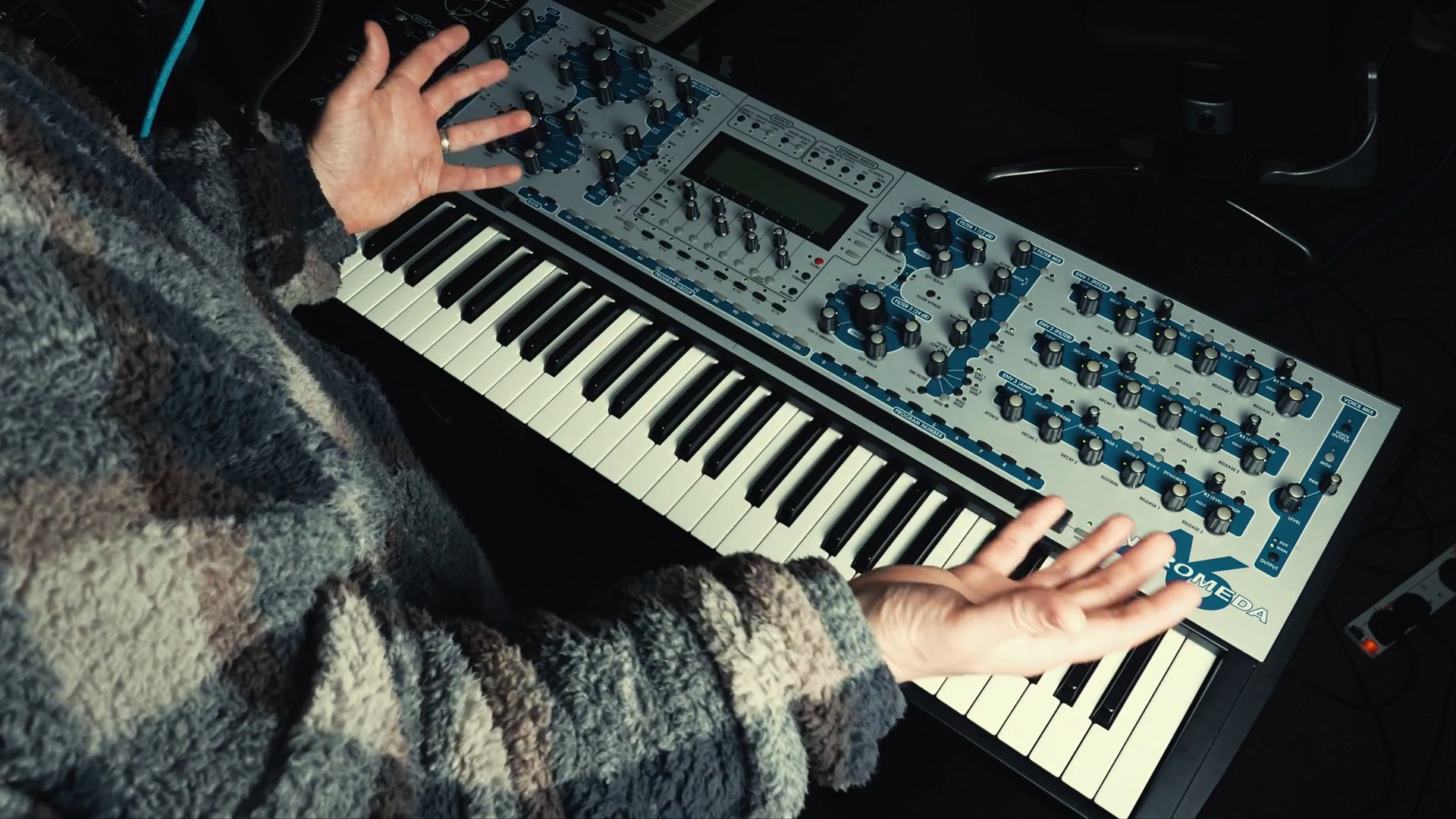
Analog drums on different keys, a 303-style sequence, and still spare voices for a pad: Alex Ball turns the Andromeda A6 into a small ensemble. In his video “Alesis Andromeda A6 – The Analogue Outlier,” published on November 12, 2026, he combines four sounds for this. On a workstation, that would be routine. On an analog polysynth from the year 2000, this self-evidence suddenly gains weight.
A flagship against the current
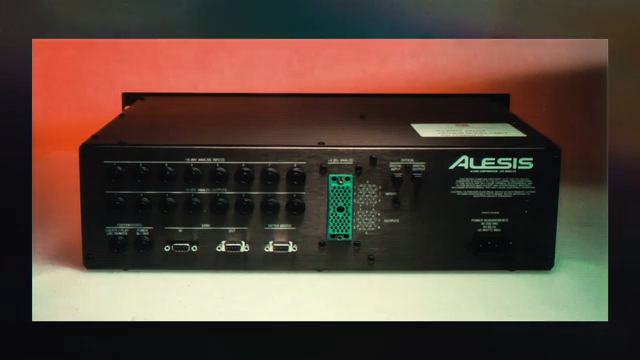
© Screenshot: Alex Ball (YouTube)
“and really jumping ahead of the analog resurgence”
© Quote: Alex Ball (YouTube)
Ball first traces Alesis as a manufacturer of digital effects, recording technology, and sample-based synthesizers. By the late nineties, the market was predominantly digital. It was precisely then that the company developed an analog flagship, which landed in 2000 among workstations, virtual analog synths, and samplers. According to Ball, product manager Eric Norlander pitched the idea of custom analog chips to Keith Barr during a Christmas party in 1996.
But what emerged was not a nostalgic austerity program: Ball describes 16 voices, up to 16 sound parts, two filters per voice, digital control, multi-effects, and deep modulation. Here, analog meant the sound generation, not an obligation to the past. He formulates the historical punchline as a leap ahead of the later renaissance:
Alesis Andromeda A6 – Amazon keyword search
Search for this product on Amazon →
No verified direct product link was available. This link opens an Amazon keyword search; results may vary.
Advertising – affiliate link. If you buy through this link, we may earn a commission – at no extra cost to you.
Feedback expressly desired
How little well-behaved this concept needs to be is shown by synth4ever in his 2022 review. He starts with basic waveforms, stacks them, and works his way up to FM, ring modulation, and filter feedback. Especially with the feedback, his enthusiasm becomes concrete: he demonstrates how feeding the filter signal back breaks up the sound. His explanation:
Ball, in turn, explores the space between an Oberheim-style two-pole multimode filter and a Moog-style four-pole ladder filter. He mixes filter outputs and adds unfiltered sine components or ring modulation. Here, the filter is not just the knob that makes a finished sound darker. Its routing itself becomes a musical decision.
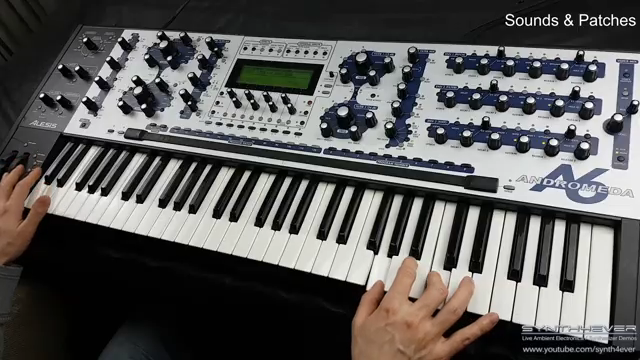
© Screenshot: synth4ever (YouTube)
“You can actually boost the signal from the filter back into the filter.”
© Quote: synth4ever (YouTube)
Not all colors at once
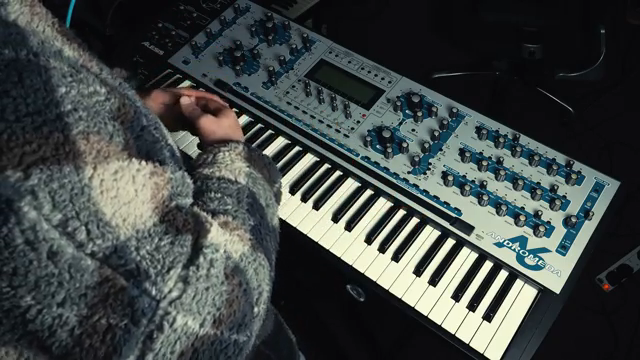
© Screenshot: Alex Ball (YouTube)
“'cause that's like an artist putting all their paint in at the same time, they'll just wind up with brown.”
© Quote: Alex Ball (YouTube)
With 71 modulation sources and 92 destinations, you could mistake sound design for filling out a tax return. Ball explicitly acknowledges the intimidating side of these possibilities. More interesting than the number is his own patch: the levels of two oscillators move inversely, different LFOs and looping envelopes bring filters in and out, plus stereo modulation.
His advice is refreshingly unheroic: pursue one idea, start a new patch for the next. Not every available function has to play along. For Ball, using everything at once leads to the sonic equivalent of a mixed color palette:
No oath of allegiance to the hardware
That Ball then includes the A6 emulation from Isla Instruments fits this undogmatic approach. He transfers factory presets via SysEx and compares them to the hardware, without first tweaking them to match. Some sound practically identical to him, others differ; as a possible explanation, he also cites the quirks of analog instruments. This is his listening impression, not proof of complete identity.
Vulture Culture, in his video published October 22, 2026, compared an explicitly pre-release emulation with his own A6. He finds differences in the ring modulation mixed post-filter and appreciates the extra resonance of his Oberheim-style hardware filter. The overall winner’s crown thus stays in the closet. For the ladder filter, however, he decides based on what he prefers in the bass range:
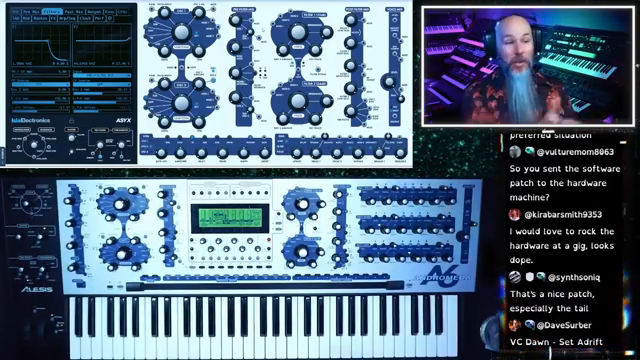
© Screenshot: Vulture Culture (YouTube)
“But what I like about the software is they're, to my ear, more sub coming through. I'm not losing as much of that low end.”
© Quote: Vulture Culture (YouTube)
Anyone who takes the Andromeda seriously doesn’t have to treat all its quirks as sacred. Its most appealing legacy is the permission to experiment—with feedback, with conscious limitation, and if necessary, even without the original hardware. After all, analog doesn’t have to be a prescription for thinking.
Alesis Andromeda A6 – View product
Search for this product on Amazon →
No verified direct product link was available. This link opens an Amazon keyword search; results may vary.
Advertising – affiliate link. If you buy through this link, we may earn a commission – at no extra cost to you.
Videos for this article
All YouTube videos featuring the Alesis Andromeda A6
Primary – main topic (10)
 Alesis Andromeda A6 - The Analogue Outlier
 I Own the Andromeda A6. I Think I Prefer the Plugin.
 Alesis Andromeda A6 - I didn´t see this coming ...
 ALESIS ANDROMEDA A6 - Ambient Chillout Jam (Step Sequencer)
 ALESIS ANDROMEDA A6 - Synth Review, Sounds & Demo | Polyphonic Analog Synthesizer
 ALESIS ANDROMEDA A6 - Ambient Chillout / Space Music 【SYNTH DEMO】
 【DEMO】 ALESIS ANDROMEDA A6 - Ambient step sequencer soundscape
 【DEMO】 ALESIS ANDROMEDA A6 synthesizer - Ambient LFO space music


