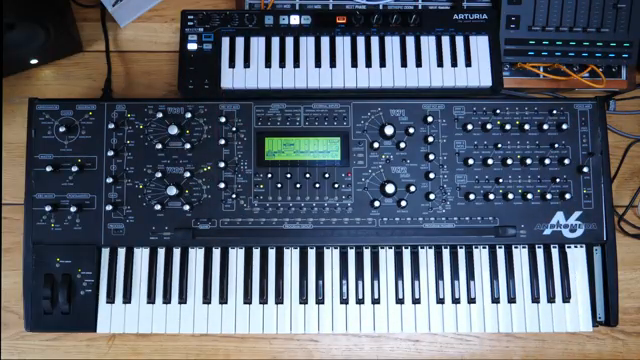
Starsky Carr first lets the high-pass through, then mixes in sine bass. A small gesture of sound construction that explains the appeal of the Alesis Andromeda A6 better than any reverent gear list: here, unusual signal paths can actually be tried out. But in his hardware/software comparison published on November 16, 2026, Carr draws a clear line between exploring and owning. For him, the crucial catch lies in the custom chips.
Rarity Also Shows Up on the Spare Parts Bill
© Screenshot: Starsky Carr (YouTube)
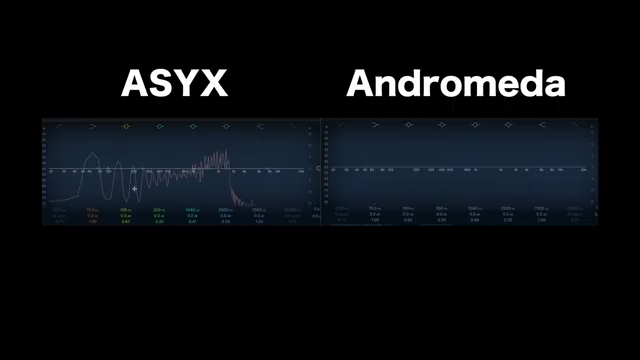
“Not cheap. And unlike other proprietary chips from manufacturers like Roland,”
“Not cheap. And unlike other proprietary chips from people like Roland,”
© Quote: Starsky Carr (YouTube)
Carr doesn’t keep his warning abstract. He shows Reverb listings: 349 euros for a chip, 1,410 euros for a board equipped with them. These are the prices shown in the video, not universally valid repair costs. Labor or the diagnosis of a specific defect cannot be inferred from this.
His explanation for the risk: these custom components are found exclusively in the Andromeda, were only manufactured in limited quantities, and are no longer produced. As replacements, he mentions parts from other defective A6s. For the Juno-106, on the other hand, he points to newly manufactured chips from Analog Renaissance. Carr considers a comparable new production for the Andromeda economically unrealistic. That’s his assessment—not proof that a replacement could never be developed. His comment on the prices leads directly into this comparison:
Alesis Andromeda A6 – Amazon keyword search
Search for this product on Amazon →
This link opens an Amazon keyword search. Depending on availability, other results may be shown.
Advertising – affiliate link. If you buy through this link, we may earn a commission – at no extra cost to you.
One Chip, Two Voices Lost
Despite its name, the A6 has 16 voices. According to Carr, a failed chip can take out two of them at once, since each chip contains building blocks for a pair of voices. The practical difference is significant: it’s not just about a rare spare part, but about a potential loss of polyphony.
This should not automatically be taken to mean a completely unusable synthesizer, nor a 14-voice instrument that continues without issue. The video does not clarify how a specific defect could be isolated or what continued operation would be possible. Likewise, there are no reliable failure rates. The warning thus mainly concerns the consequences of a possible fault, not its likelihood. The erratic knob values Carr describes on his loaner unit are also not presented as proof of a chip failure.
© Screenshot: Starsky Carr (YouTube)
“And you don't just lose one voice, you lose two, because each has a pair of voices or a pair of oscillators or filters on them.”
“And you don't just lose one voice, you lose two 'cause they've each got a pair of voices or a pair of oscillators or a pair of filters on them.”
© Quote: Starsky Carr (YouTube)
Why You Still Want to Keep Turning Those Knobs
© Screenshot: synth4ever (YouTube)
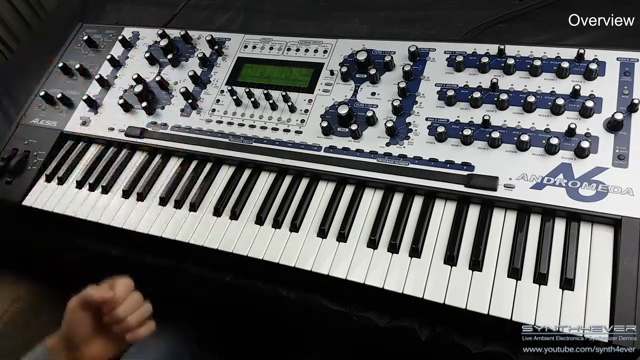
“You can actually boost the signal from the filter back into the filter.”
© Quote: synth4ever (YouTube)
How seductive this instrument can be is shown by synth4ever in his review from May 29, 2022. He works his way from the individual oscillator through the architecture and lingers enthusiastically at the pre-mixer. With filter feedback, he routes the filter signal back into the filter and explores how it breaks up. He then emphasizes that even the individual mixer knobs can be modulated. This isn’t just more features: even the mixing itself becomes a moving part of the sound.
His walkthrough makes tangible something that can easily get lost in a pure buying warning: the Andromeda is not just a collector’s item. It invites you to take a different turn while tweaking—and then another.
Polyphony Here Is More Than a Brochure Value
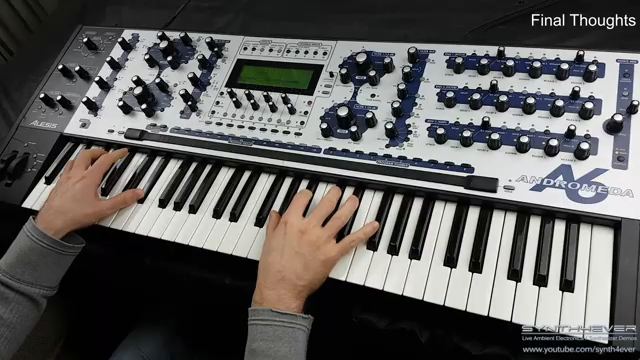
synth4ever explicitly links the long envelopes to big pads and the available 16 voices. He then tries out Unison X, which can stack all voices. Carr, in turn, describes a mix with kick, snare, and bassline, as well as the ability to address 16 different sounds on 16 channels. The voices are thus material for distributing, letting ring out, or stacking. Losing two of them directly affects this musical scope.
© Screenshot: synth4ever (YouTube)
“There's also something here called Unison X, where it allows you to stack all the voices.”
© Quote: synth4ever (YouTube)
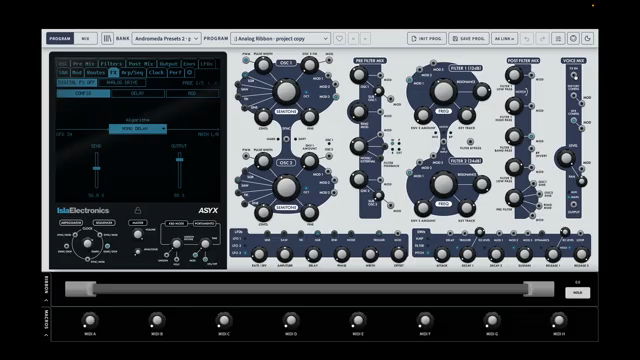
Carr ultimately finds his approach through the software recreation: he transfers the instrument’s user bank and compares the patches. His enthusiasm is also for exploring the architecture, not just the sound similarity. He still points out differences in distortion and effects. That doesn’t repair any A6, but it does open another path to its ideas. But anyone wanting to own the original should ask a second question alongside the one about sound: what happens if this very instrument needs a part that’s no longer available?
Alesis Andromeda A6 – Amazon keyword search
Search for this product on Amazon →
This link opens an Amazon keyword search. Depending on availability, other results may be shown.
Advertising – affiliate link. If you buy through this link, we may earn a commission – at no extra cost to you.
Videos for this article
All other articles featuring the Alesis Andromeda A6
All YouTube videos featuring the Alesis Andromeda A6
Primary – main topic (16)
 The Andromeda A6 Has a Fatal Flaw. The ASYX Doesn’t.
 Alesis Andromeda A6 - The Analogue Outlier
 I Own the Andromeda A6. I Think I Prefer the Plugin.
 Alesis Andromeda A6 - I didn´t see this coming ...
 ALESIS ANDROMEDA A6 - Ambient Chillout Jam (Step Sequencer)
 ALESIS ANDROMEDA A6 - Synth Review, Sounds & Demo | Polyphonic Analog Synthesizer
 Synth Talk With Taiho Yamada & Rob Rampley (MOK) - How Realistic Is An Andromeda 2?
 Alesis Andromeda
Show all (8 more)
 Seymour Duncan Andromeda Dynamic Delay Sound Demo (no talking) with Novation Peak
 Alesis A6 Andromeda Demo
 ALESIS ANDROMEDA A6 - Ambient Chillout / Space Music 【SYNTH DEMO】
 Moonlight Matters - Studio Tour
 【DEMO】 ALESIS ANDROMEDA A6 - Ambient step sequencer soundscape
 【DEMO】 ALESIS ANDROMEDA A6 synthesizer - Ambient LFO space music
 【DEMO】 ALESIS ANDROMEDA A6 - Ambient arpeggiator soundscape on vintage analog synth keyboard
 ALESIS ANDROMEDA A6 【SYNTH DEMO】 - Ambient sequencer / chillout drone music / soundscape

