Metamyther is back in the bunker with three wavetable monsters: Modbap Osiris, Piston Honda MKIII, and Ferry Island Four Seas. This isn’t your average spec-sheet snooze—expect hands-on demo, brutal honesty, and a side of industrial grit. If you’re after glassy leads, gnarly morphs, or just want to know which module slaps hardest in a real-world rack, this is the face-off you need. Metamyther’s cinematic-industrial style keeps things sharp and the verdicts sharper. Ready for a synth shootout that actually matters? Let’s get noisy.
16. April 2026
SPARKY
Wavetable Rumble: Metamyther Throws Down Osiris, Piston Honda MKIII & Four Seas
Ferry Island Four Seas, Industrial Music Electronics Piston Honda MKIII, Modbap Osiris
The Wavetable Heavyweights Enter the Arena
Metamyther kicks things off with a straight-up challenge: three wavetable modules, one video, and no prisoners taken. The Modbap Osiris, Industrial Music Electronics Piston Honda MKIII, and Ferry Island Four Seas are all lined up for a proper head-to-head. No endless backstory, just straight into the action—exactly how we like it.
Each module brings its own flavour to the table, and Metamyther wastes no time getting stuck in. If you’re expecting a polite, academic comparison, look elsewhere. This is about real-world use, quirks, and which box actually earns its rack space.
"The results might surprise you."
© Screenshot/Quote: Metamyther (YouTube)
Feature Brawls & Sonic Arsenal
"It just gets you going so much faster."
© Screenshot/Quote: Metamyther (YouTube)
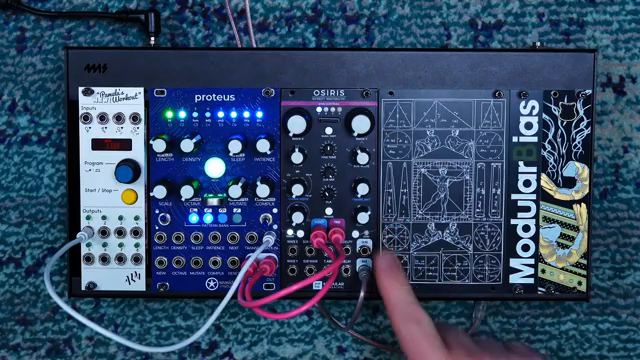
First up, the Osiris. It’s got those X and Y controls for slicing through wavetables, eight banks (four factory, four user), and a sub that’ll beef up your basslines when things get too glassy. The decay knob is right on the panel—no faffing with extra envelopes—and there’s a fidelity control for when you want to get crunchy. Timbre modes like unison, bend, wavefold, sync, noise, and FM are all on tap, making this a surprisingly performative little beast. The quantiser is a nice touch for keeping things musical, and the sub output is a proper bonus, even if the decay doesn’t touch it (which is a bit odd, honestly).
Piston Honda MKIII comes out swinging with its three sliders—X, Y, and Z axes—so you’re not just scanning a wavetable, you’re navigating a cube. Two voices, two outputs, plus a mix output, and you can morph between presets or randomise them on the fly. The unison menu lets you stack oscillators in octaves or fifths, and there’s built-in FM and a tuner. The interface is a bit cramped, but the morphing and preset tricks are unique—this thing’s got depth if you can handle the menu diving.
Performance: From Studio to Stage
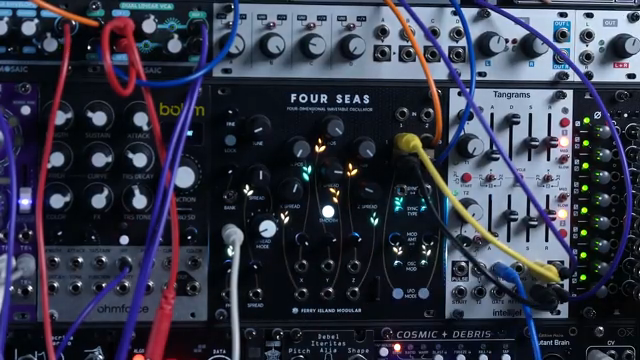
Four Seas is the wildcard here. Four outputs, each one can be audio or LFO, and you can spread the X, Y, and Z axes to get different timbres at each output—think chords, weird intervals, or just total chaos. The smooth/interpolate button is a lifesaver for avoiding steppy transitions, and the tune lock is a gigging musician’s dream. Twelve banks mean you’re not running out of raw material any time soon.
Metamyther highlights how the spread mode can create happy accidents and chordal relationships you’d never patch up on purpose. There’s linear FM, phase modulation, and three sync types (hard, soft, flip), plus three oscillator mod types. If you want a module that can go from lush pads to metallic clangs in a heartbeat, this one’s got your back. And yes, Metamyther’s taking it to Superbooth for a live set—so it’s clearly stage-ready.
"This can create really interesting happy accidents and tonal relationships that you might not have thought of."
© Screenshot/Quote: Metamyther (YouTube)
Spec Sheet Smackdown
"These modules are so freaking different. Pretty much the only commonality is that they use wavetables."
© Screenshot/Quote: Metamyther (YouTube)
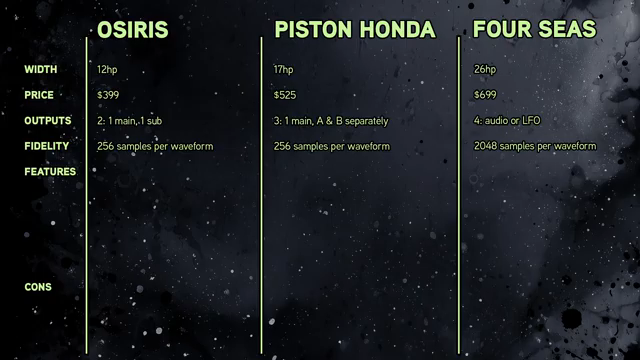
Now for the scorecard: Osiris gives you two outputs (main and sub), Piston Honda offers A and B layers plus a mix, and Four Seas just flexes with four outputs that can be audio, LFO, or both. Osiris and Piston Honda both use 256 samples per waveform, while Four Seas goes big with 2048. Storage? Osiris has eight banks, Piston Honda stores eight presets, and Four Seas rocks twelve banks.
Metamyther lays out the features rapid-fire: Osiris is a full voice with quantiser and timbre modes, Piston Honda has three-dimensional morphing and a built-in tuner, and Four Seas is all about multi-dimensional madness and performance tricks. If you want the full nerdy breakdown, the video’s spec chart is where the toaster-fight gets real—don’t just read about it, go watch the numbers fly.
Taste, Bias, and the Final Verdict
Here’s where it gets personal. Metamyther doesn’t pretend there’s a single winner—these modules are wildly different, and your taste will decide which one rules your rack. Osiris is compact and immediate, Piston Honda is deep but fiddly, and Four Seas is a playground for experimentalists.
If you’re after a display, you’ll miss it on Osiris and Four Seas. If you hate shift functions and tiny screens, Piston Honda might drive you mad. And if you want to get lost in spread modes, Four Seas is your ticket. The real answer? Watch the video, hear the sounds, and let your own rave bunker instincts decide. And don’t forget to drop your own verdict in the comments—this is a street fight, not a lecture.
This article is also available in German. Read it here: https://synthmagazin.at/wavetable-rumble-metamyther-laesst-osiris-piston-honda-mkiii-four-seas-antreten/
Watch on YouTube:
Latest articles
Watch on YouTube:
Visit the channel:
https://www.youtube.com/Metamyther
https://www.youtube.com/Metamyther
Links from Metamyther:
Main Site: https://metamyther.com
Instagram: https://instagram.com/metamyther
Bandcamp: https://metamyther.bandcamp.com
Facebook: https://facebook.com/tkexit
Sponsored links:
If you purchase via these links, we may earn a small commission – at no extra cost to you. The link opens an Amazon keyword search, and results may vary depending on availability.
Ferry Island Four Seas
🔗 Check price on Amazon
🔗 Check price on Amazon
Industrial Music Electronics Piston Honda MKIII
🔗 Check price on Amazon
🔗 Check price on Amazon
Modbap Osiris
🔗 Check price on Amazon
🔗 Check price on Amazon