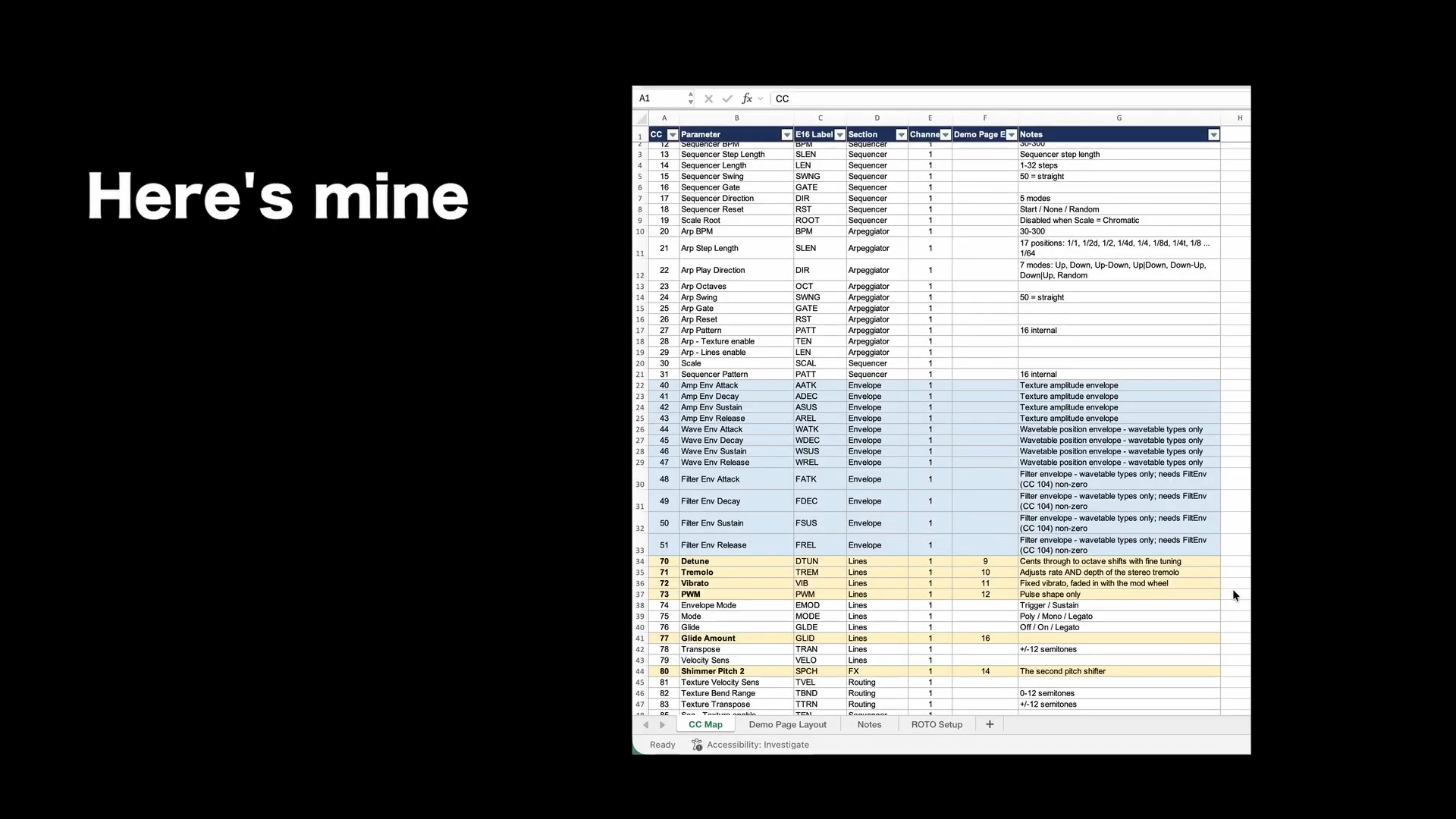
Next to the Crema, Starsky Carr has a device that does a good part of the explaining for him: a MIDI controller with custom-configured parameter pages. Carr uses it to make functions accessible that the small control panel doesn’t immediately reveal. In his video “Waldorf Crema | More than Meets the Eye,” published on October 29, 2026, this becomes more than just a technical aid. The extra controller exposes just how much instrument is hidden behind the modest interface.
The Strings Are Just the Beginning
Carr considers the string ensemble label an understatement. For the Texture engine, he lists not only the string model but also 17 wavetables and six FM algorithms. Added to this is Lines, a second, independent sound engine; both can be layered or split across the keyboard. This is more than just a feature list: Carr dissects the sections instead of settling for a parade of ready-made pads.
This becomes especially clear when he selects a deliberately robotic wavetable sound, tweaks its wave envelope, and then switches to the envelope page on his controller. What was a menu entry becomes a directly accessible sound-shaping tool. However, not every model is equally equipped: for example, the string model lacks a filter envelope. To understand the depth, you not only have to find parameters but also learn the differences between the sound engines.
Assigning Once Is Easy. Assigning Very Often, Less So.
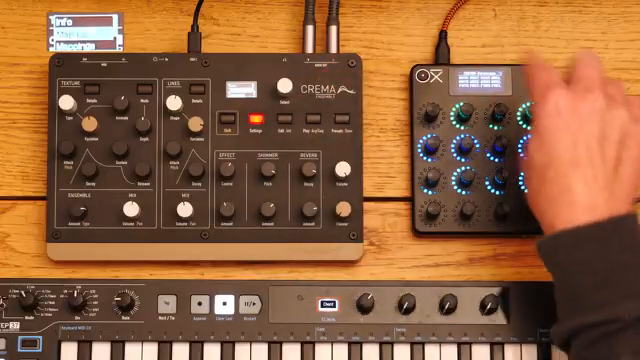
“it doesn't come with any midi mappings on board to start with, which I think is a bit of a shame, because there's about 117 different things or something crazy that you can modulate on it, so to set them up can take forever,”
© Screenshot/Quote: Starsky Carr (YouTube)
Carr demonstrates the learning process refreshingly matter-of-factly: move Animate, call up the Map CC function with Shift and Settings, then move the desired external control. His objection isn’t to this single process. He misses preconfigured MIDI assignments—and given the sheer number, a simple hand movement quickly turns into setup work.
Carr mentions about 117 things you can modulate, explicitly as a rough estimate. On his controller, he has prepared eight pages with about 16 controls each. Still, he’s not finished; he cites the time required as the reason. The displayed CC table fits: it documents his assignments but is no substitute for a preconfigured mapping. A small box saves space on the desk. The configuration work, however, doesn’t automatically shrink with it.
Not Every Simplification Is a Loss
Interestingly, Carr doesn’t fundamentally reject reduced control. He describes the Lines engine as limited, but quirky and inventive. With its pulse width modulation, he observes that one knob first increases the modulation depth and then the speed. Here, sound movement is bundled rather than split into individual controls. That can be a musically meaningful reduction—something different from an important parameter you have to hunt for in a menu.
Accordingly, his external controller isn’t meant to turn the Crema into a different synthesizer. It simply gives better access to what’s already there. Carr’s motivation remains much more musical than just managing a complete parameter list:
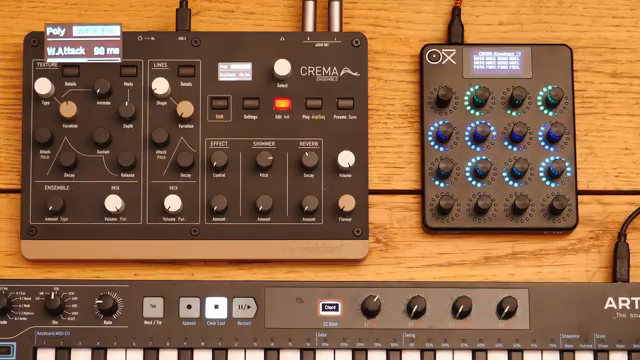
“just showing you really that you can access everything from something else, because I think it's worth doing that with this, there's so much happening in here, it's a shame not to dig in,”
© Screenshot/Quote: Starsky Carr (YouTube)
For Carr, digging deeper is clearly worthwhile. But his demonstration is no carte blanche for hidden controls. Precisely because he explores the possibilities so thoroughly, the extra effort becomes tangible. The appealing idea isn’t to have every parameter permanently under a separate finger. It’s the freedom to choose the musically important ones yourself—ideally without having to set up a whole admin department first.
Video for this article
All YouTube videos featuring the Waldorf Music Waldorf Crema
Primary – main topic (6)
 Waldorf Crema Ensemble Synth - Sound Demo (no talking)
 Waldorf Crema, Behringer SP1200X & KICK, Logic Pro 13: Hardware Becomes a Software Platform
 Can Do More Than Just Streichfett 2.0! Waldorf Crema with Rolf Wöhrmann in DeveloperTalk
 Waldorf Crema | More than Meets the Eye
 Waldorf Crema - Deep Dive with CTO - Rolf Wöhrmann
 Waldorf Crema (Ambient improvisation and sound design walkthrough)