UDO Audio, the Bristol-based purveyors of analog-hybrid synth wizardry, put their Super 8’s sequencer front and centre in this hands-on demonstration. Hazel Mills walks us through the instrument’s approach to layering, step sequencing, and real-time manipulation, showing how the Super 8’s design ethos supports both structured composition and spontaneous play. If you’re curious about how this FPGA-powered polysynth lets you blend, tweak and perform with sequences across dual layers, this video is a deep dive into its creative potential. Expect practical patching tips, expressive controls, and a taste of UDO’s signature immediacy.
16. October 2024
MILES
UDO Audio’s Super 8 Sequencer: Layered Performance, British Style
Layers Upon Layers: The Super 8’s Sequencer in Focus
UDO Audio’s Super 8 is introduced as a versatile synthesizer, with the spotlight firmly on its integrated sequencer. The video wastes no time in highlighting how this sequencer isn’t just a bolt-on feature, but a core part of the instrument’s approach to sound design and performance. Hazel Mills demonstrates how the Super 8’s architecture encourages users to think in terms of layers, with the sequencer providing a foundation for building complex, evolving textures.
The workflow begins with recording a basic sequence on the lower layer, making use of the instrument’s split keyboard functionality. This immediately sets up a playground for interaction between layers, as the upper layer remains free for live performance or further sequencing. UDO’s design philosophy—centred on immediacy and play—comes through in the way the sequencer is presented: it’s about hands-on exploration, not menu-diving or programming by spreadsheet.
"This is how you can get creative with sequence-based performance using the UDO Super 8."
© Screenshot/Quote: Udo Audio (YouTube)
Step by Step: Recording and Manipulating Sequences
"Each chord or note as you play it will sequentially be assigned to each step."
© Screenshot/Quote: Udo Audio (YouTube)
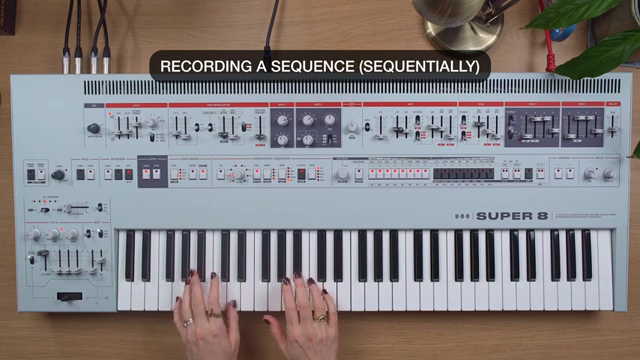
The Super 8’s sequencer offers four pages of 16 steps each, giving a total of 64 steps—a generous canvas for melodic or harmonic ideas. Each of the 16 buttons on the front panel corresponds to a step, and the process of recording is as direct as pressing a button and playing notes or chords. The length of the sequence is determined by how many steps you fill, which allows for anything from snappy riffs to extended patterns.
Hazel demonstrates how each note or chord is assigned to a step in real time, making it easy to build up a sequence by ear. Once a sequence is running, the Super 8 offers expressive tools to bring it to life. The slide function lets you tie notes together for legato effects, while the accent feature adds dynamic variation by making selected steps louder. Rests can be inserted to break up the rhythm and add space, all with a few button presses.
For those who prefer a less linear approach, the sequencer allows for non-sequential programming. You can set the sequence length first, then jump to any step and assign a note or chord, opening the door to more unpredictable or experimental patterns. This flexibility is a nod to classic step sequencers, but with a modern, performance-oriented twist.
Creative Workflows: Layering, Arpeggiators and Performance Tools
Hazel doesn’t just stick to basic sequencing—she explores how the Super 8’s dual-layer architecture can be harnessed for more creative workflows. By recording a sequence on the lower layer and playing live on the upper, performers can blend programmed material with spontaneous improvisation. The split function allows for precise control over which parts of the keyboard trigger each layer, making it easy to carve out sonic roles.
The arpeggiator comes into play as another performance tool, running over the top of a sequence to add rhythmic complexity and movement. The video shows how arpeggiated patterns can interact with sequenced material, creating evolving textures that are more than the sum of their parts. Modulation options like the mod wheel and expression pedal are also highlighted, allowing for real-time manipulation of filter sweeps or other parameters across both layers—ideal for hands-on performers who want to shape sound on the fly.
Transpose and Transform: Real-Time Performance Flexibility
The Super 8’s sequencer isn’t just about programming and playback—it’s built for dynamic, real-time performance. Hazel demonstrates how sequences can be transposed on the fly by taking the instrument out of record mode, letting players shift harmonic content without stopping the groove. This feature is particularly useful for live sets or jam sessions, where adaptability is key.
The video also explores the ability to transpose both layers simultaneously, opening up further possibilities for harmonic interplay. This dual transposition capability means that complex, layered sequences can be recontextualized mid-performance, keeping things fresh and interactive. It’s a practical demonstration of UDO Audio’s ethos: technology in service of play, with the performer always in the driver’s seat.
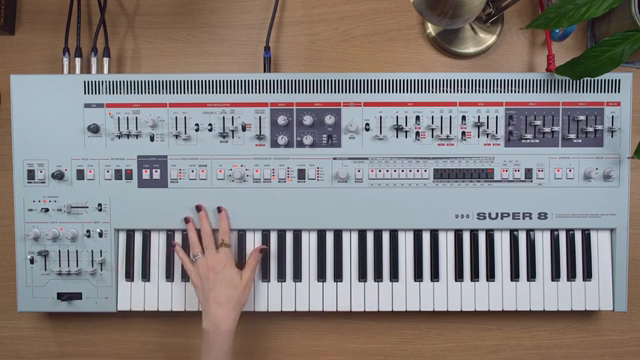
"You can transpose it in real time if you take it out of sequence record mode."
© Screenshot/Quote: Udo Audio (YouTube)
This article is also available in German. Read it here: https://synthmagazin.at/udo-audio-super-8-sequencer-layer-performance-auf-britische-art/
Watch on YouTube:
Latest articles
Watch on YouTube:
Visit the channel:
https://www.youtube.com/udo_audio
https://www.youtube.com/udo_audio
Links from udo_audio:
website: https://www.udo-audio.com
instagram: https://www.instagram.com/udo_audio
Sponsored links:
If you purchase via these links, we may earn a small commission – at no extra cost to you. The link opens an Amazon keyword search, and results may vary depending on availability.
UDO Super 8
🔗 Check price on Amazon
🔗 Check price on Amazon