Step into the vapor-lit corridors of memory with Tim Shoebridge as he unboxes the MEMOTRON—a digital Mellotron that doesn’t just emulate, but reimagines the spectral charm of its tape-based ancestor. Shoebridge, known for his cinematic approach to sound and visuals, guides us through a labyrinth of features that transform nostalgia into a living, breathing soundscape. This isn’t just a walkthrough; it’s an invitation to drift inside a machine where every note exhales fog and fractured light. Prepare to be swept into a world where the past is not just recalled, but remixed, and where the boundaries between analog ghosts and digital clarity dissolve.
14. January 2026
LUMINA
Tim Shoebridge and the MEMOTRON: Digital Ghosts in a Magnetic Choir
From Tape Ghosts to Digital Nebulae
The MEMOTRON emerges as more than a digital facsimile—it is a vessel for the Mellotron’s haunted nostalgia, but with a heart of silicon and memory. Tim Shoebridge, whose love for the Mellotron is palpable, frames this instrument as a bridge between eras. Gone are the days of mechanical burdens and limited frames; in their place, the MEMOTRON offers a weighty, solid presence that channels the spirit of its ancestor while shedding its prehistoric constraints.
This is not mere imitation. The MEMOTRON revolutionizes the user experience, inviting us to explore a vast library of sounds without the maintenance rituals of vintage hardware. Shoebridge’s narrative is tinged with reverence for the Mellotron’s role in shaping the sound of bands like Tangerine Dream and Genesis, yet he is quick to point out how the MEMOTRON’s digital core liberates the user from the tyranny of tape. Here, the Mellotron’s ghosts are not trapped—they are set free to roam and evolve.

"I am instantly in love with this thing."
© Screenshot/Quote: Timshoebridge (YouTube)
Sonic Alchemy: Blending and Shaping the MEMOTRON
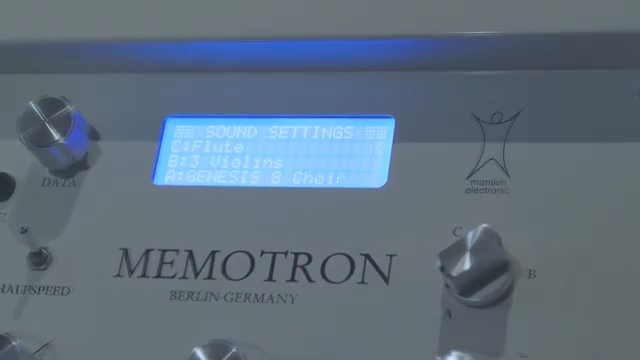
"This one's called Genesis Eight Voice Choir."
© Screenshot/Quote: Timshoebridge (YouTube)
At the heart of the MEMOTRON lies a triad of sound slots—A, B, and C—each a vessel for a different spectral voice. The blend control is a magnetic dial, allowing users to drift seamlessly between these voices, or to let them bleed into one another, creating new textures that shimmer and dissolve like mist. Shoebridge demonstrates how each sound can be individually sculpted: volume, attack, release, and even stereo placement are at your fingertips, each parameter a brushstroke on a shifting sonic canvas.
The MEMOTRON’s architecture encourages experimentation. You can split or layer sounds across the keyboard, transpose them into unfamiliar registers, or invert velocity so that gentle touches bloom into full volume while forceful strikes recede into shadow. This is not just a collection of presets—it’s a toolkit for building your own nebulae, where every blend and tweak births a new constellation of timbres. The possibilities are vast, and the video only hints at the depths waiting to be explored.
Mirrors and Divergence: MEMOTRON vs. Digital Mellotron
When Shoebridge places the MEMOTRON beside its digital Mellotron sibling, the contrasts are stark and revealing. The MEMOTRON’s three-sound blending eclipses the digital Mellotron’s two-voice limitation, opening up a wider horizon for sonic layering and morphing. Where the MEMOTRON offers per-sound control over volume, attack, release, and velocity, the digital Mellotron confines these adjustments to a global level—its architecture more rigid, its experience more akin to reliving the past than reshaping it.
Stereo panning on the MEMOTRON lets each voice find its place in the field, while the digital Mellotron remains stubbornly mono unless routed externally. The MEMOTRON’s mix matrix and keyboard splits allow for intricate layering and performance setups, features absent in its counterpart. Even the act of saving and recalling presets—frames, in MEMOTRON parlance—becomes a creative act, a way to capture and revisit your own sonic stories. In contrast, the digital Mellotron is a browser of memories, not a builder of new ones.
Yet, Shoebridge’s comparison is not without affection for both. Each instrument, he suggests, serves a different purpose: one is a vessel for performance and tactile nostalgia, the other a laboratory for sculpting magnetic resonance. The choice, as always, depends on the story you wish to tell.

"The fact that you have control over each sound's overall volume attack and release and velocity sensitivity is incredible on the Memetron."
© Screenshot/Quote: Timshoebridge (YouTube)
Presets as Portals: Saving and Recalling Sonic Worlds

"It's just a really, really wonderful way of creating combinations of sounds that you really want to work with."
© Screenshot/Quote: Timshoebridge (YouTube)
The MEMOTRON’s ability to save and recall user presets—frames—transforms it from a static instrument into a living archive of your own sonic explorations. Shoebridge highlights how each frame can capture not just the choice of sounds, but every nuance of their sculpting: blends, envelopes, stereo placement, and effects. This is a boon for both the stage and the studio, where inspiration often arrives in fleeting moments.
With presets, the MEMOTRON becomes a time machine, letting you revisit and refine your favorite soundscapes at will. The process is intuitive, echoing the tactile satisfaction of loading a tape frame, but with the speed and flexibility of the digital realm. For those who weave long-form ambient pieces or need instant recall in performance, this feature is nothing short of liberating.
Sound Demos: Drifting Through the Magnetic Fog
Shoebridge’s video is rich with sound demonstrations—each a journey through the MEMOTRON’s textured landscapes. From flutes that shimmer like morning mist to choirs that swell and recede like distant tides, the instrument’s voice is both familiar and uncanny. Effects such as reverb, chorus, and amp modeling add further depth, letting each note bloom or dissolve as the player desires.
Yet, words can only sketch the outlines of these sonic ghosts. The true resonance of the MEMOTRON—the way it exhales fog and fractured light—can only be felt by immersing yourself in the video’s soundscapes. For those who seek to drift inside the machine, Shoebridge’s walkthrough is an invitation to listen, to feel, and to dream.
This article is also available in German. Read it here: https://synthmagazin.at/tim-shoebridge-und-der-memotron-digitale-geister-im-magnetischen-chor/
Watch on YouTube:
Latest articles
Watch on YouTube:
Visit the channel:
https://www.youtube.com/TimShoebridge
https://www.youtube.com/TimShoebridge
Links from TimShoebridge:
Instagram: https://instagram.com/soundmangling/
Sponsored links:
If you purchase via these links, we may earn a small commission – at no extra cost to you. The link opens an Amazon keyword search, and results may vary depending on availability.
Mellotron M4000D
🔗 Check price on Amazon
🔗 Check price on Amazon
Memotron
🔗 Check price on Amazon
🔗 Check price on Amazon