OXI Instruments brings us an inside look at their favourite melodic workflows with the OXI One sequencer, focusing on the Saga pattern engine. In this video, we see practical techniques for creating evolving, interlocking melodies with minimal steps and clever sequencing tricks. Hardware fans get a proper session: two classic oscillators, a low-pass gate, Maths for envelopes, and a handful of utilities all under OXI’s control. It’s a showcase of how a sequencer can become the heart of a modular system, not by menu-diving, but by hands-on rhythmic and melodic experimentation.
16. July 2026
MILES
OXI Instruments: Saga Sequencing for Interlocking Melodies – A Patch-Oriented Deep Dive
LXD Low Pass Gate, Macbeth Dual Oscillator, Make Noise Maths, Mimeophone, OXI One MIDI/CV Sequencer, OXI Pipe, Quadrat, Verbos Complex Oscillator
Setting the Stage: OXI One Meets Saga
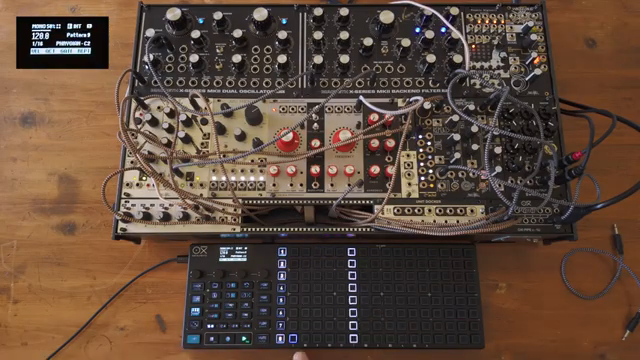
The video opens with OXI Instruments kicking off their Playbook series, putting the spotlight squarely on the OXI One sequencer and its Saga pattern mode. Rather than just running through features, the focus is on a workflow: building complex, interlocking melodies by starting from a single, simple pattern. The patch is built around two distinct voices—Macbeth Dual Oscillator and Verbos Complex Oscillator—bridged into a modular rig via the OXI One, with connections handled through an HDMI-linked Oxypipe.
This is classic modular thinking: take a minimal seed, route it cleverly, and let timing and step length do the heavy lifting. The setup is patched so both oscillators receive their own note and gate streams, and the low pass gate (LXD) and Maths module provide envelope shaping. It’s a demonstration rig with a clear purpose: to show how OXI’s sequencer can be the nerve centre for nuanced, evolving melodic interplay without drowning in unnecessary complexity.
Pattern Duplication and Variation: The Saga Unfolds
The first major trick on display is the rapid creation and duplication of a monophonic Saga pattern. With preview enabled, it’s easy to input pitches and refine the melodic material step by step. Once satisfied, the pattern is copied over to a second sequencer channel with just a few button presses, allowing both channels to control separate oscillators in parallel.
Where things get interesting is in the manipulation of step durations and sequence lengths. By offsetting the step count or adjusting individual step durations, the two patterns begin to phase against one another, creating those sought-after interlocking melodic cycles. This isn’t just a theoretical demonstration—OXI shows how a modest sequence can morph into a richer texture, simply through timing tweaks. The output is then summed and processed with the Mimeophone for a touch of delay and reverb, clocked by the sequencer for tight sync. It’s a demonstration of how minimal input can yield maximal generative complexity when the sequencer is at the helm.
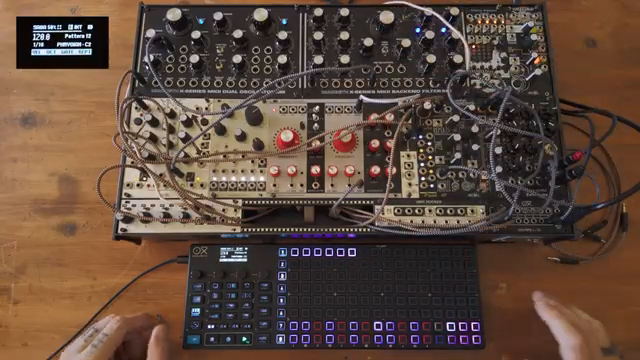
"As you can hear, we already created something interesting and different."
© Screenshot/Quote: Oxiinstruments (YouTube)
Accent as Anchor: Rhythmic Grounding in Saga Patterns
"So, every time that this accent happens, it falls on a different spot of the first sequence."
© Screenshot/Quote: Oxiinstruments (YouTube)
Accents are introduced as a clever means to inject structure and rhythmic punctuation into the evolving melodic patterns. By using a third sequencer lane to fire accents at periodic intervals—every 16 steps, for example—the patch gains a recurring point of emphasis. Maths is again leveraged to translate these accent gates into filter-opening envelopes, giving every accented note a distinctive dynamic contour.
What’s more, by decoupling the accent sequence length from the main pattern (say, five steps versus twelve), OXI demonstrates how accents can land in different positions each cycle, keeping the groove alive and unpredictable. It’s a modular solution for avoiding repetitive, grid-locked phrasing, and it shows how even a simple accent track can glue together otherwise drifting melodic components.
Layering Sequencers: Evolving Soundscapes in Practice
The final segment explores layering additional sequencer tracks to build up a more complex, polyrhythmic texture. Track 4 is set to mono and patched to strike the LXD low pass gate directly, introducing a new, syncopated rhythm into the mix. Adjustments are made to sequence length, gate routing and pulse patterns, demonstrating how quickly one can sketch out new rhythmic layers on the fly.
The result is a modular system that feels alive—each sequencer lane interlocks with the others, yet each evolves at its own rate thanks to differing step lengths and accent patterns. OXI’s approach is shown to be less about static composition and more about iterative, hands-on exploration: experiment with lengths, durations, and routings, and let the system surprise you. It’s modular sequencing at its best—patch, listen, tweak, repeat.
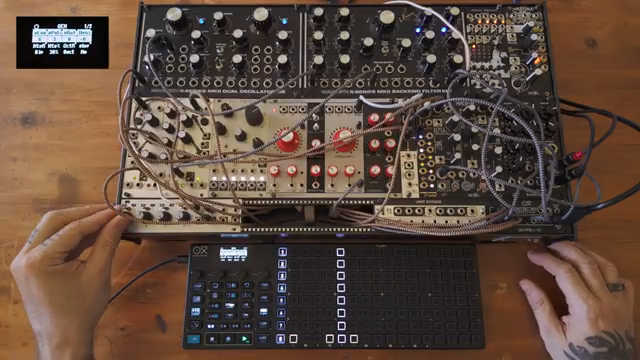
"The more you experiment and explore, the more you will find interesting sweet spots."
© Screenshot/Quote: Oxiinstruments (YouTube)
This article is also available in German. Read it here: https://synthmagazin.at/oxi-instruments-saga-sequencing-fuer-verschraenkte-melodien-ein-patch-orientierter-deep-dive/
More articles about these products:
 OXI Instruments: Harmonizing Leads and Bass with a Dummy Chord Sequencer
 The Unperson vs. Rings: Guitars, Modular Mayhem & Physical Modelling Madness
 The Unperson’s Modular Drum Safari: Kicking Writer’s Block in the Teeth
 The Unperson Unleashes the Instruo Neoni: Triangle Core Mayhem in Eurorack
 The Unperson’s Braids Banger: Mutable’s Macro Monster Still Slaps
 The Unperson’s Filter Rumble: From Sine Slices to Stereo Mayhem
 AP Mastering vs. Preset Zombies: Make Noise Modules Unleashed
 West Coast Mayhem: The Unperson’s Eurorack Goes Full Buchla
 Lodewijk Vos (LØ): Modular Synthesis as Sonic Storytelling
 Make Noise PoliMATHS: A Deep Dive into Span Modes and Modular Possibilities
 Make Noise Spectraphon: Spectral Bouncing Balls and Echoes in the Array
 MAKEN0ISE Resynthesizer: Smoke, Memory and Modular Crossfire
Watch on YouTube:
Latest articles
Watch on YouTube:
Visit the channel:
https://www.youtube.com/oxiinstruments
https://www.youtube.com/oxiinstruments
Links from oxiinstruments:
website: https://oxiinstruments.com
instagram: https://www.instagram.com/oxiinstruments
facebook: https://www.facebook.com/oxiinstruments/
support: https://oxiinstruments.com/support
Sponsored links:
If you purchase via these links, we may earn a small commission – at no extra cost to you. The link opens an Amazon keyword search, and results may vary depending on availability.
LXD Low Pass Gate
🔗 Check price on Amazon
🔗 Check price on Amazon
Macbeth Dual Oscillator
🔗 Check price on Amazon
🔗 Check price on Amazon
Make Noise Maths
🔗 Check price on Amazon
🔗 Check price on Amazon
Mimeophone
🔗 Check price on Amazon
🔗 Check price on Amazon
OXI One MIDI/CV Sequencer
🔗 Check price on Amazon
🔗 Check price on Amazon
OXI Pipe
🔗 Check price on Amazon
🔗 Check price on Amazon
Quadrat
🔗 Check price on Amazon
🔗 Check price on Amazon
Verbos Complex Oscillator
🔗 Check price on Amazon
🔗 Check price on Amazon