Moog Music’s Spectravox isn’t just another filter bank in a box—it’s a hybrid instrument and processor that blurs the line between classic vocoding and modular experimentation. In this official Moog demo, the team walks us through Spectravox’s approach to analog vocal processing, from dynamic microphone input to spectral shifting and noise blending. The video highlights how Spectravox’s envelope followers and patch bay invite creative modulation, and even shows how to expand its palette by vocoding polyphonic material from Matriarch. For anyone curious about the hands-on patchability and sonic quirks of Moog’s latest spectral processor, this is a deep dive worth your voltage.
17. May 2024
MILES
Moog Music’s Spectravox: Analogue Vocoding with a Modular Edge
Spectravox: Instrument or Processor?
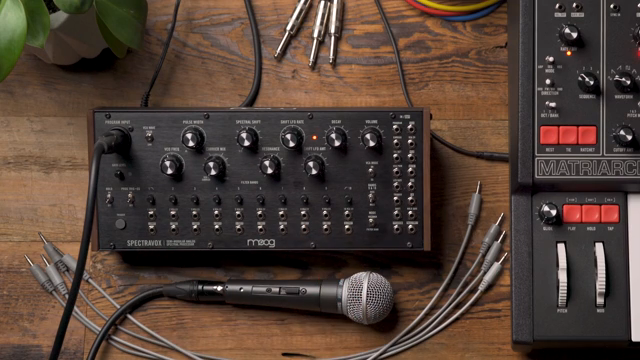
Spectravox is introduced as a device that sits comfortably between the worlds of instrument and processor, a rare hybrid in the modular landscape. Moog Music positions it as a tool for both generating and transforming sound, with a particular focus on vocal processing in this demonstration. Its architecture, featuring ten filter bands and a spectrum analyzer, is designed to extract and manipulate the spectral content of incoming audio.
The video makes clear that Spectravox’s analog roots shape its character, especially when compared to modern digital vocoders. While it may not reach the same level of speech intelligibility as some digital counterparts, it compensates with a distinctive tonality and a hands-on approach to spectral manipulation. This dual nature is at the heart of the module’s appeal, inviting users to treat it as both a sound source and a creative processor within a modular setup.

"Spectravox is unique in that it straddles the line between instrument and processor."
© Screenshot/Quote: Moogsynthesizers (YouTube)
Classic Vocoding: Microphone Meets Analog Circuits

"If I flip this up to hiss, it's going to replace band's 9 and 10's carrier oscillator with the internal noise source so that I can simulate some of the sibilance and s-sounds coming from my voice."
© Screenshot/Quote: Moogsynthesizers (YouTube)
The demonstration begins with a Shure SM58 dynamic microphone patched into Spectravox’s program input, with gain adjusted to accommodate the mic’s output level. Moog’s video notes that while dynamic and passive microphones are supported, condenser mics requiring phantom power are not compatible. Once levels are set and the vocoder mode engaged, Spectravox’s internal carrier oscillator and white noise generator come into play, enabling classic analog vocoding textures. The user can tweak the carrier’s pitch and waveform, and employ the spectral shift control to move all ten filter bands in parallel, shaping the focus of the vocoded sound. A dedicated switch allows the last two bands to be replaced with noise, adding sibilance and enhancing the clarity of processed vocals—a thoughtful nod to the quirks of human speech.
Envelope Followers and Attenuators: Sculpting Dynamics and Clarity
A standout feature in the Spectravox workflow is the program envelope follower, which tracks the amplitude of the incoming vocal signal. This output can be patched to modulate various parameters—such as the oscillator’s pitch—yielding dynamic, voice-reactive effects. The video demonstrates an extreme example by routing the envelope follower directly to the volt-per-octave input, resulting in pronounced pitch modulation tied to vocal amplitude.
For more nuanced control, the envelope follower is sent through an attenuator (in this case, using the Matriarch’s attenuator), allowing the user to dial in subtler modulation depths. This setup enhances the intelligibility of the vocoded signal by ensuring that pitch shifts track the natural dynamics of speech without overwhelming the carrier. The video also shows how the program output itself can be used for additional modulation, and highlights the flexibility offered by Spectravox’s patch bay for further customisation of the vocoding behaviour.

"So as you can hear, that makes things quite extreme."
© Screenshot/Quote: Moogsynthesizers (YouTube)
Polyphonic Vocoding: Matriarch Joins the Patch Bay
To showcase Spectravox’s versatility, the workflow expands to include external polyphonic material. By patching the Moog Matriarch’s output into Spectravox’s carrier input, the internal oscillator is bypassed, and the vocoder now processes chords and complex textures. This opens up classic vocoder territory—think lush, harmonised vocal effects—while retaining the analog grit and patchability that define the Spectravox. The video closes by demonstrating how this setup can transform both vocals and external synths, underlining Spectravox’s role as a modular processor that thrives on creative routing and experimentation.
This article is also available in German. Read it here: https://synthmagazin.at/moog-music-spectravox-analoger-vocoder-mit-modularem-anspruch/
Watch on YouTube:
Latest articles
Watch on YouTube:
Visit the channel:
https://www.youtube.com/MoogSynthesizers
https://www.youtube.com/MoogSynthesizers
Links from MoogSynthesizers:
website: https://moogmusic.com
instagram: https://instagram.com/moogsynthesizers
facebook: https://www.facebook.com/moogmusicinc
twitter: https://twitter.com/moogmusicinc
Sponsored links:
If you purchase via these links, we may earn a small commission – at no extra cost to you. The link opens an Amazon keyword search, and results may vary depending on availability.
Moog Matriarch
🔗 Check price on Amazon
🔗 Check price on Amazon
Moog Spectravox
🔗 Check price on Amazon
🔗 Check price on Amazon
Shure SM58
🔗 Check price on Amazon
🔗 Check price on Amazon