Modor Music, the Belgian champions of digital drum design, are back with a firmware update that’s more than just a bug fix. The DR-2’s OS012 upgrade introduces a trio of new drum models—each with its own twist on sound sculpting—and a parametric EQ stage that promises to make your kicks punchier and your hats snappier. In this official walkthrough, Modor’s Marcel demonstrates how these features push the DR-2 further into creative territory, blending club-ready rumble with surgical frequency shaping. For those who like their beats synthetic but hands-on, this update is worth a closer look.
13. April 2024
MILES
Modor Music’s DR-2 OS012: Rumble, Filters and a Smarter Drum Machine
Firmware OS012: New Models and EQ for the DR-2
Modor Music’s latest OS012 firmware for the DR-2 drum machine isn’t just a maintenance update—it’s a substantial expansion of the instrument’s sonic toolkit. The headline features are three new drum models and a parametric equalisation stage, each designed to bring more flexibility and depth to digital drum programming.
As is typical for Modor’s approach, these additions aren’t mere imitations of classic analogue circuits. Instead, they leverage digital processing to offer sound design options that go beyond the usual virtual-analogue fare. The update is introduced with a clear focus on practical, hands-on improvements for electronic musicians who want to shape their drum sounds with precision.
Rumble Kick: Club Weight with Controlled Space
The new rumble kick model borrows a trick from techno production: it combines a punchy kick with a reverb tail that’s ducked by a compressor, ensuring the reverb doesn’t muddy the initial transient. This approach allows the main kick to cut through cleanly, while the reverb tail blooms afterwards—evoking the cavernous feel of a large club or hall without sacrificing clarity.
Modor’s implementation goes further by low-pass filtering the reverb tail, keeping it sonically distinct from the rest of the mix. The result is a deep, weighty kick that maintains its presence even in dense arrangements. This model is clearly aimed at those who want their drums to fill the room without overwhelming the groove, and the video demonstrates how the DR-2’s digital architecture makes this possible with just a few parameter tweaks.
"When you put a reverb on a kick drum and make the reverb sound duck with a compressor to the main kick sound, the reverb tail does not get in the way of the main kick sound."
© Screenshot/Quote: Modormusic (YouTube)
Filter Claps and Hi-Hats: Slope Control for Sonic Precision
"These models both use a filter with adjustable filter slopes in steps of 6 or 12 dB/octave."
© Screenshot/Quote: Modormusic (YouTube)
The filter claps and filter hi-hats models both introduce adjustable filter slopes, giving users detailed control over the frequency content of their percussion. For the claps, the filter offers a gentle slope at the low end and an impressively steep low-pass filter—up to 96 dB/octave—at the top, effectively silencing anything above the cutoff. This is applied to a wide noise source, allowing for handclap sounds that range from naturalistic to highly sculpted, depending on the settings.
The filter hi-hats take this concept further, with filter slopes up to 84 dB/octave available on both low-pass and high-pass filters. Users can blend cymbal noise with pink noise and adjust the separation between the filter cutoffs, resulting in hi-hat and cymbal sounds that are intentionally synthetic and edgy. Modor makes it clear that realism isn’t the goal here; instead, these models are about creative control and new timbral territory.
Parametric EQ: Punch and Polish for Every Drum
The new parametric equalisation stage is found in the after-treatment section of the DR-2, positioned between the distortion and tilt filter. Each of the six instrument slots gets its own EQ, allowing for per-voice frequency shaping. The video highlights how this is especially useful for kick drums, where cutting a specific lower-mid frequency range can add punch and clarity.
Rather than limiting this feature to the rumble kick, Modor has made the EQ available to all drum models. With adjustable centre frequency, Q factor, and a generous gain range from -36 to +36 dB, this stage provides the kind of surgical control usually reserved for studio outboard gear. The result is a drum machine that not only generates a wide palette of sounds, but also lets users refine and polish each voice to fit their mix.
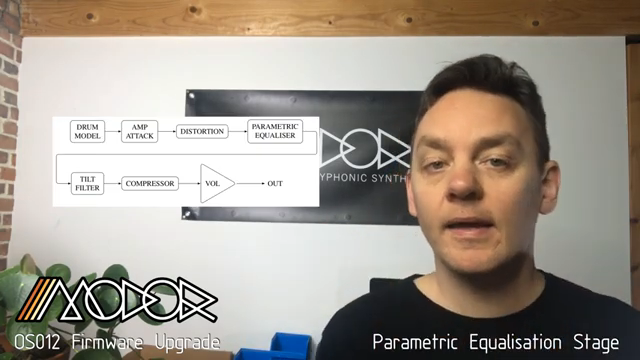
"And so there is one of these equalizers available for each of the six instrument slots on the Modo Audio 2."
© Screenshot/Quote: Modormusic (YouTube)
This article is also available in German. Read it here: https://synthmagazin.at/modor-music-dr-2-os012-rumble-filter-und-ein-clevererer-drumcomputer/
More articles about these products:
Watch on YouTube:
Latest articles
Watch on YouTube:
Visit the channel:
https://www.youtube.com/ModorMusic
https://www.youtube.com/ModorMusic
Links from ModorMusic:
website: https://www.modormusic.com
instagram: https://www.instagram.com/modormusic
facebook: https://www.facebook.com/modormusic
Sponsored links:
If you purchase via these links, we may earn a small commission – at no extra cost to you. The link opens an Amazon keyword search, and results may vary depending on availability.
Modor DR-2
🔗 Check price on Amazon
🔗 Check price on Amazon