In this updated overview, Modor Music spotlights the DR-2—a digital drum machine that’s anything but conventional. Unlike most rhythm boxes fixated on samples or analog emulation, the DR-2 puts digital synthesis at the forefront, offering a palette of over 20 unique drum models and a hands-on interface with deep sound-shaping controls. The video walks us through not only the synthesis engines but also a powerful after treatment section and a sequencer brimming with polyrhythmic and parameter-locking potential. If you’re searching for a proudly digital drum synth that rewards exploration, this walkthrough reveals why the DR-2 stands apart.
Beyond the Sample: DR-2’s Digital DNA
Modor Music kicks things off by positioning the DR-2 as a digital drum machine built from the ground up for synthesis, not sampling. There’s no analog circuitry or sample memory inside—every sound you hear is generated through real-time digital synthesis. The DR-2 provides six independent instruments, labeled A through F, each with its own fader and dedicated output, all encased in a robust steel chassis with wooden side panels.
This architecture means each drum part can be customized from the oscillator up, rather than relying on static recordings. For those integrating with larger setups, the DR-2 offers MIDI, clock in/out for modular sync, and discrete outputs for every instrument. The instrument’s design choices make clear Modor’s intent: to deliver a drum machine that’s all about digital sound creation and flexible routing, not retro mimicry.
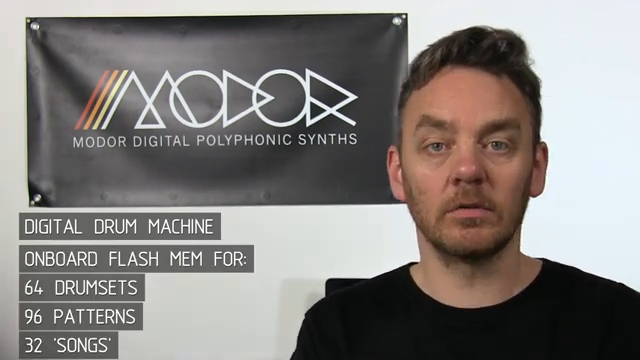
"There is no sample memory inside, it's all based on digital drum sound synthesis."
© Screenshot/Quote: Modormusic (YouTube)
A Universe of Drum Models
At the heart of the DR-2 is its collection of over 20 digital synthesis models, each tailored to specific drum sounds. Users can assign one model per instrument, with options ranging from five different bass drum engines and four snare drum architectures to specialized models for claps, hi-hats, cymbals, and more experimental percussion.
The video demonstrates how each model is constructed with its own DSP architecture: for example, a drive bass drum uses a sine oscillator routed through multiple distortion and filter stages, while the rumble bass drum includes a primitive reverb and gating for textured sub-layering. The glass bottle model stacks over 20 sine oscillators tuned to mimic the resonances of struck glass. This diversity enables users to sculpt drum tones that go far beyond what typical sample-based machines can offer.
After Treatment: Per-Instrument Effects
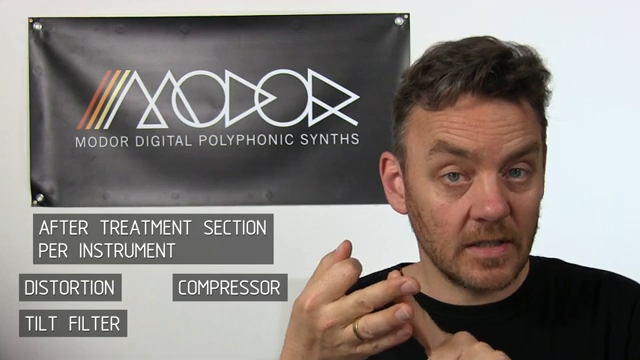
"There is a distortion per instrument, there is a tilt filter, there is a compressor for every instrument with side chaining if you need it and there's also a parametric equalization stage."
© Screenshot/Quote: Modormusic (YouTube)
Every instrument on the DR-2 benefits from an individual after treatment section, which Modor describes as a series of effects tailored for drum sound refinement. Each channel includes its own distortion, tilt filter, compressor (with sidechain), and a parametric EQ.
This per-instrument processing chain allows for detailed shaping of each drum voice before it hits the outputs—making it possible to dial in anything from subtle punch to aggressive saturation. The inclusion of sidechain compression and on-board EQ means users can finalize drum mixes entirely within the DR-2, without relying on outboard gear.
Sequencer: Polyrhythms, Parameter Locks & More
The DR-2’s sequencer goes well beyond the basics, starting with a classic 16-step button layout that expands to 64 steps across four pages. Notably, the sequencer supports double resolution (allowing for 32nd-note steps) and dedicates a sequencer line to each instrument, giving granular control over rhythms.
Advanced features include per-instrument accent lines, global accents, and performance tricks like flams, double hits, breaks (for instant muting), and reverse playback. The sequencer also supports trig conditions and parameter locks, enabling the user to automate sound parameters on a per-step basis—a workflow reminiscent of more advanced grooveboxes.
A highlight for the rhythmically adventurous is the polyrhythmic clock system. Each instrument can operate on its own clock division, making it possible to program complex, interlocking patterns that evolve over time. This is where the DR-2’s flexibility really shines, catering to intricate rhythm design in both live and studio settings.
"It is possible to store parameter locks to have a deviant value for a certain parameter on a certain step."
© Screenshot/Quote: Modormusic (YouTube)
Drum Machine or Drum Synthesizer?
"It is sometimes maybe more of a drum synthesizer than a drum machine."
© Screenshot/Quote: Modormusic (YouTube)
Modor Music poses an interesting question: is the DR-2 a drum machine, or is it more accurately described as a drum synthesizer? Unlike classic analog machines that typically offer just a handful of tweakable parameters per voice, the DR-2 provides a dozen synthesis controls per model, inviting deeper sound design and a broader sonic palette.
As the video demonstrates with a performance segment, this design ethos pays off in the ability to craft intricate drum patterns and evolving soundscapes. The DR-2 doesn’t just play back drum sounds—it synthesizes them in real time, making it a powerful tool for those who want their percussion to be as dynamic and customizable as the rest of their setup.
This article is also available in German. Read it here: https://synthmagazin.at/modor-music-dr-2-digitale-drum-synthese-entfesselt/
More articles about these products:
Watch on YouTube:
Latest articles
Watch on YouTube:
Visit the channel:
https://www.youtube.com/ModorMusic
https://www.youtube.com/ModorMusic
Links from ModorMusic:
website: https://www.modormusic.com
instagram: https://www.instagram.com/modormusic
facebook: https://www.facebook.com/modormusic
Sponsored links:
If you purchase via these links, we may earn a small commission – at no extra cost to you. The link opens an Amazon keyword search, and results may vary depending on availability.
Modor DR-2
🔗 Check price on Amazon
🔗 Check price on Amazon