Make Noise delivers a trio of firmware updates for their New Universal Synthesizer System (N.U.S.S.) modules: MultiWAVE, PoliMATHS, and MultiMod. This video announcement walks through each digital enhancement, from innovative wavetable modulation to expanded offset and mixing tricks, and smarter audio processing. As always with Make Noise, the focus is on pushing modular boundaries while keeping the architecture open and inviting for deep experimentation.
A Triple Firmware Drop: Digital N.U.S.S. Evolves
Make Noise has rolled out fresh firmware for its three digital N.U.S.S. modules—MultiWAVE, PoliMATHS, and MultiMod—marking a significant step in the evolution of these already versatile Eurorack tools. The announcement, delivered in the brand’s typically exploratory tone, sets the stage for a suite of new features aimed squarely at digital modulation and workflow expansion.
While the video is a concise overview, it’s clear that these updates are designed for users who want to squeeze ever more architectural complexity and creative modulation out of their systems. Each module receives targeted improvements that should appeal to power users and patching minimalists alike.
MultiWAVE: Modulate the Modulator, Craft New Shapes
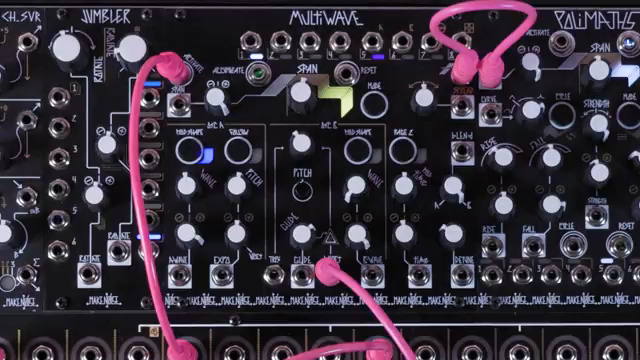
MultiWAVE’s headline feature is a new MultiMod shape, bringing internal modulation of wavetable position directly into the heart of the module. Instead of relying solely on external sources, MultiWAVE can now use the oscillator output from the corresponding channel on the opposite side for audio-rate cross-modulation. This enables complex, evolving timbres completely within the module, offering a workflow that feels both self-contained and ripe for experimentation.
Alongside this, MultiWAVE’s page 2 expands the quantizer with selectable custom scales, including major, minor, and others, accessed by turning the OSC-A pitch control. These scales are stored as Scala files in internal memory, and adventurous users can load custom tunings via USB. This update not only boosts the sound design palette but also aligns MultiWAVE with contemporary microtonal and alternative tuning workflows.
"MultiWave has a new MultiMod shape for internal modulation of wavetable position."
© Screenshot/Quote: Maken0Isemusic (YouTube)
PoliMATHS: Offset Generation and Evolving LFOs
"The biggest change to polymaths is the ability to use the strength control to generate offsets."
© Screenshot/Quote: Maken0Isemusic (YouTube)
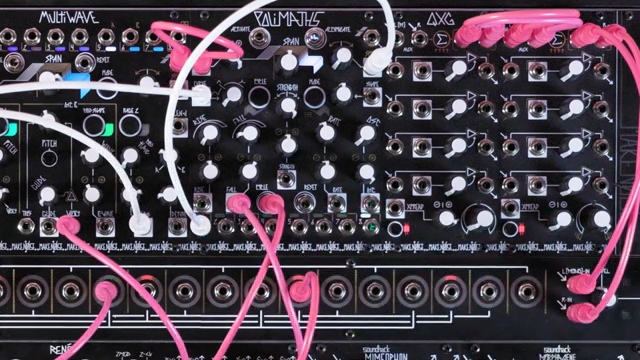
The standout addition to PoliMATHS is the ability for its strength control to generate offsets. By pushing a channel’s strength beyond the knob’s range—either via spread or CV—users can produce positive offsets that are summed with the activated function. On the left side of the control, this results in equal positive offsets across all eight channels, and when triggered, negative-going functions for a voltage mirror effect.
This architectural tweak transforms PoliMATHS into a more flexible modulation and mixing hub. Not activating channels allows QXGs to act as a basic mixer for droning MultiWAVE channels or other audio sources, and increasing oscillation depth introduces a new flavor of eight-channel LFO. The LFOs can now also run significantly slower than before. Notably, enabling output summing disables the offset functionality, a tradeoff users should be aware of in patch design.
MultiMod: Channel Index Output Grows Smarter
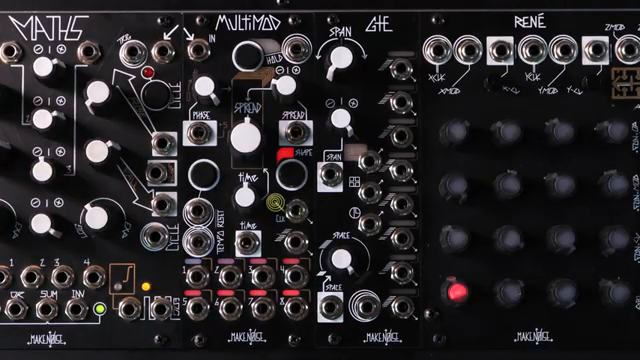
MultiMod’s update centers on its channel index output, making it more effective for audio processing workflows. Previously, the channel index output struggled with audio sources. With the new firmware, it now leverages an internal envelope follower, allowing the derivation of gates from delayed signals containing transients. This is particularly useful for extracting timing information when MultiMod is used as an audio delay.
The improvement is subtle but significant—users can now integrate MultiMod into more complex timing and audio manipulation scenarios, bridging the gap between standard CV/gate duties and audio-rate modular tricks. The update shows Make Noise’s commitment to evolving their digital architectures toward deeper hybrid workflows.
"The Multimod's channel index output has been altered slightly so that it can be used more easily when Multimod is processing audio."
© Screenshot/Quote: Maken0Isemusic (YouTube)
Bug Fixes and Power Optimizations: The Small Print
All three N.U.S.S. modules also benefit from minor bug fixes and improved power consumption, according to Make Noise. While the video does not detail specific bugs addressed, the recommendation is clear: all users should update to the new firmware for optimal performance and efficiency. As always, Make Noise encourages checking out the updated video manual and staying tuned for further patching ideas utilizing the fresh features.
This article is also available in German. Read it here: https://synthmagazin.at/make-noise-n-u-s-s-firmware-updates-digitale-power-fuer-multiwave-polimaths-multimod/
More articles about these products:
 S1gns Of L1fe Modular: Modular 101 Without the Fluff
 MAKEN0ISE MultiWAVE: Patching Through Space and Unusual Tunings
 MAKEN0ISE GTE: Channel Index Translation for Rhythmic Control in Eurorack
 Make Noise Skiff Systems: Compact Powerhouses in Modular Synthesis
 MIDI, CV and the Make Noise N.U.S.S.: Skiff System in Hybrid Action
 Make Noise Unveils the Universal Skiff System: Polyphony and MIDI in a Compact Modular Format
 MAKEN0ISE: Strumming the Grid – A Patch Adventure Beyond Sequencing
 MAKEN0ISE MultiWave: Gliding into Polyphonic Possibilities
 Make Noise Output Mixing: Exploring Submixing on PoliMATHS and MultiWAVE
 MAKEN0ISE PoliMATHS: Exploring Dual Cycle Modes for Modular Mayhem
 MAKEN0ISE MultiWAVE: MultiMod LFO Architecture for Deep Timbre Modulation
 MAKEN0ISE PoliMATHS: Oscillation, Submixing, and Audio-Rate Adventures
Watch on YouTube:
Latest articles
Watch on YouTube:
Visit the channel:
https://www.youtube.com/MAKEN0ISEMUSIC
https://www.youtube.com/MAKEN0ISEMUSIC
Links from MAKEN0ISEMUSIC:
website: https://www.makenoisemusic.com
instagram: https://www.instagram.com/makenoisemusic
twitter: https://twitter.com/makenoisemusic
facebook: https://www.facebook.com/makenoiseco
Sponsored links:
If you purchase via these links, we may earn a small commission – at no extra cost to you. The link opens an Amazon keyword search, and results may vary depending on availability.
Multimod
🔗 Check price on Amazon
🔗 Check price on Amazon
MultiWAVE
🔗 Check price on Amazon
🔗 Check price on Amazon
PoliMATHS
🔗 Check price on Amazon
🔗 Check price on Amazon