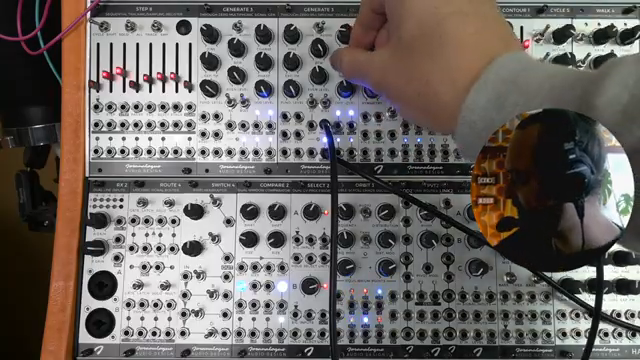
Joranalogue Audio Design’s latest video is a true feast for the modular-minded: Simon (aka Bries Modular) takes us on a meticulous, module-by-module journey through the entire current Joranalogue Eurorack range. From sequencers and oscillators to esoteric utilities and stereo processors, every device gets its moment in the patch cable spotlight. True to Joranalogue’s reputation for precision and clean design, the walkthrough is packed with practical patching tips, creative tricks, and a healthy dose of dry wit. If you’ve ever wondered how these “lab grade” modules behave in real-world systems, or how they might slot into your own rack, this is essential viewing.
30. December 2025
MILES
Joranalogue Audio Design: The Full Modular Line-Up Dissected – Stories, Tricks and Patchcraft
A Grand Tour of the Joranalogue Arsenal
Simon opens with a refreshingly honest take on the usual year-end roundups, opting instead for a comprehensive walkthrough of every Joranalogue module in his rack—essentially the entire catalogue, minus TEST 3. The approach is personal yet technical, with Simon sharing not just specs but also his own patching habits and the quirks he’s discovered over years of use. The video’s tone is informal but densely packed with practical insights, making it clear this isn’t just a marketing parade, but a real-world look at how these modules function in the wild.
The journey begins with Step 8, which Simon demonstrates as both a sequencer and a unique eight-stage sample-and-hold. He quickly moves into creative territory, showing how chaotic CV sources can be sampled and attenuated for semi-random melodies, with quantization and root note control via the sliders. This sets the stage for the rest of the video: each module gets a spotlight on both its bread-and-butter use and at least one clever trick or alternative workflow, all grounded in patchable reality.
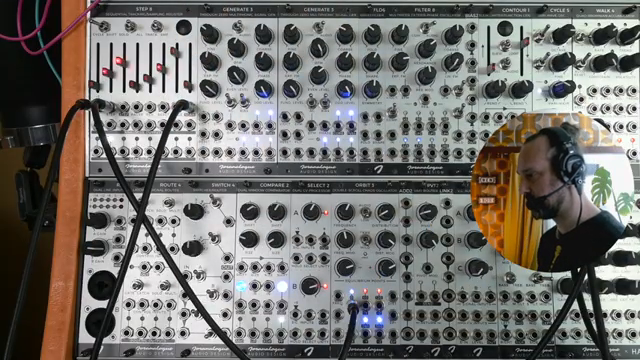
"There's no other module that gives you this functionality."
© Screenshot/Quote: Joranalogue (YouTube)
Feature Deep Dive: From Oscillators to Utilities
"To me it sounds, well, it's just a personal preference, it sounds to me more interesting, more pleasing than FM."
© Screenshot/Quote: Joranalogue (YouTube)
The walkthrough dives into Generate 3, the oscillator that launched Simon’s Joranalogue journey. He highlights its multi-harmonic outputs, phase modulation capabilities, and the sheer breadth of timbral options—especially when modulated by envelopes or chaotic voltages. Simon’s preference for phase modulation over traditional FM is noted, and he demonstrates how combining the various outputs leads to evolving, complex tones.
Fold 6 and Filter 8 are next, with the former praised for its audio-rate modulation potential and the latter for its versatility as both a filter and a sine wave generator. Simon patches up feedback loops, explores linear versus exponential FM, and makes a strong case for Filter 8’s role as a modulation source as much as a filter. The discussion then shifts to a parade of utilities: Receive 2 for external input, Route 4 for melodic transposition, Switch 4 for silent audio and trigger switching, and Compare 2 for logic and creative comparator tricks. Each utility is shown not just as a technical necessity, but as a source of creative patching possibilities.
Select 2, Orbit 3, Add 2, Pivot 2, Link 2, and Mix 3 all get their due. Simon demonstrates how Select 2 excels at attenuation, inversion, and offsetting—especially when wrangling wide-ranging voltages from chaos modules like Orbit 3. Orbit 3 itself is described as a chaos oscillator with stereo and modulation tricks, while Add 2 and Link 2 are shown as essential for precision voltage management. Pivot 2’s processor-order switching and Mix 3’s VCA/mixer flexibility round out the section, with Simon emphasizing how these modules interlock in a larger system.
Creative Workflows and Modular Patchcraft
Simon’s demonstrations are peppered with creative workflows that highlight the modular ethos. He shows how chaotic voltages from Orbit 3 can be sampled, attenuated, and offset for melodic purposes, and how feedback and audio-rate modulation can turn even simple patches into complex sonic organisms. The use of Route 4 for on-the-fly melodic transposition, Switch 4 for live drum pattern manipulation, and Compare 2 for extracting triggers and logic signals all underscore the flexibility of the Joranalogue ecosystem.
Modules like Enhance 2 and Collide 4 are explored for their stereo processing and noise generation capabilities, respectively. Enhance 2’s mid-side processing is demonstrated with practical patch examples, including routing only the mid or side channels through wavefolders or saturators for dramatic stereo effects. Collide 4, developed with Hainbach, is described as a noise machine and a source of precise voltages, but Simon’s favourite trick is simply pinging its filter for clean, resonant tones. These workflows illustrate how even the most technical modules can become creative tools in the right hands.
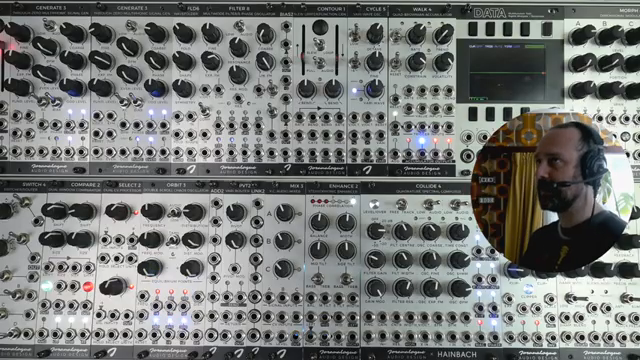
"If you don't know what mid-side is, it's just a different way of looking at a stereo signal instead of looking at the left and the right as separate signals."
© Screenshot/Quote: Joranalogue (YouTube)
Unique Functions: Wavefolding, Filtering, and Modulation Marvels
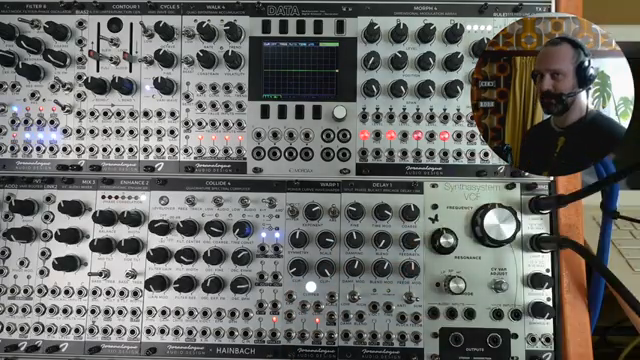
"It has quite a few clever utility features on board."
© Screenshot/Quote: Joranalogue (YouTube)
Several modules stand out for their unique functionalities. Cycle 5, the latest VCO, is highlighted for its tuning reference capabilities and morphing wave outputs, which can be modulated for evolving timbres. Simon demonstrates how the Vari Wave output morphs smoothly from sine to triangle to saw and pulse, and how PWM and LFO modes expand its palette. He also shows how Cycle 5 can serve as a reference for tuning other oscillators, a practical touch for live and studio setups.
Warp 1, still in prototype, is presented as a utility wave shaper with voltage-controlled clipping, asymmetrical shaping, and even full-wave rectification. Simon runs morphing synth sounds through Warp 1, revealing its ability to distort and reshape complex signals in musically useful ways. Delay 1, a bucket brigade delay, is praised for its high-frequency clocking (eliminating typical BBD whine) and its suitability for chorus, flanging, and Karplus-Strong synthesis. Simon demonstrates both clean and grungy delay tones, as well as comb filtering and feedback tricks.
Dim 2, the CV-controllable light module, gets a brief but entertaining mention as both a performance light show tool and a practical rack illuminator. Simon notes its potential for visual feedback in live patches, even if he personally prefers to avoid triggering epileptic seizures during his videos. These modules exemplify Joranalogue’s knack for combining technical depth with creative potential.
Encouraging Exploration: The Modular Mindset
As the presentation winds down, Simon reflects on the experimental and nuanced sound design possibilities that Joranalogue modules offer. He encourages viewers to dig into manuals, experiment with patching orders, and explore the less obvious features—reminding us that even the most utilitarian modules can unlock surprising results with a bit of creative thinking.
The video closes with a nod to the future, as Simon hints at more content and ongoing development within the Joranalogue ecosystem. The overall message is clear: these modules aren’t just lab instruments, but tools for sonic adventure, inviting users to push boundaries and invent their own workflows. For anyone serious about modular, it’s a compelling call to patch, tweak, and explore.
This article is also available in German. Read it here: https://synthmagazin.at/joranalogue-audio-design-das-komplette-modular-line-up-zerlegt-geschichten-tricks-und-patchkunst/
Watch on YouTube:
Latest articles
Watch on YouTube:
Visit the channel:
https://www.youtube.com/joranalogue
https://www.youtube.com/joranalogue
Links from joranalogue:
website: https://joranalogue.com
facebook: https://facebook.com/joranalogue
twitter: https://twitter.com/joranalogue
soundcloud: https://soundcloud.com/joranalogue
modulargrid: https://www.modulargrid.net/e/vendors/view/578
instagram: https://instagram.com/joranalogue