Intellijel’s Swells module lands as a reverb powerhouse for Eurorack, promising hands-on control and a buffet of spatial flavours. In this first part of their official video manual, Intellijel walks us through Swells’ main reverb controls, from its eight tactile sliders to the model selection switches and performance-oriented features. As ever with Intellijel, the focus is on practical patching, immediate feedback, and creative sound shaping. If you’re after a reverb that’s as tweakable as it is musical, this deep-dive is worth your patch cables’ attention.

12. April 2026
MILES
Intellijel Swells: A Reverb Odyssey for Modular Patchers
Intellijel MultiGrain, Intellijel Palette Case, Intellijel Stereo I/O, Intellijel Swells
Swells Arrives: A Modular Reverb with Ambition
Intellijel introduces the Swells module as a dedicated reverb effect designed for modular synthesists who crave nuanced control and sonic variety. The video sets the stage for a hands-on exploration, emphasising that this is part one of a multi-part manual series. Before diving in, users are reminded to update their firmware—a classic Intellijel move, ensuring everyone’s on the same page for feature parity. The opening moments make it clear: Swells isn’t just another reverb, but a module built for deep interaction and patching flexibility.
Eight Sliders, Infinite Spaces: The Main Controls
The heart of Swells is its row of eight sliders, each mapped to a crucial reverb parameter: Pre-Delay, Size, Decay, Low Damping, High Damping, Ebb, Flow, and EQ. Each slider is paired with its own CV input and a tenuverter, inviting modulation from any corner of your rack. The panel also features parameter LEDs, which change colour to reflect both manual and modulated values, making it easy to visualise what’s happening in a busy patch.
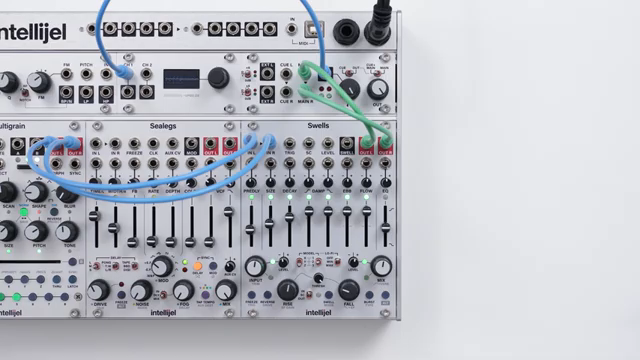
Input and mix knobs flank the sliders, controlling the signal sent to the reverb path and the balance between dry and wet signals. Both are CV-controllable and share a tenuverter, with their own LEDs for instant feedback. The video demonstrates a basic stereo patch, routing audio from a Multigrain module through Swells and out to a stereo I/O, showing how quickly Swells can be inserted into a modular signal chain. The result is a straightforward setup, but one that immediately reveals the tactile and visual feedback that Swells is designed to provide.
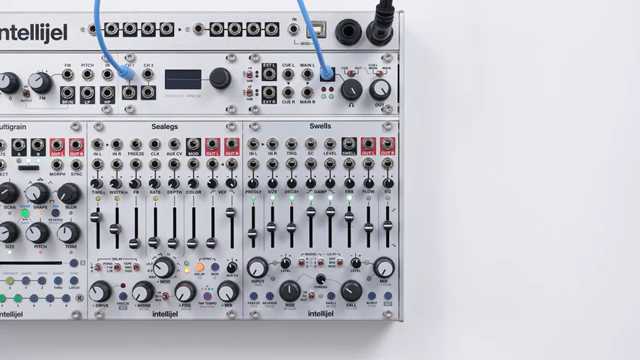
"We have eight sliders which control the parameters. These include Pre-Delay, Size, Decay, Low Damping, High Damping, Eb, Flow and EQ."
© Screenshot/Quote: Intellijel (YouTube)
Model Mayhem: Exploring Swells’ Reverb Engines
"There are nine different reverb models on swells and we select between them using the model selector switches."
© Screenshot/Quote: Intellijel (YouTube)
Swells offers nine distinct reverb models, selectable via two switches: one for bank (X, Y, Z) and one for model (1, 2, 3) within each bank. Each model brings its own sonic fingerprint, from the atmospheric FOG to the lush Gaze and the stereo-rich options in between. The video provides a taste of several models, highlighting how each selection instantly transforms the spatial character of the sound.
While not every model is demoed in this video, Intellijel points viewers to the model reference table for a full breakdown of features and encourages further exploration in their launch demos. The immediate model switching and audible differences underline Swells’ role as a versatile reverb toolbox, ready to adapt to any patching scenario.
Performance Tools: EBB, FLOW, and the Lo-Fi Switch
Swells isn’t content with static reverbs—its EBB and FLOW sliders unlock model-specific parameters, such as diffusion, modulation, pitch shifting, and feedback shaping. The video demonstrates how these controls can radically alter the reverb’s behaviour, from dense, smeared textures to chattery, modulated spaces. Assignments for EBB and FLOW vary by model, and Intellijel recommends consulting the reference table for the full list.
The lo-fi switch adds another layer of performance flavour, offering three intensity levels that change function depending on the selected bank and model. From tape-style saturation and compression to BBD clock manipulation and hard clipping, the lo-fi switch is a playground for those who want their reverbs to get gritty or unpredictable. The video walks through several examples, showing just how much character can be dialled in with a flick of a switch.
"The lofi switch is a modifier for the reverb with three intensity levels off min and max."
© Screenshot/Quote: Intellijel (YouTube)
Hands-On Discovery and What’s Next
Intellijel wraps up this first part by encouraging users to get hands-on with Swells’ controls, sliders, and switches to discover unique reverberant spaces. The ALT page is briefly introduced, revealing additional parameters like trim, reverb high-pass, and drive, with the promise of more in-depth coverage in future videos. The message is clear: Swells is designed for exploration, and this video is just the beginning. With further episodes set to cover modulation and momentary effects, there’s plenty more patching potential on the horizon.
This article is also available in German. Read it here: https://synthmagazin.at/intellijel-swells-eine-reverb-odyssee-fuer-modular-patcher/
Watch on YouTube:
Latest articles
Watch on YouTube:
Visit the channel:
https://www.youtube.com/intellijel
https://www.youtube.com/intellijel
Links from intellijel:
website: https://intellijel.com
forum: https://forum.intellijel.com
instagram: https://instagram.com/intellijel
facebook: https://www.facebook.com/intellijel
Sponsored links:
If you purchase via these links, we may earn a small commission – at no extra cost to you. The link opens an Amazon keyword search, and results may vary depending on availability.
Intellijel MultiGrain
🔗 Check price on Amazon
🔗 Check price on Amazon
Intellijel Palette Case
🔗 Check price on Amazon
🔗 Check price on Amazon
Intellijel Stereo I/O
🔗 Check price on Amazon
🔗 Check price on Amazon
Intellijel Swells
🔗 Check price on Amazon
🔗 Check price on Amazon