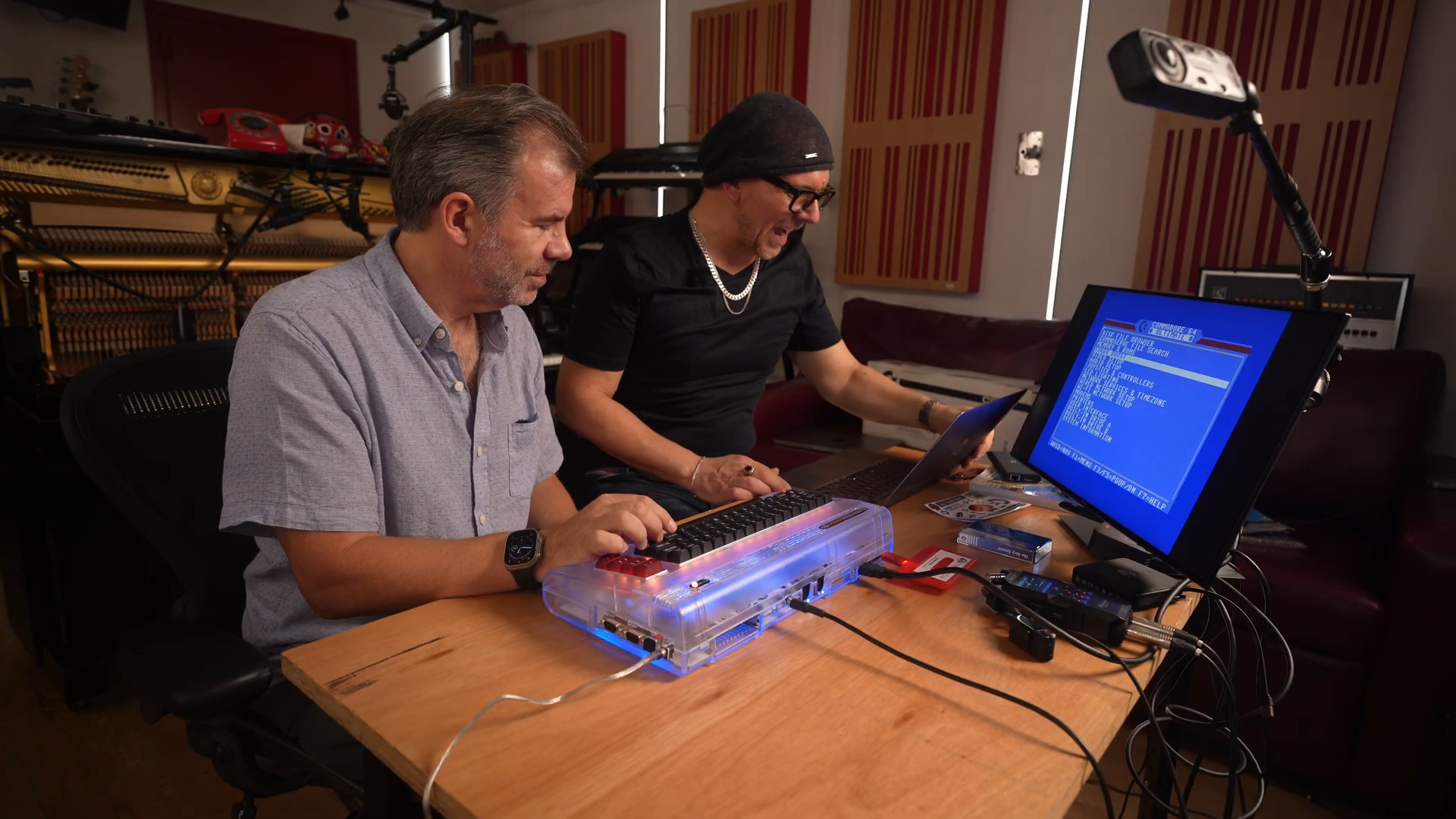
This is actually supposed to be an unboxing. But Doctor Mix soon cares less about the packaging and more about the question of where the drums are hidden in Commando. In his video on the Commodore 64 Ultimate, published on October 30, 2026, he and his guest Chris B. listen to individual voices, examine short bursts of noise, and finally play with dropouts and re-entries. What starts as nostalgic rediscovery quickly turns into a mini remix session. This is exactly where this retro computer becomes exciting for musicians.
Not Just Playback
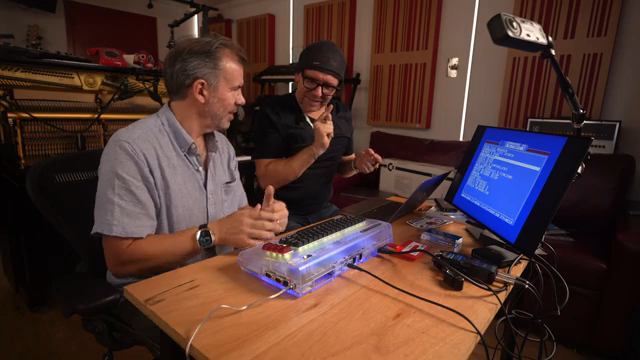
“I also want to be able to isolate each one of them, so you know what I'm going to do? I'm going to ask Claude to write the piece of code, whilst we enjoy more.”
© Screenshot/Quote: Doctor Mix (YouTube)
First, the two rummage through the included music material on USB. Later, the online file search in the music category leads to further finds. The network access is explicitly described in the conversation as a gateway, not as unrestricted internet access. For this afternoon, something more tangible counts anyway: finding music, loading it, and working with it.
Doctor Mix already knows videos about Hubbard’s programming. But he’s interested in the arrangement: how are musical tasks distributed among the three voices, how do drums appear in them? He wants to see waveforms and be able to listen to voices individually. Instead of just wishing, he commissions Claude to write a suitable program.
The Snare Is Right in the Voice
The program, which according to the two was created by Claude, is finally started via the file browser. In the demonstration, it runs, voices can be muted; both celebrate this as a first-try success. More interesting than this AI euphoria, however, is what they work out with it.
When listening to an isolated voice, they describe a snare-like noise component in the attack, immediately followed by the note. So one voice rapidly takes on changing tasks, rather than simply corresponding to an instrument track. Anyone wanting to understand the groove here also has to listen to the small transitions. Doctor Mix doesn’t stay long in analysis: he mutes and unmutes voices until they’re talking about breakdowns and drops. Analytical access becomes musical intervention.
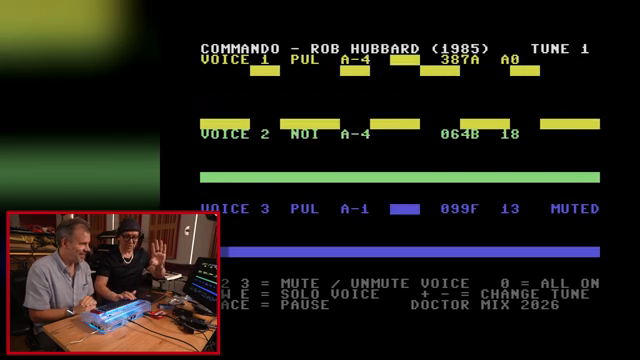
“Here we go. I'm remixing it, man.”
© Screenshot/Quote: Doctor Mix (YouTube)
Twelve Knobs Instead of a Prompt
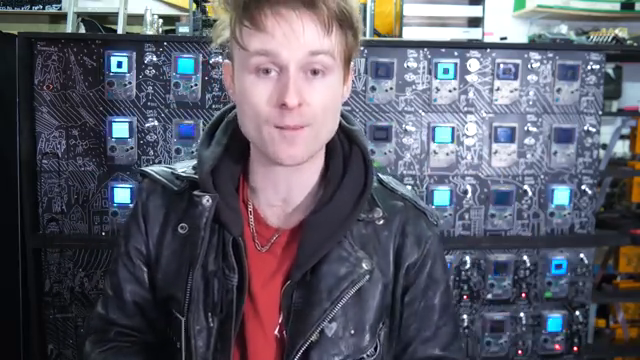
“I took his tutorial code I adjusted it to work with all the control commands inside this little setup and designed a PCB and a panel”
© Screenshot/Quote: LOOK MUM NO COMPUTER (YouTube)
That Doctor Mix prefers to get hands-on with the C64 rather than just admire it has a concrete backstory. In his 2019 Cynthcart Megamod video, LOOK MUM NO COMPUTER builds a control panel for him: Arduino Nano, twelve knobs, and MIDI control commands for the synthesizer software. The basis is a MIDI controller tutorial by Notes and Volts, whose code he adapts.
In the demonstration, he changes pulse width and waveforms, can edit voices two and three separately, and add noise to the third. This is sound design, not analysis of a finished Commando arrangement. Practical access also has its limits: he reports an increasingly noisy filter, the cause of which he cannot determine. According to his own statements, he provides PCB documentation and adapted Arduino code for others to build.
The Studio Builds the Chord
Espen Kraft, in his C64 music video from January 2020, starts from his own song. For the new version of The Golden Boy, he develops bass and drum sounds with the MIDI software referred to as Messiah in the transcript, plays them in, and records them in the DAW. His arpeggiated bass figure doesn’t come from a fundamental love of acid: he needs it for the bridge. First the musical task, then the sound.
For chords, Kraft circumvents the limitation of the mono synthesizer module used by multitrack recording. This is not additional real-time polyphony of the C64, but studio craft: individual lines are combined in the arrangement. Where Doctor Mix makes audible how much happens within a single voice, Kraft lets several recorded voices work together.
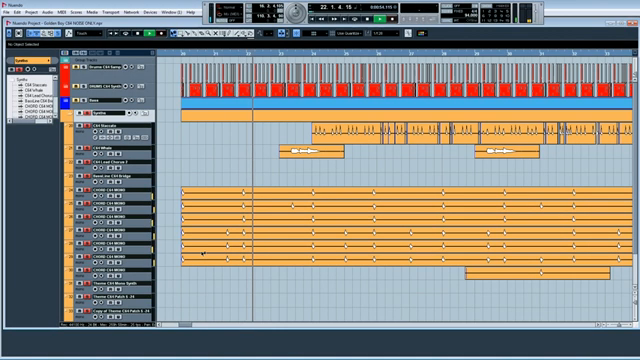
“And I've used the mono synthesizer for this as well, but you can't play chords. So what I've done is I've played each line, the top line, middle line, bottom line and that way made a three chord.”
© Screenshot/Quote: Espen Kraft (YouTube)
The best moment with Doctor Mix is therefore not just the successful program launch. It’s the switch from understanding to playing: one voice is missing, comes back, and suddenly its use matters. Nostalgia provides the occasion. What you make of it musically is still decided by listening.
Videos for this article

All YouTube videos featuring the Commodore 64
Primary – main topic (12)
 The Commodore 64 Is BACK, and It’s Better Than Ever
 A.I. Survival Guide For P****d Off Musicians
 Sonic RETROCAST EP 3 - Ravi Abbott 90s Pirate Radio
 Who is this guy? - Chipsounds Developer Interview
 6 vintage synths I recommend (if you're hell bent on getting one)
 How Portable Is A 40 Year Old "Portable" Music Computer?
 THE ULTIMATE Commodore Educator 64 Music Production Tool???
 Making music with a Commodore 64 is easy | And you don't have to learn programming
Show all (4 more)


Substantial coverage (5)


Mentioned (31)
 Molten Music Monthly August 2026
 Sonic RETROCAST #2 - Anders Enger Jensen
 One Year Later
 I Need to Stop Making Videos.
 Why your DRUMS Sound like SH*T in a MIx!
 My First Synth - Extended Version
 Making Beats with Super Mario
 Sound Design Pt2: Synth Features You Should Know.
Show all (23 more)
 Studio Tour 2022 | 80s Vintage Synthesizers and Gear
 CD Baby BLOCKED my Review! VC333
 Doctor Mix Answers: “What Synthesizer Will You Buy Next?”
 The LAST SMG Viewer's Comments | VC297
 How a ZX Spectrum Game Inspired a Sci-Fi Concept Album!
 Studio Tour & Mega Jam Session
 Talk with Jakob Haq! being nerds, #YouTube and #ios music production.
 1 Hour Challenge: Scoring a Dog Video Using Only TOY SAMPLES
 In Conversation with Bill Pettaway
 THE FUTURE OF MIDI - What's Next in MIDI 2.0? | Presentation by Mike Kent, MIDI Industry Expert
 Home Recording Gear with Nita Strauss & Jen Majura | SpectreSoundStudios
 PAUL'S STORY
 The Singer CAN'T TALK to the AUDIENCE? | Spectre VC
 MUSIC TRACKERS XOR NERDSEQ AND LSDJ
 Rare Interview w PO-32 Creator Magnus Lidström Sonic Charge
 Smg Viewer's Comments #51
 Smg Viewer's Comments #42 - When is a mix finished?
 Sonic TALK 422 - Hartmanns New Synth, 8-bit Roots
 Elite Dangerous - The install from hell!
 Sonic TALK 373
 Elektron from SID to RYTM - A History
 WNAMM13: The Future Of MIDI
 Sweetwater Minute - Vol. 43, Mitch Gallagher Interviewed