Bastl Instruments, known for their inventive and community-driven approach to electronic instrument design, present the Kastle 2 Alchemist—a portable, hybrid-synthesis powerhouse that invites deep exploration. This official video manual, hosted by Wes, walks viewers through the Alchemist’s five synth modes, macro envelope, and a patch bay that encourages hands-on, modular-style play. With features like morphing between engines, expressive arpeggiation, USB MIDI integration, and a companion app for firmware and scale management, the Kastle 2 Alchemist is positioned as a compact but surprisingly deep tool for sound designers and modular tinkerers alike. We dive into the architecture, workflow, and creative potential as demonstrated in the video, highlighting both the instrument’s strengths and the questions that remain for real-world integration.
4. December 2025
LYRA
Bastl Instruments Kastle 2 Alchemist: Hybrid Synthesis, Modular Playfulness and Digital Depth
A Portable Playground for Sonic Exploration
The Bastl Instruments Kastle 2 Alchemist is introduced as a mini modular multi-synth, designed to be both portable and packed with creative potential. Right from the outset, the video emphasizes the Alchemist’s hybrid nature, blending digital synthesis engines with a modular-style patch bay and hands-on controls. The device is described as a tool for discovering new sounds, melodies, and arpeggios, with a macro envelope at its core that shapes everything from timbre to morphing between synth modes.
Bastl’s presentation style is playful yet detailed, reflecting their broader ethos of community-driven, exploratory instrument design. The Alchemist is not just a preset machine; it’s built to encourage experimentation and happy accidents. The video makes it clear that the device is meant to be played with, challenged, and explored, rather than simply programmed and left alone. This sets the tone for a workflow that rewards curiosity and rewards those willing to patch, tweak, and morph their way through its architecture.
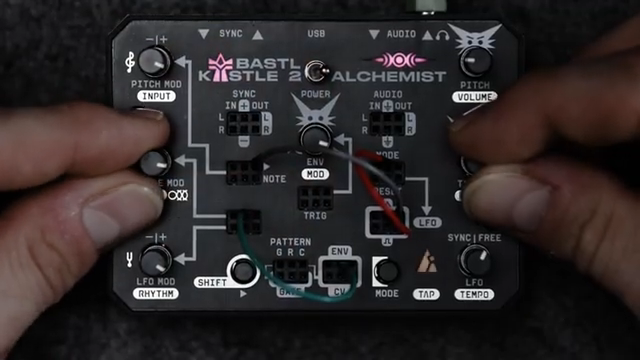
"The Alchemist is really, really meant to, you know, be played with, be discovered and explored."
© Screenshot/Quote: Bastlinstruments (YouTube)
Five Synth Modes: From Filtered Tones to Glitchy Textures
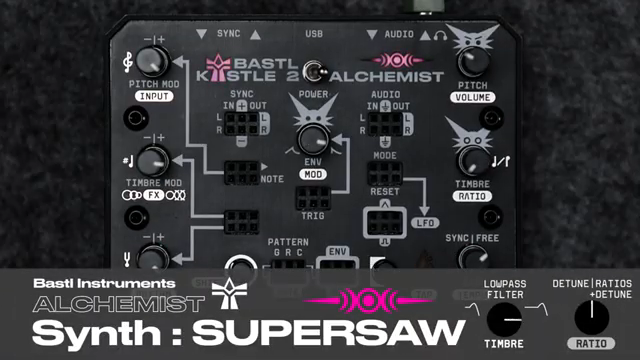
"Moving on to one of my personal favorites, the pink is supersaw."
© Screenshot/Quote: Bastlinstruments (YouTube)
The heart of the Kastle 2 Alchemist lies in its five distinct synth engines: Filter, FM, Supersaw, Hypersine, and Glitch Noise. Each mode brings a unique sonic character and a set of dedicated controls. The Filter mode offers classic subtractive textures, with the timbre knob acting as a filter cutoff and the ratio knob morphing between waveforms and sub-octave stacking. FM mode provides a range from pure sines to metallic, bell-like tones, with the ability to sweep FM amounts and detune or set precise ratios for complex harmonics.
Supersaw mode is highlighted as a personal favorite in the video, delivering lush, detuned stacks with a low-pass filter for taming brightness and ratio controls for dialing in intervals or wild detune. Hypersine mode, inspired by the original Kastle, layers and ring-modulates sine waves for clean or dirty basses, while Glitch Noise mode unleashes unpredictable, noisy chaos—ideal for experimental textures. Across all modes, the macro envelope and modulation options allow for deep sound shaping, and effects like delay, chorus, and distortion are tuned per engine for further character.
Morphing Engines, Expressive Arps, and Creative Control
Beyond its sound engines, the Alchemist stands out with dynamic features that enhance creative workflows. The central envelope knob acts as a macro, not just shaping amplitude but morphing between modes and controlling transient character. In drone mode, users can smoothly transition between synth engines, opening up evolving soundscapes and experimental timbres. The video demonstrates how envelope position influences both the play grid (arpeggiator timing) and the density of melodic patterns.
The arpeggiator itself is highly reactive, generating intervals like thirds, fifths, and octaves above the root, and responding to both modulation and envelope settings. The play input, when patched, creates intricate arpeggios and patterns, while the pattern generator and scale selection tools allow for quantized melodies and harmonic exploration. The new pitch slide feature introduces portamento and pitch envelopes, adding expressive glides and quirky pitch effects—especially effective in modes like Glitch Noise.
Workflow is further enhanced by the ability to stack modulation, randomize or invert sequences, and layer effects. The video repeatedly encourages users to experiment, reassuring that nothing can be broken and that the Alchemist’s architecture is designed for risk-free sonic discovery.
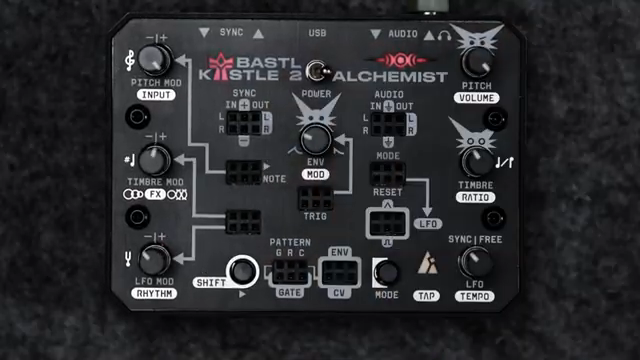
"It's worth noting that morphing drone mode is exclusive to the left side of the knob."
© Screenshot/Quote: Bastlinstruments (YouTube)
USB MIDI and Software Integration: Expanding the Ecosystem
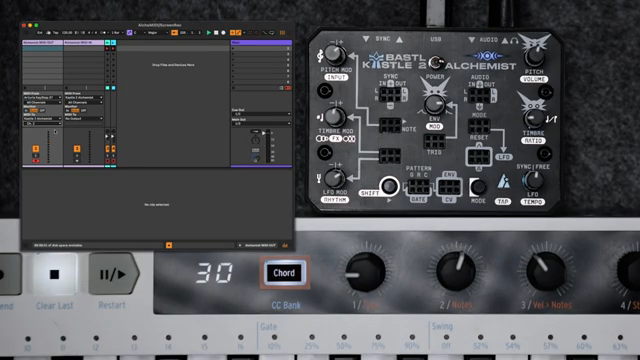
"So that's pretty sick. MIDI learn works pretty well."
© Screenshot/Quote: Bastlinstruments (YouTube)
The Kastle 2 Alchemist’s USB MIDI capabilities open the door to integration with DAWs, controllers, and other hardware. The video demonstrates connecting the Alchemist to a computer (acting as a USB MIDI host) and shows how to set up MIDI channels, use MIDI learn, and assign CCs for real-time control of all major parameters—including shift functions and effects. The device can both send and receive MIDI, making it a flexible node in a hybrid setup.
MIDI integration is not just about note and clock sync; it extends to deep parameter control, with the manual offering a full CC map for advanced users. The video highlights how the mod wheel and keyboard notes can switch synth modes, and how the Alchemist can function as a MIDI controller itself. This positions the device as a bridge between modular-style patching and modern digital workflows, though the video leaves open questions about latency, DAW automation, and long-term reliability in live rigs.
The Alchemist Laboratory App: Customization and Firmware Evolution
A major feature of the Kastle 2 Alchemist ecosystem is the Alchemist Laboratory app, a web-based utility for managing firmware, custom scales, and rhythm patterns. The video walks through the process of creating and editing scales, customizing rhythm grids, and saving configurations as draft files for later use. Once satisfied, users can generate a new firmware file and update the device via drag-and-drop, with the process taking just a few minutes.
The app also supports offline installation for Chrome-based browsers, making it accessible for users who want to tweak their Alchemist without constant internet access. This approach reflects Bastl’s commitment to user-driven customization and ongoing updates, allowing the instrument to evolve with new features or user-contributed content. The workflow for firmware updates is straightforward, though the video recommends consulting the manual for deeper details and hints at future updates and community-driven expansions.
Ultimately, the Alchemist Laboratory app extends the Kastle 2 Alchemist’s flexibility, letting users tailor scales, rhythms, and even firmware to their creative needs. This digital layer complements the hands-on, modular feel of the hardware, creating a hybrid environment where experimentation is both encouraged and supported by evolving software tools.
Watch on YouTube:
Latest articles
Watch on YouTube:
https://www.youtube.com/bastlinstruments
Links from bastlinstruments:
Sponsored links:
If you purchase via these links, we may earn a small commission – at no extra cost to you. The link opens an Amazon keyword search, and results may vary depending on availability.
🔗 Check price on Amazon