The MPC Live III marks Akai Professional’s latest leap into standalone music production, promising a blend of tactile control and deep digital power. In this MPC Academy episode, Akai’s team walks us through the instrument’s navigation, sound access, and a few of its headline features, all with a practical, producer-oriented focus. We get a close look at the new E-pads, RGB step sequencer, and performance tools, plus a taste of how the MPC Live III integrates into modern setups via USB-C. For those curious about how digital architecture meets hands-on workflow, this video offers a structured, no-nonsense introduction to the MPC Live III’s core strengths.

3. October 2025
LYRA
Akai Professional MPC Live III: Navigating the Next-Gen Standalone Workflow
First Impressions: Standalone Power, Streamlined Navigation
Akai Professional positions the MPC Live III as a true standalone production center, emphasizing both intuitive navigation and immediate sound creation. Right from the outset, the video makes clear that this is not just a controller tethered to a computer, but a self-contained instrument designed for hands-on music making. The interface is presented as approachable, with a focus on direct access to key functions and a workflow that encourages exploration.
The introduction sets the tone for a device that wants to be played, not programmed. Akai’s approach here is to minimize friction between the user and their ideas, highlighting the tactile elements and the streamlined menu structure. The MPC Live III is shown as an instrument that invites users to dive in and start creating, rather than getting bogged down in setup or configuration.
Pads, Sequencer, and Capture: The Hardware Heartbeat
The all new MPC E-pads are front and center, offering not just classic finger drumming but also new gestural possibilities—sliding across quadrants for expressive input. The 16 RGB step sequencer is another highlight, providing visual feedback and direct access to sequencing, while the assignable touch strip adds a modern layer of performance control. Users can quickly switch the touch strip between modes like Q-link, pad level, track level, and touch effects, making it a flexible tool for both sound shaping and navigation.
Akai also introduces a built-in microphone, expanding the MPC Live III’s role beyond beatmaking into sound capture and design. Whether it’s vocals, field recordings, or spontaneous sampling, the onboard mic is positioned as a creative enabler. The hardware layout is rounded out by performance buttons, a new matrix mode for clip and row launching, and a robust transport area, all designed to keep the workflow fluid and hands-on.
Under the hood, the MPC Live III boasts an eight-core CPU and 8GB of RAM, supporting up to 32 instrument plugins. Editing tools, banks, and Q-links are all easily accessible, reinforcing the idea that this is a machine built for both depth and immediacy. The hardware tour underscores Akai’s commitment to giving users a comprehensive, performance-ready toolkit.
"We are now introduced with our all new MPC E-pads."
© Screenshot/Quote: Akai Pro (YouTube)
Creative Workflows: Kits, Plugins, and Performance Tools
The video shifts into practical workflow, showing how users can load drum kits, audition sounds, and quickly build beats. The browser is organized into places, content, and expansions, making it straightforward to find and load samples. Auditioning is a one-touch affair, and loading a kit is immediate—no menu diving required. The process is designed to keep the creative flow uninterrupted, with clear visual feedback at every step.
Performance tools like note repeat and the touch strip are demonstrated in context, adding rhythmic complexity and expressive stutters to patterns. Layering is simple: users can add samples, 808s, and plugins in rapid succession, switching between tracks and sound engines with minimal effort. The video highlights the speed of plugin loading, thanks to the expanded RAM, and shows how the touch strip can be reassigned for modulation duties, such as acting as a mod wheel for synth plugins.
Track mutes and performance buttons are integrated into the arrangement workflow, allowing for dynamic live manipulation without sacrificing pad access for finger drumming or melodic input. The overall impression is of a system that prioritizes immediacy, flexibility, and performance, with a digital backbone that keeps up with the demands of modern production.
Integration and Connectivity: USB-C and Beyond
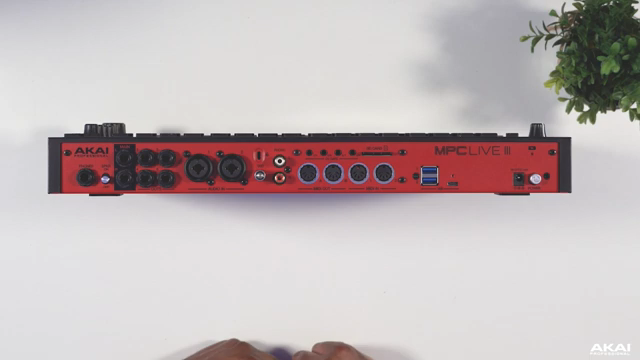
"We can use this to connect to a computer or we can also use the type C port to sample from our smartphones."
© Screenshot/Quote: Akai Pro (YouTube)
Akai makes a point of showcasing the MPC Live III’s connectivity, particularly the USB-C port. This isn’t just about file transfer—the port supports direct connection to computers, sampling from smartphones, and seamless audio routing into DAWs. The device offers up to 24 USB audio outputs and inputs, making it a serious contender for hybrid studio setups.
Beyond USB-C, the hardware includes multiple stereo and mono outputs, combo XLR/quarter-inch inputs, phono for turntables, CV/gate outputs, MIDI, SD card slot, and classic USB-A. The inclusion of a lithium rechargeable battery rounds out the package, reinforcing the MPC Live III’s role as a portable, standalone hub for both studio and DAWless environments.
MPC Academy: A Guided Path to Mastery
The MPC Academy series, as demonstrated in this episode, is structured to empower users to explore the MPC Live III with confidence. By breaking down navigation, sound access, and performance workflows, Akai provides a clear, step-by-step guide for both newcomers and seasoned producers. The focus on practical demonstration ensures that viewers can translate what they see directly into their own creative routines, making the MPC Live III’s deep architecture accessible from day one.
This article is also available in German. Read it here: https://synthmagazin.at/akai-professional-mpc-live-iii-navigation-und-workflow-der-naechsten-generation/
Watch on YouTube:
Latest articles
Watch on YouTube:
Visit the channel:
https://www.youtube.com/Akai_Pro
https://www.youtube.com/Akai_Pro
Links from Akai_Pro:
website: https://akaipro.com
instagram: https://instagram.com/akai_pro
facebook: https://www.facebook.com/AkaiPro
twitter: https://twitter.com/akai_pro
google_plus: https://plus.google.com/107127819149441645522/posts
Sponsored links:
If you purchase via these links, we may earn a small commission – at no extra cost to you. The link opens an Amazon keyword search, and results may vary depending on availability.
MPC Live III
🔗 Check price on Amazon
🔗 Check price on Amazon