WaldorfMusicChannel’s latest deep dive introduces the PROTEIN, a polyphonic wavetable synthesizer that fuses the raw digital DNA of the original Microwave with a contemporary, workflow-driven design. CTO Rolf Wöhrmann walks us through the instrument’s core: eight voices, four layers, and a sound engine that’s unapologetically digital, complete with 8-bit ASIC oscillators and all the classic wavetables. This video isn’t just a nostalgia trip—it’s a technical exploration of how PROTEIN’s architecture, modulation, and performance tools are engineered for today’s producers. If you’re curious about how Waldorf translates its legacy into a modern, affordable package, this is the tutorial to watch.

28. November 2025
LYRA
WaldorfMusicChannel’s PROTEIN: Digital Heritage, Modern Workflow
Digital Roots, Modern Form
PROTEIN is introduced as Waldorf’s new polyphonic wavetable synthesizer, designed to be both affordable and deeply rooted in the company’s digital legacy. The instrument boasts eight voices and four layers, a configuration that immediately signals its ambitions as a versatile, multi-timbral powerhouse. Waldorf’s CTO emphasizes that, while the design is new, the sonic character is a direct homage to the original Microwave, complete with its signature 8-bit ASIC oscillators and classic PPG and Microwave wavetables.
What stands out is the attention to authenticity: the oscillators run at the original 250 kHz sample rate, capturing the aliasing and quantization that defined the Microwave’s aggressive, overtone-rich sound. Waldorf has even modeled the original DACs and unique noise generator, ensuring that the digital artifacts and quirks are preserved. This isn’t just retro branding—the PROTEIN is engineered to deliver the raw, digital edge that made the Microwave a staple of 90s techno and hard bass, but in a compact, modern form factor.
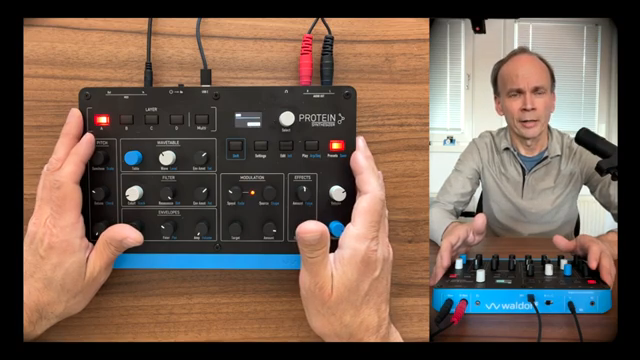
"We are running those oscillators in 250 kHz original sample rate to get all the beautiful dynamics, aliasing and 8-bit quantization of the original."
© Screenshot/Quote: Waldorfmusicchannel (YouTube)
Oscillators, Filters, and Drive: The Digital Arsenal
"That's a drive within the voice. Meaning if I'm playing a chord, I don't get the typical fuzzy distortion."
© Screenshot/Quote: Waldorfmusicchannel (YouTube)
The heart of PROTEIN’s sound engine lies in its dual ASCI oscillators, each capable of loading different wavetables—a notable evolution from the original Microwave’s architecture. Users have access to the full library of classic PPG and Microwave wavetables, and the video demonstrates how these oscillators behave across octaves, revealing the distinctive digital quantization and aliasing that define their character. The ability to independently select wavetables for each oscillator opens up new avenues for complex, layered timbres.
Beyond the oscillators, PROTEIN features a fully digital filter section, diverging from the analog filters of its ancestor. Users can select between low-pass and high-pass modes, and introduce drive at both the per-voice and master levels. The drive implementation is particularly nuanced: per-voice drive adds subtle timbral coloration without the fuzziness of global distortion, while the master drive effect can deliver more aggressive, chord-level saturation. The noise generator is more than just white noise—it includes clicks, Geiger, crackle, and burst modes, all routable through effects and filters for added sonic interest.
Performance Tools: Arpeggiator and Step Sequencer
PROTEIN’s creative workflow is enhanced by a robust arpeggiator and a 32-step sequencer, both inherited from Waldorf’s flagship Quantum and Iridium lines. The arpeggiator offers a range of rhythmic patterns and parameter controls, making it a flexible tool for live performance or generative composition. The video highlights how these features can be used to create evolving, rhythmically complex textures with minimal menu-diving.
The sequencer is equally flexible, supporting step recording and pattern-based rhythm programming. One standout feature is the scale-based sequencing: users can constrain sequences to specific scales, ensuring melodic coherence even when transposing patterns chromatically. Combined with tempo-synced delay and other effects, these tools allow for intricate, layered performances that go far beyond basic step sequencing.
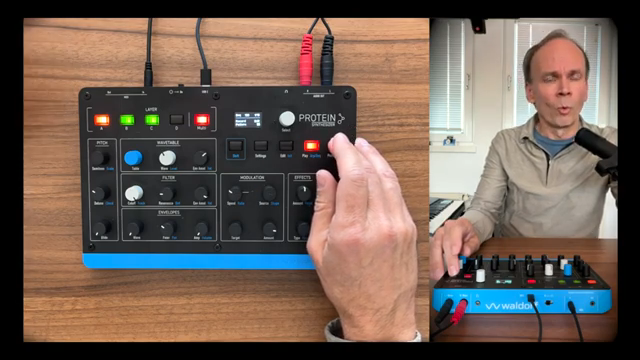
"In the normal mode, whatever key you press would chromatically transpose your sequence. But it can be snapped to a grid."
© Screenshot/Quote: Waldorfmusicchannel (YouTube)
Layers, Modulation, and MIDI Integration
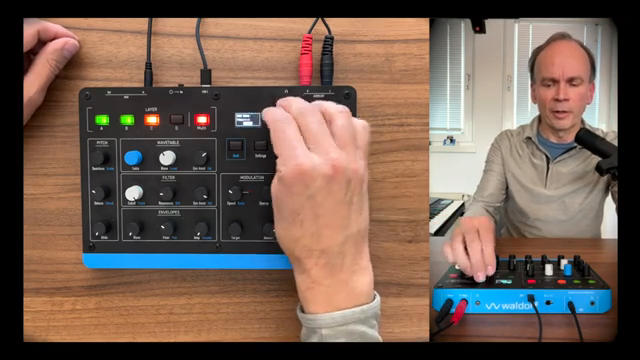
"There's another mode called midi split because some people want to play different timbres from different midi channels running from the sequencer or different controllers or whatever."
© Screenshot/Quote: Waldorfmusicchannel (YouTube)
PROTEIN’s architecture supports four independent layers, each capable of hosting its own sound and effect routing. This multi-layer approach is presented as a modern alternative to the increasingly complex voice architectures found in other synths. Instead of cramming more oscillators and filters into a single voice, PROTEIN encourages users to stack simple voices for sonic complexity, using round robin, random, and MIDI split modes to distribute timbres across the keyboard or MIDI channels.
The modulation matrix offers eight slots, with three envelopes and two LFOs available as sources. Modulation assignments are straightforward, and the matrix supports a wide range of sources—including random, release velocity, and assignable MIDI CCs. MIDI integration is comprehensive: PROTEIN supports MPE, polyphonic aftertouch, and full MIDI CC learn, making it equally at home in DAW-based, hardware, or hybrid setups. Firmware updates are described as quick and painless, a nod to the realities of modern studio workflows.
Effects, Presets, and Immediate Playability
The effects section features two slots, with a suite of algorithms borrowed from the Quantum and Iridium—chorus, flanger, phaser, tremolo, drive, multiband EQ, delay, and reverb. While the number of slots is reduced compared to Waldorf’s flagships, the parameter depth remains, allowing for detailed sound shaping. Each layer can be routed to either effect or bypassed entirely, offering flexible processing chains.
Preset management is designed for immediacy: PROTEIN ships with over 200 factory presets (out of 250 available slots), all of which can be overwritten or used as starting points. Presets can be categorized, filtered, and imported/exported via MIDI SysEx. This focus on instant access and customization means users can dive straight into sound design or performance without wrestling with deep menu systems—a clear strength for both studio and stage use.
This article is also available in German. Read it here: https://synthmagazin.at/waldorfmusicchannel-und-protein-digitale-dna-moderner-workflow/
Watch on YouTube:
Latest articles
Watch on YouTube:
Visit the channel:
https://www.youtube.com/WaldorfMusicChannel
https://www.youtube.com/WaldorfMusicChannel
Links from WaldorfMusicChannel:
website: https://waldorfmusic.com
product_quantum_mk2: https://waldorfmusic.com/quantum-mk2
facebook: https://www.facebook.com/WaldorfMusic
twitter: https://twitter.com/WaldorfGmbH
Sponsored links:
If you purchase via these links, we may earn a small commission – at no extra cost to you. The link opens an Amazon keyword search, and results may vary depending on availability.
Waldorf Protein
🔗 Check price on Amazon
🔗 Check price on Amazon