WaldorfMusicChannel brings the iconic Microwave 1 back to life in software form, and this deep dive is a treat for anyone obsessed with digital synthesis architecture. CTO Rolf Wöhrmann walks us through the plugin’s meticulous emulation of the original hardware, highlighting not just the classic wavetables and their quirks, but also the workflow enhancements that modern producers crave. This isn’t just a nostalgia trip—it’s a forensic look at what makes the Microwave 1’s sound so distinctive, and how those details translate into a DAW-friendly, MIDI-savvy plugin. For anyone who cares about the intersection of vintage digital character and contemporary usability, this video is essential viewing.
23. August 2024
LYRA
WaldorfMusicChannel Revisits a Legend: The Microwave 1 Plugin Deep Dive
A Digital Resurrection: The Microwave 1 Plugin’s Place in Synthesis History
WaldorfMusicChannel’s latest video opens with a clear mission: to reintroduce the legendary Microwave 1 as a plugin, celebrating its pivotal role in the evolution of wavetable synthesis. CTO Rolf Wöhrmann sets the stage by recounting the original hardware’s release 35 years ago—a time when digital synthesis was still finding its feet and DSPs were a distant dream. The Microwave 1 was born out of necessity and innovation, leveraging a custom ASIC chip to deliver a sound that quickly became a favorite among forward-thinking producers of the nineties.
The plugin is positioned not just as a tribute, but as a meticulous recreation. Waldorf’s team spent two years researching, modeling, and reverse-engineering the original’s architecture to ensure that the plugin captures the same sonic idiosyncrasies. This isn’t just another wavetable synth in a crowded market; it’s a deliberate effort to preserve and extend a unique digital voice, now accessible within any modern DAW environment.

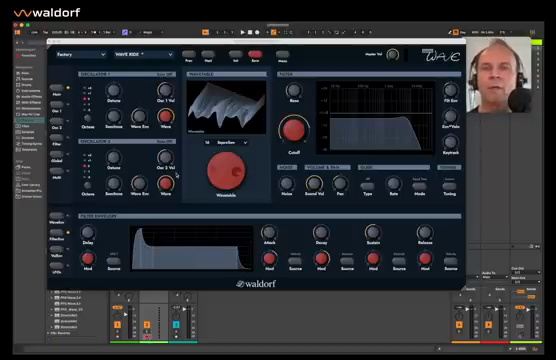
"They always had a very specific sound, a very unique and special sound, and I would like to show a little bit here how it sounds and how it works and what's very special about it and why we need this."
© Screenshot/Quote: Waldorfmusicchannel (YouTube)
Interface, Wavetables, and Hardware Integration: The Core Features
"The plugin can be also used as a controller for the hardware."
© Screenshot/Quote: Waldorfmusicchannel (YouTube)
The plugin’s user interface is laid out with both clarity and depth, mirroring the original’s signal flow while embracing modern usability. At the heart of the UI sits the wavetable display, flanked by dual oscillators, a filter section, and envelope controls—all visually animated to reflect real-time modulation and parameter changes. This design makes it easy to trace how sound evolves, whether you’re tweaking presets or building patches from scratch.
Waldorf has included all the classic factory sounds—singles and multis—directly in the plugin, ensuring instant access to the Microwave’s signature timbres. The plugin also supports hardware control: users can route MIDI from the plugin to an original Microwave 1, effectively turning the software into a hands-on editor and controller. This tight integration is a nod to hybrid workflows, allowing seamless toggling between plugin and hardware for those lucky enough to own both.
Crucially, the plugin doesn’t just look the part—it sounds the part. Waldorf’s engineers reverse-engineered the ASIC chip, matching the 8-bit quantization noise and unique pitch algorithm down to the bit. The internal engine runs at a fixed 250 kHz sample rate, regardless of the DAW’s settings, ensuring the plugin’s sonic character remains true to the original hardware’s quirks and charm.
Multi-Mode: Building Complexity with Eightfold Timbres
One of the Microwave 1 plugin’s standout workflow features is its multi-mode, which allows up to eight independent timbres—or instruments—to be layered, split, or velocity-zoned across the keyboard. This opens up a vast palette for sound design, from massive bass stacks to intricate keyboard splits and evolving pads. Each instrument within a multi can be individually panned, detuned, transposed, and assigned its own key and velocity range, offering a level of control that goes beyond the original hardware’s capabilities.
Waldorf’s implementation makes it easy to combine factory presets or user-created patches, and even clone or copy settings between instruments. The plugin’s multi-mode is not just a technical curiosity—it’s a creative engine for building complex, performance-ready sounds that leverage the Microwave’s digital DNA in ways that feel both classic and contemporary.
Modeling the Magic: Quantization, Envelopes, and the ASIC Bug
A key focus of the video is the plugin’s commitment to faithfully modeling the original Microwave’s unique sound characteristics. Wöhrmann demonstrates how the 8-bit quantization noise, fixed 250 kHz sample rate, and envelope response are all meticulously recreated. The plugin’s envelopes, for example, are modeled after the timing and behavior of the original’s Motorola 68k CPU, capturing the lively, organic feel that made the hardware so musically expressive—even with its technological limitations.
Perhaps most intriguing is the emulation of the infamous ASIC bug, a digital artifact that occurs when oscillator and noise generator signals exceed a certain threshold, resulting in a distinctive wrapping distortion. Rather than smoothing out this flaw, Waldorf embraced it, recognizing that many classic factory sounds rely on its unpredictable, fuzz-like character. The result is a plugin that doesn’t just sound vintage—it behaves vintage, with all the quirks and happy accidents that made the original Microwave a cult favorite.

"This bug is so beautiful, here just a little bit, if I'm going to seven, that's a special sound you want to have."
© Screenshot/Quote: Waldorfmusicchannel (YouTube)
SysEx Import: Bridging Hardware and Software Sound Worlds
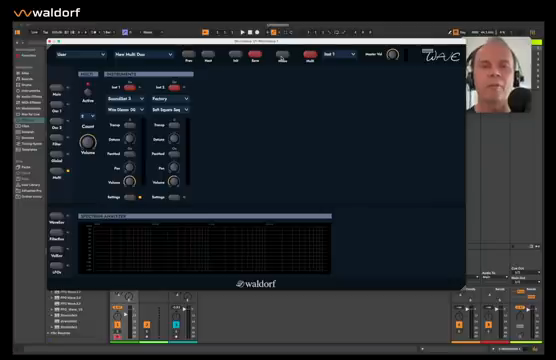
"You can hear from the menu import SysX and MIDI files with program dumps from original hardware, and we'll read them and import them and give you this as user sounds."
© Screenshot/Quote: Waldorfmusicchannel (YouTube)
Waldorf’s attention to workflow doesn’t stop at sound generation. The Microwave 1 plugin supports importing SysEx and MIDI program dumps from the original hardware, making it possible to bring decades of user-created sound banks into the plugin environment. This is a crucial feature for longtime Microwave owners and sound designers who want to migrate their legacy patches without compromise.
The plugin also imports tuning tables and user wavetables, ensuring that even the most idiosyncratic setups are faithfully preserved. This level of compatibility bridges the gap between vintage hardware and modern production, allowing users to continue evolving their sound libraries within today’s DAW-centric workflows.
With a fixed polyphony of eight voices—mirroring the original hardware—and support for all major plugin formats, the Microwave 1 plugin is positioned as both a tribute and a practical tool. Waldorf’s deep dive makes it clear: this is a plugin designed for those who value both sonic authenticity and contemporary flexibility.
This article is also available in German. Read it here: https://synthmagazin.at/waldorfmusicchannel-belebt-eine-legende-neu-der-microwave-1-plugin-deep-dive/
Watch on YouTube:
Latest articles
Watch on YouTube:
Visit the channel:
https://www.youtube.com/WaldorfMusicChannel
https://www.youtube.com/WaldorfMusicChannel
Links from WaldorfMusicChannel:
website: https://waldorfmusic.com
product_quantum_mk2: https://waldorfmusic.com/quantum-mk2
facebook: https://www.facebook.com/WaldorfMusic
twitter: https://twitter.com/WaldorfGmbH
Sponsored links:
If you purchase via these links, we may earn a small commission – at no extra cost to you. The link opens an Amazon keyword search, and results may vary depending on availability.
Microwave 1 Plugin
🔗 Check price on Amazon
🔗 Check price on Amazon
Waldorf Microwave 1 (Hardware)
🔗 Check price on Amazon
🔗 Check price on Amazon