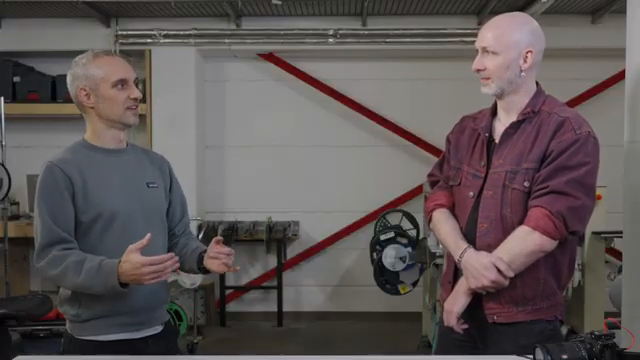
Ever wondered what it’s like to improvise techno live, wrangling a modular rig that’s as unpredictable as a Melbourne weather forecast? The crew at Underdog Electronic Music School dropped in on Mark Verbos at his Berlin workshop, and what followed was a wild ride through the art of live patching, performance philosophy, and the kind of gear that makes you want to chuck your setlist in the bin. Mark’s approach is all about freedom, happy accidents, and building instruments that let you ride the chaos like a kangaroo on a Red Bull bender. If you’re keen for stories, sound demos, and a peek into the mind of a true modular maverick, this one’s for you.
24. February 2026
TAS
Underdog Electronic Music School: Modular Mayhem with Mark Verbos – Improvising Techno Like an Outback Storm
Verbos Electronics Bark Filter, Verbos Electronics Harmonic Oscillator, Verbos Electronics Voltage Multistage
Patching Live: No Guts, No Glory
Mark Verbos doesn’t just talk about improvisation—he lives it, mate. Right from the get-go, he smashes the myth that live patching is some kind of high-wire act for synth daredevils. According to Mark, once you know what your parameters are up to, patching live is no riskier than flipping a switch on your old faithful. It’s all about creating an infinite modulation playground, where everything can talk to everything else—no menus, no faffing about, just pure connection.
Instead of seeing modular as intimidating, Mark reckons it’s a neutral canvas that lets you do whatever the heck you want. Forget digging through digital menus or getting lost in preset jungles; here, you just plug what you want, where you want, and let the magic happen. That’s the kind of freedom that gets your creative juices flowing faster than a busted keg at a bush doof.
"It's really a means of allowing everything to be connected to everything else."
© Screenshot/Quote: Oscarunderdog (YouTube)
From 1992 to Now: Evolution of a Techno Tinkerer
"The more that I was trapped into like planning ahead, then the more limited I was going to be in what changes or like how I could be inspired in the moment."
© Screenshot/Quote: Oscarunderdog (YouTube)
Mark’s journey started back in 1992, when live techno meant wrangling whatever gear you could afford as a teenager—think Ensoniq ES-Q1, Alesis MMT-8, and a dodgy HR-16 drum machine. No internet, no YouTube tutorials, just magazine scraps and word-of-mouth from older DJs. It was all about the interface and workflow, not whether something was analog or digital. If it inspired you, it was good enough to hit the stage.
Over the years, Mark’s setup morphed from basic hardware to samplers and eventually to modular, always chasing that elusive blank slate. The less he planned ahead, the more room he had for inspiration to strike mid-set. He wanted gear that let him show up with nothing prepared and still pull off a set that could blow the roof off. That’s the spirit that’s driven his designs ever since—tools that encourage you to dive in headfirst and see where the night takes you.
Buchla Vibes and Interface Obsession
If you reckon Mark’s modules look a bit Buchla-ish, you’re not wrong—but don’t go calling them clones, mate. Mark’s design philosophy is a wild cocktail of Buchla’s interface-driven approach, classic techno boxes, and a healthy disrespect for the whole East Coast vs West Coast synth debate. For him, it’s all about having everything on the panel—knobs, switches, or jacks—so you’re never stuck in menu hell or staring at a patch that doesn’t match your knobs.
He’s obsessed with making instruments that respond like traditional ones: you tweak, you hear, you react, just like a violinist fixing a flat note on the fly. The lineage is there—red Rogan knobs and all—but Mark’s modules are about empowering performers to express ideas, not just chase happy accidents. There’s a poetic side to his engineering, blending history with workflow so you can improvise, collaborate, and get inspired without feeling like you’re wrestling a croc in a bathtub.
"It's a common misconception that you don't have to learn how to play an electronic instrument."
© Screenshot/Quote: Oscarunderdog (YouTube)
Sequencers, Harmonics, and the 10-Step Curveball
"There's something cool about the fact that it's an unexpected number."
© Screenshot/Quote: Oscarunderdog (YouTube)
Now, let’s talk gear that’ll make your head spin. Mark’s Voltage Multistage sequencer is a beast—originally eight steps, now stretched to a cheeky ten, just to keep you on your toes. Why ten? Because it’s memorable, a nod to his early DIY days, and it shakes up the usual 8/16 groove rut. With stage select gate inputs and analog addressing, you can jump, loop, and mash up sequences in ways that’d make a kangaroo dizzy.
Then there’s the Harmonic Oscillator, a module that takes additive synthesis and makes it as dynamic as an outback thunderstorm. Eight harmonics, sine wave blending, and envelope-driven morphing give you everything from organ tones to clipped, crunchy madness. And don’t get me started on percussion—Mark’s approach means you can whip up metallic noise, noise sweeps, and nuanced drum sounds that’ll sit right alongside your trusty 909. It’s all about flexibility and breaking out of the usual patterns, so you can bring the chaos and keep the dancefloor guessing.
Sound Demos: You’ve Gotta Hear It to Believe It
Look, I could bang on all day about Mark’s modules and philosophy, but the real proof’s in the pudding—or in this case, the sound. The video is packed with juicy demos, from drones that’ll rattle your windows to percussion tricks that’ll have you itching to patch up your own mayhem. If you want to feel the full impact of these wild machines, you’ve got to watch and listen for yourself. Trust me, some things just can’t be bottled up in words—this is one of those times.
This article is also available in German. Read it here: https://synthmagazin.at/underdog-electronic-music-school-modularer-wahnsinn-mit-mark-verbos-improvisiertes-techno-wie-ein-outback-sturm/
Watch on YouTube:
Latest articles
Watch on YouTube:
Visit the channel:
https://www.youtube.com/OscarUnderdog
https://www.youtube.com/OscarUnderdog
Links from OscarUnderdog:
underdog.brussels: https://underdog.brussels
Underdog instagram: https://instagram.com/oscarunderdog
Underdog facebook: https://facebook.com/underdogbrussels
Sponsored links:
If you purchase via these links, we may earn a small commission – at no extra cost to you. The link opens an Amazon keyword search, and results may vary depending on availability.
Verbos Electronics Bark Filter
🔗 Check price on Amazon
🔗 Check price on Amazon
Verbos Electronics Harmonic Oscillator
🔗 Check price on Amazon
🔗 Check price on Amazon
Verbos Electronics Voltage Multistage
🔗 Check price on Amazon
🔗 Check price on Amazon