In this Halloween-themed Patchwork episode, UDO Audio enlists Hazel Mills to dissect and recreate two of the most iconic synth sounds from Michael Jackson’s ‘Thriller’—all on the Super 8. True to UDO’s hands-on ethos, the video is less about slavish imitation and more about understanding the sound design DNA behind those legendary pads and basses. From detuned saws to expressive filter sweeps, Hazel demonstrates how the Super 8’s hybrid engine can channel vintage character with modern flexibility. For synth nerds and patchers alike, it’s a revealing look at how classic tones are built from the ground up on contemporary hardware.
31. October 2025
MILES
UDO Audio’s Super 8: Synthesising Thriller’s Spirit for Halloween
A Halloween Homage: Thriller Reimagined on the Super 8
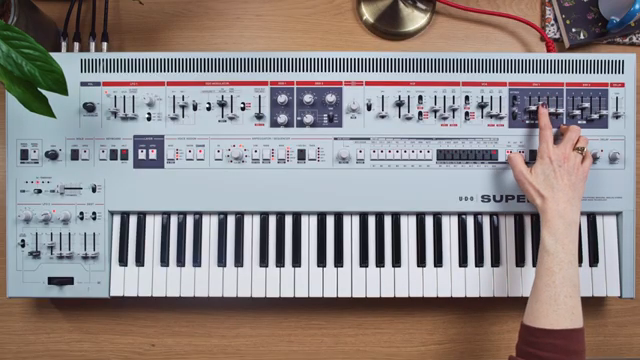
UDO Audio’s latest Patchwork episode lands just in time for Halloween, with Hazel Mills taking the Super 8 for a spin through the spectral soundscape of Michael Jackson’s ‘Thriller’. Rather than attempting a full song reconstruction, the focus is on capturing the essence of two pivotal synth sounds: the lush pad and the driving bass. This approach fits UDO’s philosophy of play and immediacy, inviting viewers to explore the architecture of classic pop timbres rather than simply copying presets.

"This song is chock full of synth sounds so I'm not going to cover all of them but I have picked two that I think might go well together."
© Screenshot/Quote: Udo Audio (YouTube)
Crafting the Pad: Detune, Filter, and Vintage Flavour
"It's kind of like a Juno-y sound really. It might be a Juno."
© Screenshot/Quote: Udo Audio (YouTube)
Hazel begins with an initialized patch, quickly identifying the pad’s sawtooth foundation—likely two oscillators, gently detuned for width. The Super 8’s filter cutoff is dialed back for a softer, more subdued tone, while envelope modulation is used to open the filter subtly, mimicking the movement found in the original track. The sound is further shaped with a touch of release, ensuring smooth note transitions and avoiding abrupt cutoffs.
To evoke that unmistakable ‘Juno-y’ vibe, Hazel introduces a chorus effect, which adds depth and a hint of shimmer, reminiscent of the classic Roland chorus circuits. The oscillators are detuned slightly more to emulate the quirks of vintage analog gear, and a dash of pitch modulation is applied to both oscillators, imparting a gentle instability that makes the pad feel authentically aged. Notably, resonance is kept minimal, and some low end is trimmed to keep the pad from muddying the mix.
Building the Bass: Envelope Punch and Filter Character
Switching to the bass, Hazel again starts from scratch, opting for a sawtooth wave—this time likely just one oscillator, possibly with an octave layered in for extra weight. The filter is set much more closed than on the pad, and the sound is intentionally short and punchy, with the envelope used to open the filter quickly and then snap it shut. This creates the percussive, driving quality that anchors the groove in ‘Thriller’.
Resonance is dialed in just enough to add bite without making the sound too peaky or aggressive. The key is balancing how much the envelope opens the filter versus the filter’s base position, a subtle interplay that defines the bass’s character. Hazel’s walkthrough highlights the importance of envelope timing and filter settings in nailing the original’s vibe, all within the Super 8’s immediate, hands-on interface.

"It's getting the balance between how much the envelope is opening the filter and how much the filter is open in the first place."
© Screenshot/Quote: Udo Audio (YouTube)
Performance Tools: Expression Pedal Dynamics and Sectional Contrast

"I've set it to open the filter a little bit because I think the verse is more closed and it opens up more for the chorus."
© Screenshot/Quote: Udo Audio (YouTube)
To add dynamic movement between song sections, Hazel plugs in an expression pedal and assigns it to the filter cutoff. This allows her to manually open the filter during the chorus, giving the pad more presence and energy, while keeping it subdued in the verse. It’s a simple but effective way to inject performance nuance—something that’s often overlooked in static recreations.
Hazel points out that, while the pad isn’t the main synth in the chorus, it does open up to support the arrangement, demonstrating how real-time control can transform a patch’s role in a mix. This workflow, combining the Super 8’s tactile controls with external pedals, exemplifies UDO’s commitment to playability and expressive sound design.
This article is also available in German. Read it here: https://synthmagazin.at/udo-audio-super-8-thriller-sounds-zum-leben-erweckt/
Watch on YouTube:
Latest articles
Watch on YouTube:
Visit the channel:
https://www.youtube.com/udo_audio
https://www.youtube.com/udo_audio
Links from udo_audio:
website: https://www.udo-audio.com
instagram: https://www.instagram.com/udo_audio
Sponsored links:
If you purchase via these links, we may earn a small commission – at no extra cost to you. The link opens an Amazon keyword search, and results may vary depending on availability.
UDO Super 8
🔗 Check price on Amazon
🔗 Check price on Amazon