Make Noise returns to their signature world of spectral experimentation, this time delving into the ReSynthesizer’s knack for rhythmic invention. In this official walkthrough, the channel demonstrates how the Spectraphon module can inscribe, recall, and manipulate rhythmic arrays—transforming simple pulses into evolving, ratcheting textures. With a focus on modulation, memory, and hands-on control, the video offers a patch-oriented look at how spectral tools can reshape sequencing and performance. If you’re curious about how spectral arrays and modulation curves can unlock new rhythmic possibilities in a Eurorack setup, this is a deep dive worth your attention.
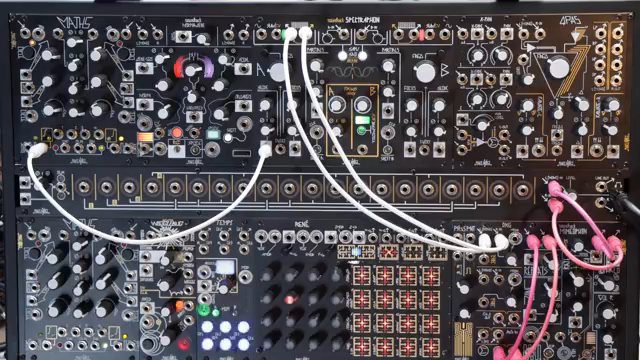
Spectral Memory: The ReSynthesizer’s Rhythmic Canvas
The video opens with a nod to the ReSynthesizer’s unique ability to store and recall sonic memories, setting the stage for a patching approach that’s as much about inscription as it is about playback. Make Noise’s Spectraphon module is at the heart of this, acting as both a recorder and performer of spectral arrays. Unlike traditional step sequencers or sample players, the ReSynthesizer captures traces of motion—allowing users to revisit and manipulate past gestures as if recalling a dream.
This memory-centric workflow is demonstrated by feeding a simple, clocked rhythm into the module and then recording it as an array. The approach is less about static playback and more about creating a living, breathing rhythmic foundation that can be modulated and reinterpreted. The result is a system that blurs the line between memory and improvisation, inviting users to treat rhythm as a malleable spectral object.

"Yes, it's a machine with only a fleeting ability to store up the experiences which you and I take for granted."
© Screenshot/Quote: Maken0Isemusic (YouTube)
Modulation in Motion: Slide, Curves and the Ratchet Effect
"We can hear how this changes the simple rhythm that we've inscribed, imposing a curve on it, stretching and squeezing its temporal capacity."
© Screenshot/Quote: Maken0Isemusic (YouTube)
Once the array is inscribed, the video shifts focus to the ways modulation can reshape its playback. By using a Maths-generated ramp to scan through the array, the patch repeats the original rhythm, but the real magic comes when the ramp’s characteristics are altered. Slowing the ramp down or changing its curve from linear to logarithmic or exponential introduces new temporal dynamics, stretching and squeezing the rhythm in expressive ways.
The slide control on Spectraphon is highlighted as a key tool for setting the start point and range of the rhythmic motion. This hands-on parameter allows for precise sculpting of how the inscribed rhythm is traversed, making it possible to evoke classic ratcheting effects without relying on traditional pulse-based VCA tricks. Instead, the ratcheting is embedded within the spectral playback itself, offering a new take on a familiar sequencing technique.
Throughout this section, the demonstration underscores how modulation sources—be they ramps, curves, or manual tweaks—can dramatically transform the feel and complexity of even the simplest rhythmic material. The interplay between array memory and modulation opens up a playground for evolving, non-repetitive patterns.
Sequencing and Expressive Control: Inscribing and Triggering Rhythms
With the rhythmic array established, the workflow pivots to sequencing and performance techniques. By integrating Rene as a sequencer, the patch gains dynamic control over when and how the rhythm is triggered. Instead of relying on continuous cycling, gates from Rene are used to initiate the playback of the inscribed rhythm, allowing for precise placement within a larger musical context.
This method of triggering—paired with the ability to modulate playback speed and shape—turns the ReSynthesizer into a performance instrument rather than a static player. The video demonstrates how each gate event can launch a burst of ratcheted notes, with the character of each burst shaped by modulation and control voltage. This approach blurs the boundaries between sequencing, ratcheting, and live manipulation, making the system highly expressive for real-time use.
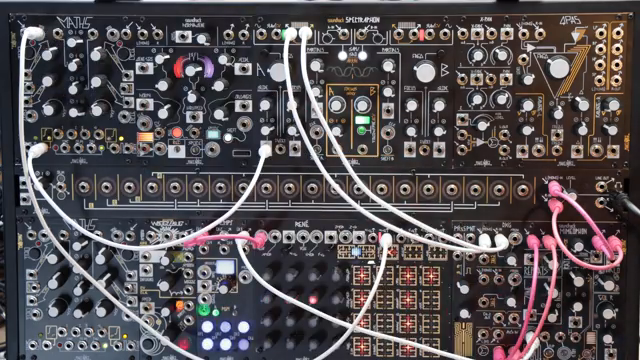
"With each gate we send, we initiate that simple rhythm."
© Screenshot/Quote: Maken0Isemusic (YouTube)
Complex Interactions: Dual Arrays and Evolving Textures
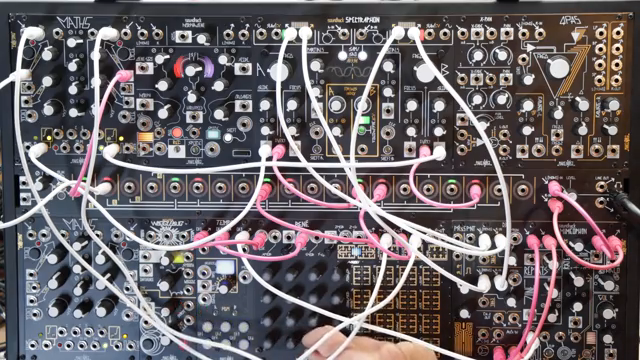
"Now, whenever side A goes higher in pitch, side B ratchets more slowly, and vice versa."
© Screenshot/Quote: Maken0Isemusic (YouTube)
The final part of the walkthrough explores the potential for even more intricate sonic interplay by introducing a second array on the Spectraphon. By duplicating the patch on both sides of the module and cross-patching modulation sources, the system creates evolving relationships between pitch, ratcheting speed, and rhythmic phrasing. For instance, when side A’s pitch increases, side B’s ratcheting slows down, and vice versa, resulting in a constantly shifting texture.
Further complexity is added by adjusting the number of access-enabled locations per channel, which changes the available steps and juxtapositions in real time. The demonstration concludes with the addition of a bass line, highlighting how these spectral ratcheting techniques can underpin more traditional musical elements. The overall effect is a patch that feels alive, with multiple layers of modulation and memory interacting to produce ever-changing soundscapes.
This article is also available in German. Read it here: https://synthmagazin.at/spektrales-ratcheting-und-rhythmische-erinnerung-make-noises-resynthesizer-im-einsatz/
Watch on YouTube:
Latest articles
Watch on YouTube:
Visit the channel:
https://www.youtube.com/MAKEN0ISEMUSIC
https://www.youtube.com/MAKEN0ISEMUSIC
Links from MAKEN0ISEMUSIC:
website: https://www.makenoisemusic.com
instagram: https://www.instagram.com/makenoisemusic
twitter: https://twitter.com/makenoisemusic
facebook: https://www.facebook.com/makenoiseco
Sponsored links:
If you purchase via these links, we may earn a small commission – at no extra cost to you. The link opens an Amazon keyword search, and results may vary depending on availability.
Maths
🔗 Check price on Amazon
🔗 Check price on Amazon
Q-PAS
🔗 Check price on Amazon
🔗 Check price on Amazon
René
🔗 Check price on Amazon
🔗 Check price on Amazon
Spectraphon
🔗 Check price on Amazon
🔗 Check price on Amazon
Wogglebug
🔗 Check price on Amazon
🔗 Check price on Amazon