SequencerTalk invites us to a machine whisper: In an exclusive interview with Waldorf CEO Rolf Wöhrmann, the new Protein synthesizer is dissected. Inspired by the legendary Microwave 1, its sound folds like origami from tension and noise—all in a compact, surprisingly affordable case. Four layers, a Flavor knob, and a modulation matrix challenge both chaos aesthetes and workflow fetishists. If you want to know how much Westcoast spirit lives in a German wavetable, this interview is not to be missed. The details? They’re better heard in the video than read here.
28. November 2025
RAUMKLANG
SequencerTalk Deconstructs the Waldorf Protein: Wavetable Origami in Miniature
Wavetable Origami: Protein as Microwave-1 Echo
The Waldorf Protein is introduced as a wavetable synthesizer that unmistakably draws inspiration from the classic Microwave 1, yet is far from being a mere clone. The developers emphasize that this is an independent evolution, capturing the essence of its legendary predecessor and reinterpreting it with contemporary technology. The focus is on the characteristic, lively core sound, achieved through targeted micro-variations and the instrument’s unique architecture.
The idea behind the Protein is to transfer the spirit of the Microwave 1 into a modern, compact format while preserving both sonic depth and usability. Waldorf dares to balance tradition and innovation: the oscillator engine is inspired by the quirks of the first-generation ASIC chip, while features like the modulation matrix and effects bring it into 2024. Anyone searching for the subtly rasping, breathing sound of the old Waldorf era will find it here—but not without new surprises.
Quadruple Nested: Layer Architecture and Polytimbrality
With its four-layer architecture, the Protein opens up new patch geometries: each layer can act independently, be stacked, or played polytimbrally. This means complex soundscapes can be created by extracting, combining, and further processing individual layers from existing presets. The ability to switch between four sounds per preset without having to load a new one is a blessing for performative flexibility.
The layers are not just a gimmick but a central tool for creative sound architecture. Whether round-robin playing, stacking, or targeted remixing of layers—the workflow invites you to transcend familiar boundaries. The logic recalls the multis of the Microwave 1, but in the Protein, it’s more accessible and faster to handle. Anyone craving patch polyphony and sound stacking will find a playground for the unpredictable here.
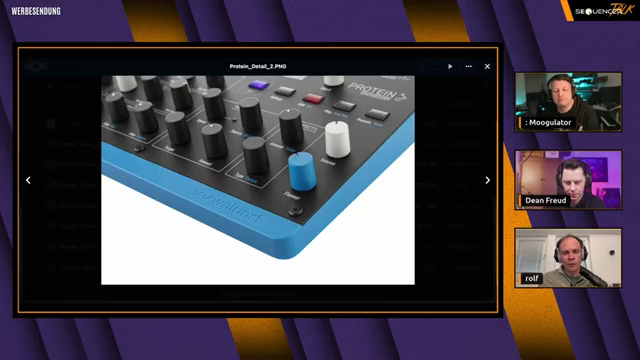
"I can do a whole lot with it."
("Ich kann da also eine ganze Menge mit anstellen.")© Screenshot/Quote: Sequencertalk (YouTube)
Flavor, Matrix, and Dirt: Machine Ethics in Sound Design
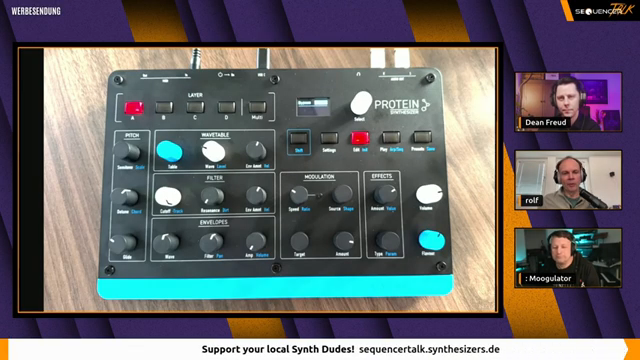
"This Flavor knob dials in such micro-variations and they relate to different parameters here."
("Dieser Flavor Knopf dreht solche Microwariations rein und die beziehen sich hier auf verschiedene Parameter.")© Screenshot/Quote: Sequencertalk (YouTube)
The Flavor knob is more than a vintage button: it injects targeted micro-variations into wavetable, filter, and tuning, inspired by the imperfect charm of the Microwave 1. This subtle instability brings organic liveliness and sets the Protein apart from sterile digital synths. The intensity can be saved per preset, so every sound gets its own dose of machine chaos.
Added to this is a modulation matrix with eight slots, linking poly aftertouch, MPE, and classic sources. Exotic parameters are accessible via menus—a compromise that challenges both nerds and pragmatists. The Dirt function expands the spectrum with various noise and drive types, from Geiger clicks to filter drive. Anyone wanting to dive deeper into these patch depths should watch the video: the nuances of Flavor and Dirt are hard to capture in words.
Price, Practice, and Target Audience: Protein for Everyone?
With an introductory price of 329 euros, the Protein positions itself as a gateway to the Waldorf world—not because it’s simple, but because it’s financially accessible. The compact case is portable, and despite many functions, operation remains surprisingly direct. Shift functions and a clever panel layout ensure that both beginners and experienced sound designers get their money’s worth.
The feature density is remarkable: two oscillators per layer, filter, effects, mod matrix, step sequencer, arpeggiator, and MPE support. The compromises—like menu diving for exotic parameters—are well considered and leave room for future updates. Those with patience and an ear for the unpredictable will be rewarded with astonishing sonic variety. For workflow fetishists, it’s a dream of chaos aesthetics.
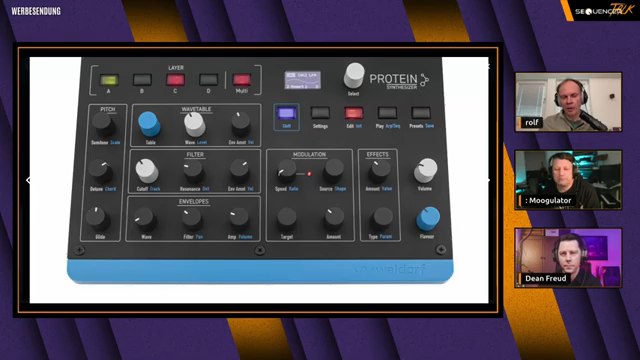
"It's a pretty good mix between still being easy to understand and operate."
("Es ist eine ganz gute Mischung zwischen, der ist noch einfach zu verstehen und zu bedienen.")© Screenshot/Quote: Sequencertalk (YouTube)
Behind the Circuit Board: Development and Future Outlook with Rolf Wöhrmann
"The Blofeld is basically the hardware incarnation of this whole DSP line I mentioned."
("Der Blowfeld ist quasi die Hardware-Inkarnation von dieser ganzen DSP-Schiene, die ich erwähnte.")© Screenshot/Quote: Sequencertalk (YouTube)
The interview with Rolf Wöhrmann provides deep insights into the creation of the Protein and the philosophy behind it. Waldorf is deliberately launching a new small-format series, featuring different devices in changing case colors. The platform is designed so that more instruments—from drum machines to effects—can follow, provided the market allows.
Wöhrmann emphasizes that the Protein is not a replacement for the Blofeld, but a sonic alternative with its own character. Development is oriented towards the needs of musicians and sound designers, with community feedback actively incorporated. Anyone wanting to know how much heart and machine ethics are in this device should not miss the full conversation—some details can only be truly grasped in the original tone and with sound examples.
Translated from German. Read the original here: https://synthmagazin.at/sequencertalk-dekonstruiert-den-waldorf-protein-wavetable-origami-im-mini-format/
Watch on YouTube:
Watch on YouTube:
Visit the channel:
https://www.youtube.com/SequencerTalk
https://www.youtube.com/SequencerTalk
Links from SequencerTalk:
SequencerTalk Supporte uns!: https://sequencertalk.synthesizers.de
Instagram: https://instagram.com/sequencertalk
Links Moogulator: https://linktr.ee/moogulator
Links Dean: https://linktr.ee/deanfreud
Impressum: https://moogulator.com/moogulator/about
Sponsored links:
If you purchase via these links, we may earn a small commission – at no extra cost to you. The link opens an Amazon keyword search, and results may vary depending on availability.
Waldorf Protein
🔗 Check price on Amazon
🔗 Check price on Amazon