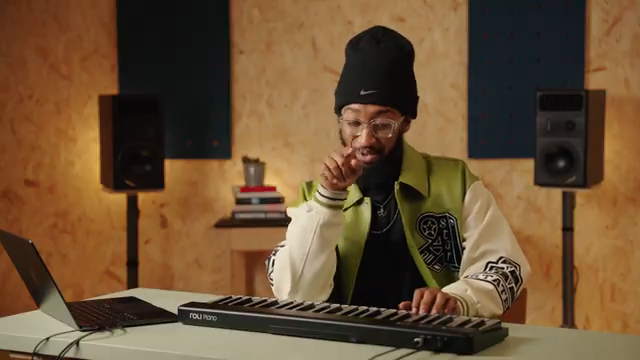
What happens when you hand a chart-topping synth-pop anthem to a jazz-minded multi-instrumentalist and equip them with ROLI’s latest expressive tools? In this official ROLI Studios session, Rashaan Brown takes on the challenge of transforming Chappell Roan’s ‘Pink Pony Club’ into a lush, emotive jazz slow jam. The video is a showcase for the ROLI Piano and Airwave, highlighting not just their sonic palette but their workflow flexibility and real-time performance depth. If you’re curious about how digital instruments can reshape genre boundaries and what ROLI’s “5D touch” really brings to the table, this is a session worth dissecting.
23. January 2026
LYRA
ROLI’s Expressive Arsenal: Jazz Reimagining with Piano and Airwave
From Pop Anthem to Jazz Canvas: The ROLI Approach
The video opens with Rashaan Brown, a South London multi-instrumentalist, stepping into ROLI Studios to tackle a bold genre flip: turning Chappell Roan’s ‘Pink Pony Club’ from synth-pop into a jazz-infused track. ROLI’s signature instruments, the ROLI Piano and Airwave, are front and center, setting the stage for a demonstration of their expressive and adaptive capabilities. The session is framed as both a technical challenge and a creative playground, with ROLI’s tools acting as enablers for musical reinvention.
What stands out immediately is the seamless way Rashaan identifies the core tonal center of the song, focusing on the tonic note and chord structure. This analytical approach is a testament to the workflow-oriented design of ROLI’s instruments, which allow quick adaptation and exploration. The video’s early moments set up not just a cover, but a re-composition, leveraging the flexibility of digital sound engines and performance surfaces to move fluidly between genres.
Reharmonization: Chords with a Jazz Twist
A key focus of the session is the reharmonization of the original pop progression. Rashaan breaks down the process, moving from the straightforward, blocky chords typical of pop into richer, more complex jazz voicings. He explains how jazz musicians often add extensions and color tones, making the harmony more extravagant and nuanced compared to the major/minor simplicity of the source material.
This transformation is not just theoretical—Rashaan demonstrates it in real time, accidentally landing on a reharm that introduces a flattened seventh, a move more common in neo-soul and R&B but equally at home in jazz. The video highlights how the ROLI Piano’s interface supports this kind of harmonic exploration, encouraging experimentation and quick iteration without menu-diving or technical friction.
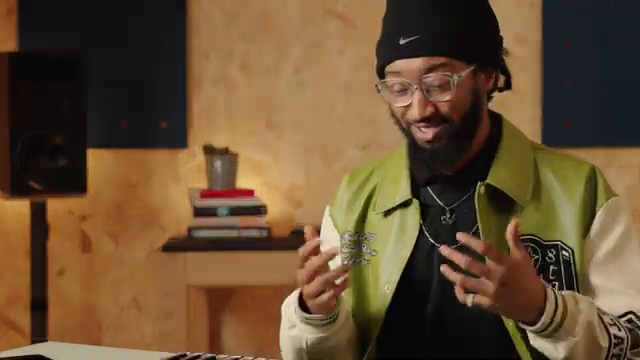
"In pop, the elements are usually very major, very minor block chords, no extensions of those chords."
© Screenshot/Quote: Weareroli (YouTube)
Layering, Bass, and the Airwave Solo: Creative Workflows in Action
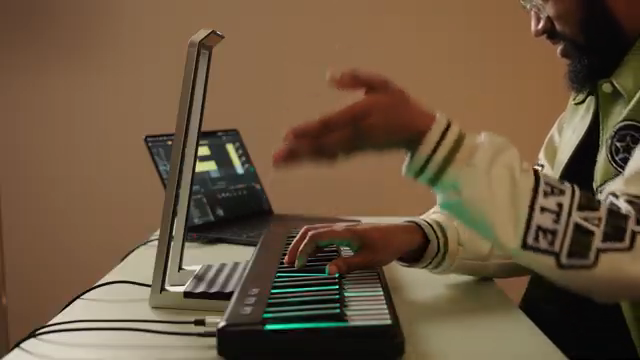
"Really cool mix between modulation, pitch bends, glides."
© Screenshot/Quote: Weareroli (YouTube)
With the new chord structure in place, Rashaan moves to recording layers, starting with a bass part that adds depth and groove to the arrangement. The workflow here is fluid—recording, reviewing, and stacking parts with minimal interruption, a nod to the integrated nature of ROLI’s hardware and software ecosystem. The ability to quickly switch roles (from keys to bass to soloist) is a clear advantage for musicians who value momentum in the creative process.
The introduction of the Airwave marks a pivot to expressive soloing. Rashaan highlights the instrument’s blend of modulation, pitch bends, glides, and filtering, all accessible through its touch-responsive interface. This section is where ROLI’s “5D touch” philosophy comes alive, as the Airwave’s surface translates nuanced gestures into dynamic, evolving sound. The workflow supports spontaneous improvisation, with Rashaan able to shape phrases in real time without being boxed in by traditional keyboard mechanics.
Throughout, the layering process is both musical and architectural: each new element is considered for its emotional and textural contribution. The video subtly demonstrates how ROLI’s instruments facilitate this kind of additive, exploratory workflow, making them well-suited for both studio experimentation and live performance contexts.
Performance Tools and Emotive Playability
As the session wraps, the focus shifts to the performance tools that underpin the emotive quality of the track. The expressive capabilities of both the ROLI Piano and Airwave allow for seamless transitions between sections and dynamic shifts in mood, all without breaking the creative flow. Rashaan’s playing showcases how these instruments respond to subtle input, translating touch and gesture into musical nuance.
The video closes with a call for further genre mashups, but the real takeaway is the demonstration of how ROLI’s digital architecture supports both technical depth and emotional immediacy. For players seeking tools that bridge the gap between programmed precision and human expressiveness, this session is a compelling proof of concept.
This article is also available in German. Read it here: https://synthmagazin.at/rolis-ausdrucksarsenal-jazz-neuinterpretation-mit-piano-und-airwave/
Watch on YouTube:
Latest articles
Watch on YouTube:
Visit the channel:
https://www.youtube.com/WeAreROLI
https://www.youtube.com/WeAreROLI
Links from WeAreROLI:
website: https://roli.com
instagram: https://www.instagram.com/we.are.roli
twitter: https://twitter.com/WeAreROLI
facebook: https://www.facebook.com/ROLI
Sponsored links:
If you purchase via these links, we may earn a small commission – at no extra cost to you. The link opens an Amazon keyword search, and results may vary depending on availability.
ROLI Airwave
🔗 Check price on Amazon
🔗 Check price on Amazon
ROLI Piano
🔗 Check price on Amazon
🔗 Check price on Amazon