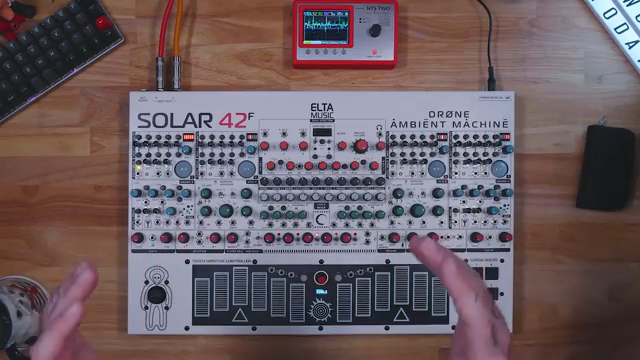
Step into the magnetic resonance of Red Means Recording’s latest exploration: the Elta Music Solar 42F. This isn’t just a synthesizer—it’s a tactile portal to the strange, the nostalgic, and the boldly untamed. Guided by Jeremy’s poetic hands, we drift through a landscape where microtonal ghosts and brash saw waves collide, conjuring memories of childhood awe and Soviet sci-fi. The Solar 42F doesn’t beg to be played; it demands to be met on its own terms. Prepare to lose your sense of pitch and float in a space where sound blooms and fractures with every twist and touch.
1. December 2025
LUMINA
Red Means Recording and the Solar 42F: A Machine for Sonic Nebulas
Nostalgia in Metal and Light: The Solar 42F’s Design
The Elta Music Solar 42F stands before us like a relic from a parallel timeline, its surface bristling with knobs, buttons, and tactile invitations. Red Means Recording, ever the conjurer of sonic narrative, describes a childhood longing reignited by the Solar’s visual allure—a machine that doesn’t just ask to be played, but to be touched, explored, and inhabited. There’s a magnetic nostalgia here, a sense that the very layout is a map to forgotten dreams of sound.
This instrument is not content to be a background drone box. Its aesthetic is a deliberate provocation, a sculpted invitation to lose oneself in the act of creation. The Solar 42F’s presence is almost cinematic—each control a prop in a film about the future’s past, each cluster of oscillators a constellation waiting to be charted. For those who remember the thrill of first encountering a synth, this machine is a time machine, humming with anticipation.
Microtonal Meteors: The Solar 42F’s Sonic Character
Beneath its tactile skin, the Solar 42F exhales a sound that is anything but conventional. Red Means Recording quickly dispels the notion that this is a typical ambient drone generator. Instead, the Solar 42F is a nebula of tension and aggression, its microtonal oscillators colliding in clusters that evoke the soundtracks of lost science fiction worlds. Here, tuning is an act of surrender—embrace the cacophony, and the machine reveals its true voice.
The oscillators, all saw waves, can be tuned into wild dissonance or fleeting harmony, creating textures that shimmer with alien resonance. This is not the gentle fog of ambient pads, but a storm of frequencies that dares you to find beauty in chaos. The Solar 42F’s sound is a living entity, drifting in and out of tune, always on the edge of something unknown. It’s a machine that scores the void, not the sunset.

"The Solar 42 is something you meet on its terms, not the other way around."
© Screenshot/Quote: Redmeansrecording (YouTube)
Sculpting Space: Oscillators and Modulation as Storytellers
The Solar 42F’s architecture is a playground for the adventurous. With clusters of five saw oscillators per drone, each can be triggered, held, and shaped independently, allowing for evolving sonic landscapes. Attack and release controls bloom and fade each note like underwater explosions, while panning and filter options split the sound into dual mono or stereo realms. The result is a canvas where one can paint with resonance and shadow.
Modulation is woven deeply into the Solar’s DNA. From photo sensors that respond to light, to morphing waveforms and built-in LFOs, every parameter is an invitation to experiment. The machine’s willingness to drift, detune, and interact with itself means that each session is a new story—a shifting constellation of drones, noise, and modulated pulses. It’s a place where soundscapes are not just created, but discovered, as if unearthing sonic fossils from beneath the surface of space.
Quirks, Limitations, and the Solar’s Uncompromising Identity

"As soon as you embrace that, you're good to go."
© Screenshot/Quote: Redmeansrecording (YouTube)
No machine this bold is without its quirks. The Solar 42F’s approach to tuning is unapologetically loose—oscillators drift, and the concept of tempered pitch is left behind in favor of microtonal exploration. Red Means Recording notes that the manual itself admits to this instability, encouraging users to meet the synth on its own terms. Embracing this imperfection is key to unlocking the Solar’s magic; fighting it only leads to frustration.
The cartridge-based effects system is another idiosyncrasy. While capable of loading different algorithms on each channel, the process is described as confusing and, at times, more trouble than it’s worth. Many will find themselves reaching for external effects, letting the Solar focus on its raw, untamed core. Other quirks—like the lack of multiples, limited CV options for filters, and a keyboard that resists deep menu diving—further define the Solar’s character.
Yet, these very limitations are what give the Solar 42F its soul. It is not a machine for every gig or every player, but for those willing to surrender control, it offers a singular experience. Its hands-on nature, wild design, and refusal to conform make it a brave outlier in the world of synthesizers—a machine that is as much about the journey as the destination.
Witness the Solar: Soundscapes Beyond Words
No written description can fully capture the Solar 42F’s magnetic resonance or the way its drones bloom and fracture in real time. Red Means Recording’s video is a portal into this world—a place where sound is sculpted live, and each patch tells a new story. To truly feel the Solar’s gravity, one must hear it in action, let its microtonal ghosts swirl through the speakers, and experience the tactile dance of hands and light. The Solar 42F is not just played—it is inhabited. Let the video be your guide into its sonic nebula.

"That is how the Soli 42 do."
© Screenshot/Quote: Redmeansrecording (YouTube)
This article is also available in German. Read it here: https://synthmagazin.de/red-means-recording-und-der-solar-42f-eine-maschine-fuer-klangliche-nebel/
Latest articles
Watch on YouTube:
Visit the channel:
https://www.youtube.com/RedMeansRecording
https://www.youtube.com/RedMeansRecording
Links from RedMeansRecording:
Business Inquiries: https://rmr.media/business-contact
All Links (Socials+Music): https://rmr.media/findme
Instagram: https://instagram.com/jjbbllkk
Bandcamp: https://soundvision.bandcamp.com/music
Twitter: https://bit.ly/rmrtwitters
Website: https://bit.ly/rmrmedia
Bandcamp: https://bit.ly/2Kq617o
Spotify: https://spoti.fi/2N40SoX
YouTube Music: https://bit.ly/3PZQ4ol
iTunes: https://apple.co/2pqh3SK
Amazon Music: https://amzn.to/2O9q1fe