Behringer Grind: A synthesizer need not squeeze into a rack
The Behringer Grind is a desktop synthesizer with a digital oscillator engine and patch bay. Four creator perspectives explore its format, its use alongside external gear, a patch-bay limitation and its range of sounds.
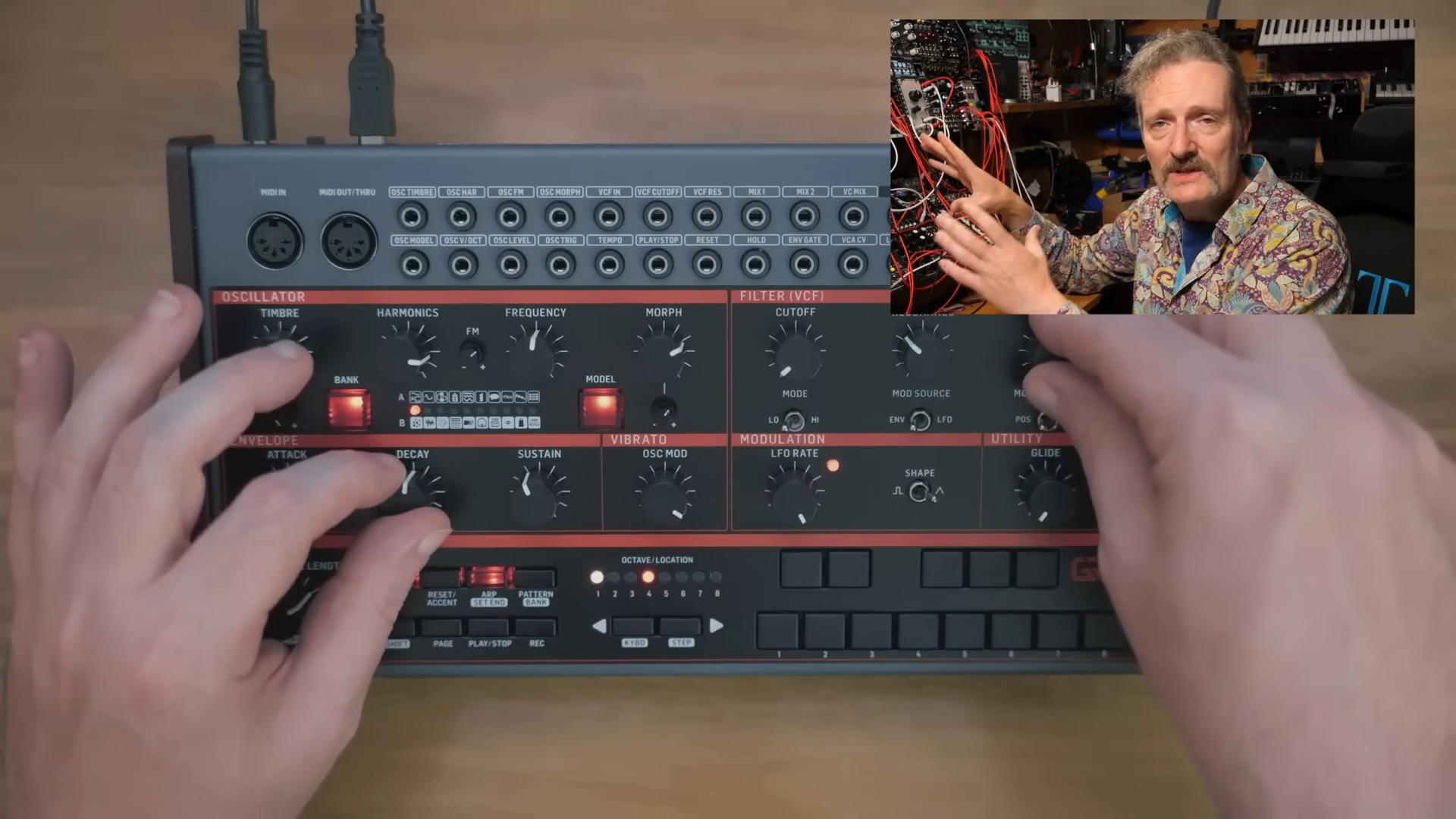
Why force a standalone instrument into an artificially narrow format? Molten Music Technology makes the case for a design that leaves room to work.
Molten Music Technology
„if you're going to design a self-contained synthesizer, then make it self-contained It doesn't have to fit in the rack because that makes everything small.“
Behringer Grind: MIDI Conductor brings synth patterns into the SP workflow
MIDI Conductor connects the Grind to the SP-404MKII's pattern workflow. Notes and recorded controller movements create shared territory for samples and synthesis.
+
A sample groove runs on the SP-404MKII while the Grind supplies a bass figure: MIDI Conductor brings both into a shared pattern workflow. Built on Klangfeld Labs' DOOM OS, the extension puts external synthesizers on pads as MIDI Instruments. Their notes can be edited in the piano roll, and controller movements can be stored in the pattern. The Grind is explicitly included in the device catalogue.
Its ASSIGN socket offers an interesting musical connection. According to the project manual, it follows one of four MIDI controllers at a time. A recorded movement could therefore become a CV modulation source for a patched sound parameter. This does not make the other sound knobs remotely controllable. MIDI effects including Echo, Chance and Euclid can also shape outgoing notes, suggesting variations over a repeating sample loop. The project extends the Grind's role alongside a sampler, with experimentally modified SP firmware as its prerequisite.
Compatibility and limitations
Grind explicitly listed; DIN MIDI connection to an SP-404MKII. ASSIGN follows CC 1, 2, 4 or 7, one at a time. Current patcher requires Roland 5.52 with bundled DOOM OS 0.7.4 (651C).
Experimental SP-404MKII firmware modification can brick the sampler; the author reports testing on only one unit. No separate Grind hardware test is documented. Grind sound controls lack comprehensive CC access; Program Changes are ignored.
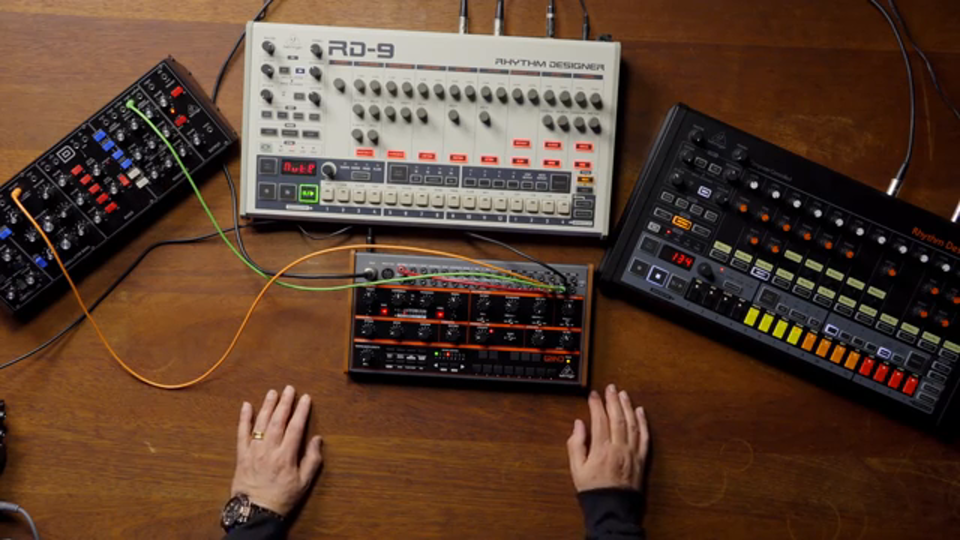
Noisegate describes combining the Grind’s digital oscillators with the analogue sound of a Model D. The quote outlines his specific use of the Grind sequencer alongside external gear.
„And now I can actually stack my sound. So I can have the nice digital model and oscillators from the grind, combine that with a nice analog flavor from the Model D.“
Starsky Carr notes that, unlike the CRAVE, the Grind does not include a built-in mult. In his setup, he adds that function with an external module.
„On the CRAVE we've got a Mult, 2 outs, 1 in. We've lost that on this. In fact I've been using this little thing here from Neutral Labs. Just a quite handy little Mult.“
According to Noisegate, the sound palette goes beyond harmonic and bass-heavy sounds. He also points to brittle digital and percussive tones.
Read the full statement
„The great thing about the grind is not just harmonic and bass type sounds. You've got lots of brittle digital and percussive sounds or you can make them percussive.“
Reddit · r/synthesizersThe Odyssey sounds better, but the Grind gets the gig
For a planned live project, one musician wants to carry less and replaces the Odyssey on bass with the Grind. He still prefers the Odyssey, but says the Grind’s VA engine is good enough for the job—and that the singer hears no difference.
+
The Odyssey remains one musician’s preferred bass synthesizer. Even so, he buys a Grind to use in a planned live project with a former bandmate. His reason is practical: he describes the Odyssey as awkward to transport and delicate to handle. The Grind is meant to lighten the load and take the bass duties off the other equipment.
A natural objection comes up in the replies: doesn’t the Odyssey sound better for this? The musician explicitly agrees. Still, the Grind’s virtual-analogue engine works well enough for his purpose; to his ears, it comes close to the slightly detuned bass character he wants. As a practical point of comparison, he says the singer hears no difference. His expectation about the audience is his own speculation. The post describes preparation for a live project, not a show that has already taken place.
Read the discussion ↗Reddit · r/synthesizersOne envelope cable extends the short LPG sound
A Grind owner initially associates its low-pass gate with short, plucked sounds. Then he patches the envelope output to OSC LEVEL. He says this adds longer contours and attack, turning a perceived limitation into a patching opportunity.
+
A Grind owner initially associates LPG mode mainly with short, percussive or plucked sounds. For him, the brief decay seems to define what the mode can do. The key discovery is an extra connection: he routes the envelope output to the OSC LEVEL input. In his account, this lets him add a longer decay, sustain or an attack phase, while also exciting certain oscillator models.
In the discussion, he asks how the low-pass gate works. One reply revises its initial explanation and ultimately describes the linked control of filter and VCA. For the owner, the practical takeaway is the extra envelope cable. The short contours no longer feel like a fixed limit to his sound design. He also notes that the response differs between models and that he still has to experiment.
If you need a bunch of sounds that you wanna get your ideas out really quickly, the sequencer is really neat. It's limited, but limitation as we know is the greatest creative driving force.
and as you can see it's almost like a CRAVE with a separate oscillator. The Crave's obviously got the single oscillator with just the square or the pulse and the sawtooth whereas this has got the 24 oscillators, 15 from Platz and 9 of Behringer's own.
we have those sounds so the fact that we have a new synthesizer That has those sounds inside is for me not particularly exciting But if that's what you're after it's certainly good value for money