Pittsburgh Modular Synthesizers have a reputation for crafting Eurorack modules that ooze analog character and patching flexibility, and their Voltage Lab 2 system is no exception. In this video walkthrough, Starsky Carr takes us on a detailed tour of Laboratory Oscillator 1—a wave folded oscillator that promises a buffet of modulation and sound-shaping options. Expect a hands-on exploration of wave shapes, center clipping, and the sort of patching possibilities that make modular heads reach for another stack of cables. If you’re curious how this oscillator fits into a broader modular workflow, or what happens when you throw random mode and external signals into the mix, this is a must-watch.
25. June 2024
MILES
Pittsburgh Modular Synthesizers: Laboratory Oscillator 1 – A Voltage Lab 2 Deep Dive
Unpacking the Laboratory Oscillator 1: Wave Folding at the Core
The Voltage Lab 2’s Laboratory Oscillator 1 is introduced as a central voice in the system, immediately setting itself apart with its wave folding architecture. Pittsburgh Modular’s penchant for organic, lively analog tones is evident here, as the oscillator is designed to be more than a basic tone generator—it’s a playground for complex sound design. The video wastes no time in highlighting the oscillator’s center clipping feature, which splits the waveform into positive and negative portions for independent manipulation.
This approach to oscillator design is all about giving users hands-on control over the harmonic content and dynamic behaviour of their sounds. The center clipping and wave folding circuits invite experimentation, making the oscillator feel less like a static source and more like a living, breathing part of a patch. For those who thrive on sculpting tones at the voltage level, this is a promising start.
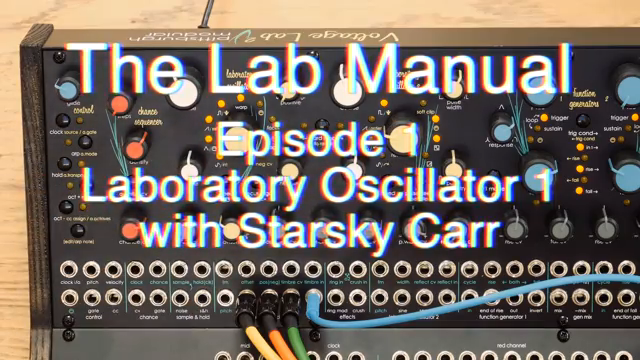
"This has got center clipping which effectively splits the wave shapes into the positive and the negative portions and we can modulate those using these two knobs here."
© Screenshot/Quote: Pittsburghmodular (YouTube)
A Palette of Wave Shapes: From Sine to Random
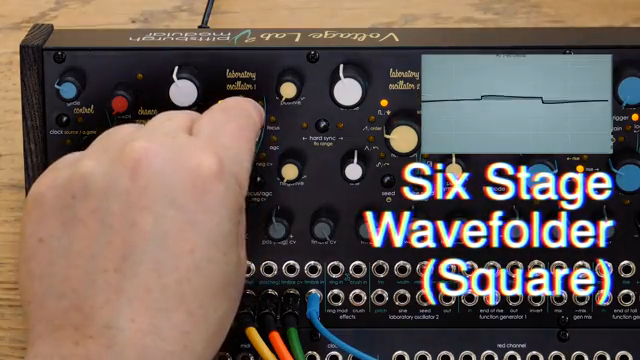
"What this does, it creates the same harmonics as the square but in a different wave shape, that's foldable."
© Screenshot/Quote: Pittsburghmodular (YouTube)
Laboratory Oscillator 1 offers a suite of classic and unconventional waveforms, including sine, triangle, sawtooth, and pulse. Each is accessible via a straightforward interface, and the video demonstrates how these shapes respond to the oscillator’s folding and clipping circuits. Notably, there’s a random mode, clocked internally, that injects a dose of unpredictability into the proceedings—a nod to those who like their modulation a bit wild.
The oscillator’s warp mode deserves special mention. It generates harmonics similar to a square wave but in a form that’s more amenable to wave folding, sidestepping the usual sonic limitations of folding a pure square or sawtooth. This opens up new textural territory, allowing users to coax both familiar and alien tones from the same core oscillator. The demonstration makes it clear that each wave shape interacts differently with the folding and clipping, offering a broad palette for sonic exploration.
Center Clipping & Modulation: Shaping Sound with Precision
The center clipping circuit is a highlight, letting users independently modulate the positive and negative halves of the waveform. This is not just a visual trick—the sonic results range from subtle harmonic shifts to more radical transformations, depending on how far you push the controls. The AGC (Automatic Gain Control) circuit comes into play here, compensating for level changes introduced by clipping and maintaining a consistent output volume, albeit with its own characterful quirks.
Further manipulation is possible with the focus and offset controls, each adding their own flavour to the resulting sound. The video shows how these parameters can be voltage-controlled, with dedicated CV inputs for offset, positive, negative, and timbre. This means that Laboratory Oscillator 1 isn’t just about manual tweaking—it’s primed for dynamic, evolving modulation within a patch. The unpredictability of the results, especially when combining different wave shapes and modulation sources, is part of the charm.
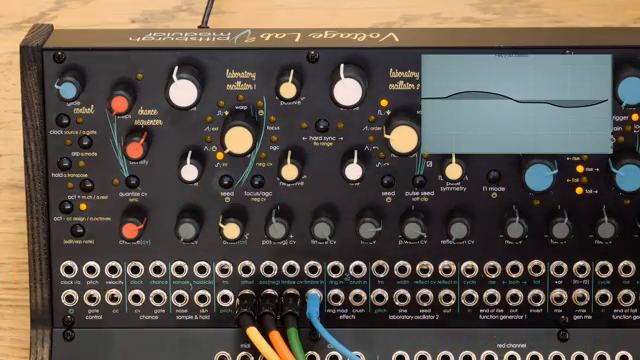
"So keep the same shape. But increase the magnitude. So increase the volume of all the gain. And that's what we're getting here."
© Screenshot/Quote: Pittsburghmodular (YouTube)
External Signals and the Wave Folder: Expanding the Sonic Toolkit
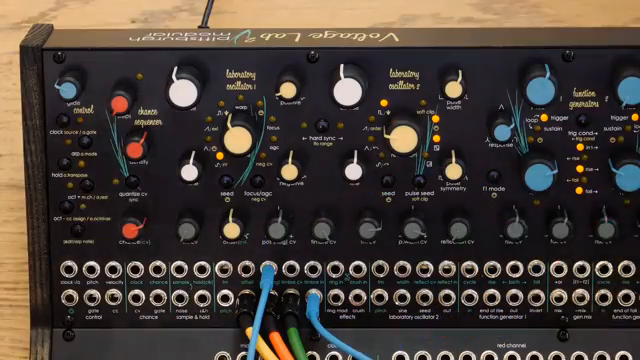
"The timbre in means we can bring any signal from anywhere and put it through the wave folder."
© Screenshot/Quote: Pittsburghmodular (YouTube)
One of the Laboratory Oscillator 1’s standout features is its ability to process external signals through its wave folder. By patching in audio from elsewhere in the system—such as another oscillator or even a modulated pulse width signal—the wave folder becomes a powerful tool for reshaping and hybridising sounds. The video demonstrates this by routing Oscillator 2’s output into Oscillator 1’s timbre input, then modulating the result for evolving, complex timbres.
Multiple outputs are available, each representing different stages of the signal path: a pure sine, a seed waveform (which morphs between shapes but remains unaffected by folding), and the AGC output (which includes all the positive/negative manipulation and AGC processing). This multi-output approach means users can tap into the oscillator at various points, layering or routing signals for parallel processing. It’s a modular-friendly design that encourages creative patching and integration with the rest of the Voltage Lab 2 system.
From LFOs to Drones: Frequency Range and Musical Roles
Laboratory Oscillator 1 isn’t confined to melodic duties—it boasts a wide frequency range, easily venturing into LFO territory for modulation tasks. The video highlights how the oscillator can be set to ignore MIDI notes, functioning as a drone or a complex LFO source. This flexibility is a boon for those who want their oscillators to pull double duty in a patch, providing both audio-rate tones and slow, evolving modulations.
Fine-tuning is possible over a range of plus or minus seven semitones, making it suitable for everything from precise musical intervals to more experimental, backvexing modulations. The combination of wave shaping, folding, clipping, and broad frequency range means Laboratory Oscillator 1 is as much a modulation powerhouse as it is a sound source. For modular users who value versatility and depth, it’s clear this oscillator is designed to be at the heart of both rhythmic and melodic explorations.
This article is also available in German. Read it here: https://synthmagazin.at/pittsburgh-modular-synthesizers-laboratory-oscillator-1-ein-deep-dive-ins-voltage-lab-2/
Watch on YouTube:
Latest articles
Watch on YouTube:
Visit the channel:
https://www.youtube.com/pittsburghmodular
https://www.youtube.com/pittsburghmodular
Links from pittsburghmodular:
website: https://pittsburghmodular.com
instagram: https://instagram.com/pghmodular
facebook: https://facebook.com/pghmodular
linktree: https://linktr.ee/pghmodular
Sponsored links:
If you purchase via these links, we may earn a small commission – at no extra cost to you. The link opens an Amazon keyword search, and results may vary depending on availability.
Voltage Lab 2 Laboratory Oscillator 1
🔗 Check price on Amazon
🔗 Check price on Amazon