Pittsburgh Modular Synthesizers returns with a deep-dive into the Voltage Lab 2 Laboratory Oscillator 2, a module that promises more than your average set of waveforms. In this official walkthrough, the focus is on pulse symmetry, modulation options, and the creative potential of signal processing within a modular context. The presentation is hands-on and exploratory, highlighting the module’s ability to shape, fold, and mangle signals in ways that will intrigue both patching purists and sonic experimenters. If you’re curious about how this oscillator might slot into your rack—or what sets it apart from its sibling—this video is a must-watch for any modular enthusiast.
25. June 2024
MILES
Pittsburgh Modular Synthesizers: Dissecting the Voltage Lab 2 Laboratory Oscillator 2
A Laboratory for Sonic Experimentation
The Voltage Lab 2 Laboratory Oscillator 2 is introduced as a versatile tool for modular sound design, picking up where its sibling, Oscillator 1, leaves off. Pittsburgh Modular’s approach is refreshingly hands-on, with a focus on how the oscillator behaves in a real patch rather than just listing specs. The module offers four standard wave shapes—sine, triangle, sawtooth, and square—providing a familiar foundation for synthesis.
What sets Oscillator 2 apart is its emphasis on modulation and signal manipulation. The walkthrough highlights the module’s ability to move from classic tones to more experimental territory with ease. The coarse and fine tuning controls allow for a wide frequency range, from LFO rates up to ultrasonic territory, making it suitable for everything from drones to percussive blips. The inclusion of MIDI toggling further expands its utility, allowing users to switch between LFO and audio-rate duties without missing a beat.
Pulse Symmetry: Beyond the Standard Pulse
A standout feature of Oscillator 2 is pulse symmetry, which enables the creation of step-like pulse waves that go far beyond traditional pulse width modulation. By manipulating the symmetry, users can sculpt unique waveforms that add a distinct rhythmic or harmonic character to their patches. The video demonstrates how pulse symmetry can be dialed in to taste, resulting in a variety of timbres and textures.
What’s especially intriguing is the ability to apply pulse width modulation not just to the square wave, but across multiple wave shapes. The seed button allows users to select between sawtooth, sine, or a blend, influencing the resulting pulse symmetry behaviour. This opens up a playground for modulation enthusiasts, offering a palette of evolving, animated tones that respond dynamically to both manual and CV control.
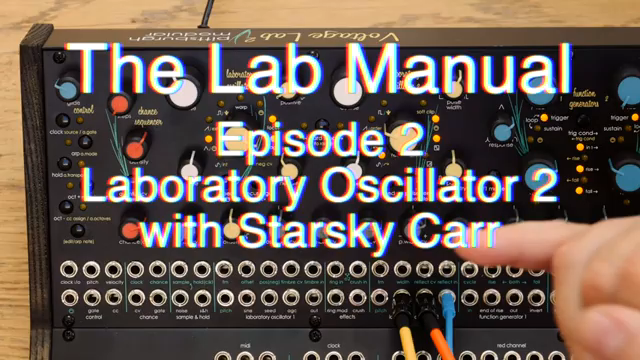
"And this introduces pulse symmetry."
© Screenshot/Quote: Pittsburghmodular (YouTube)
Soft Clipping and Randomization: Expanding the Palette
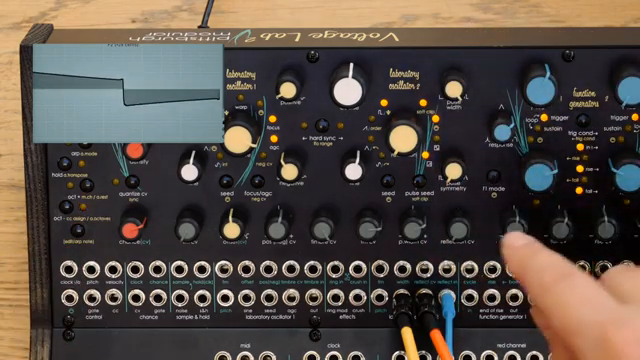
"We've got a random mode as well like we do for Oscillator 1."
© Screenshot/Quote: Pittsburghmodular (YouTube)
Oscillator 2 doesn’t stop at traditional wave shaping—it also features a soft clipping mode, which can be engaged to add harmonic richness and subtle saturation to any waveform. This is demonstrated with various wave shapes, showing how soft clipping interacts with both the standard and modulated outputs. The module also includes a randomization mode, echoing the functionality found in Oscillator 1, for injecting unpredictable movement and variation into your sound. Together, these features make the oscillator a flexible source for everything from classic analog warmth to more chaotic, experimental textures.
Signal Processing and Integration: Reflection and Beyond
One of the most compelling aspects of Laboratory Oscillator 2 is its ability to process external signals via the reflect input. This isn’t just an oscillator—it’s a signal mangler, capable of folding, reflecting, and reshaping incoming audio from Oscillator 1 or any other source. The reflection knob folds negative voltages up into the positive domain, creating complex, harmonically rich waveforms that can be further modulated or clipped.
The walkthrough demonstrates how patching Oscillator 1 through the reflect input of Oscillator 2 opens up a world of sonic possibilities, especially when combined with wave folding and modulation. All major parameters—pulse symmetry, reflection, and the big red knob—are CV-controllable, making the module highly interactive in a larger Eurorack setup. Dedicated outputs for sine and seed waveforms, along with standard FM and pitch inputs, round out the integration options, ensuring this oscillator can serve as both a sound source and a creative processor in any modular environment.
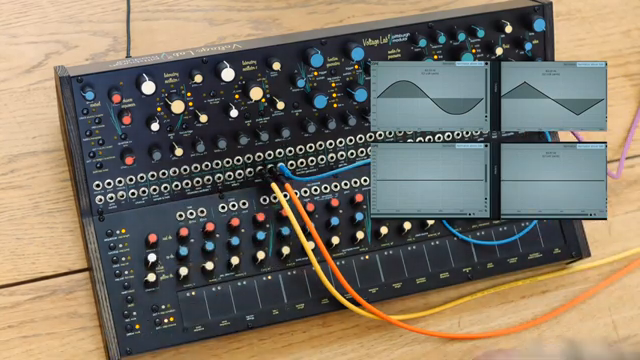
"We have a reflect in, which means we can bring Oscillator 1 or any other oscillator into Oscillator 2 to manipulate it with the reflection circuit."
© Screenshot/Quote: Pittsburghmodular (YouTube)
This article is also available in German. Read it here: https://synthmagazin.at/pittsburgh-modular-synthesizers-analyse-des-voltage-lab-2-laboratory-oscillator-2/
Watch on YouTube:
Latest articles
Watch on YouTube:
Visit the channel:
https://www.youtube.com/pittsburghmodular
https://www.youtube.com/pittsburghmodular
Links from pittsburghmodular:
website: https://pittsburghmodular.com
instagram: https://instagram.com/pghmodular
facebook: https://facebook.com/pghmodular
linktree: https://linktr.ee/pghmodular
Sponsored links:
If you purchase via these links, we may earn a small commission – at no extra cost to you. The link opens an Amazon keyword search, and results may vary depending on availability.
Voltage Lab 2 Laboratory Oscillator 2
🔗 Check price on Amazon
🔗 Check price on Amazon