OXI Instruments returns with an advanced tutorial on the OXI One’s Chord Mode, taking us well beyond the basics and into the heart of its creative sequencing architecture. As a flagship sequencer designed to command hybrid setups, the OXI One’s Chord Mode is packed with nuanced features for sculpting dynamic progressions and expressive performances. This video, presented in OXI’s signature hands-on style, explores everything from step-level strumming and probability to internal modulation and arpeggiator tricks. For anyone serious about digital sequencing workflows, this is a revealing look at how deep the OXI One’s Chord Mode can go—and how its design choices might shape your next studio or stage session.
22. June 2024
LYRA
OXI Instruments OXI One: Deep-Diving Chord Mode for Next-Level Sequencing
A Sequencer Brain with Chordal Ambitions
The OXI One is introduced as a versatile MIDI/CV sequencer, with its Chord Mode positioned as a powerful tool for both composition and live performance. OXI Instruments frames the device as more than just a step sequencer—it’s a creative hub for building harmonically rich progressions and integrating them seamlessly into hybrid setups. The tutorial wastes no time, moving quickly from a brief nod to the basic Chord Mode overview to a hands-on demonstration of advanced features.
This approach is typical of OXI Instruments’ educational style: clear, workflow-driven, and focused on real-world application. The video sets the expectation that Chord Mode isn’t just about stacking notes, but about unlocking expressive, playable chord sequences that can be deeply customized at every step. The OXI One’s interface and step-editing workflow are foregrounded as essential to this process, promising a level of immediacy that digital-centric musicians will appreciate.
Step Parameters, Arps, and Modulation: The Power Trio
Diving into the step parameter menus, the video demonstrates how double-tapping the Step Chord button opens up a suite of advanced options for each step in a sequence. Strum introduces time separation between chord notes, mimicking guitar-like articulation and allowing for both ascending and descending effects. This is not just a cosmetic tweak; it fundamentally changes the feel of a progression, especially when paired with tied steps or extended sequences.
Trigger probability and logic conditions are also highlighted, enabling steps to play with controlled randomness—think one out of two times, or more complex logic. Retrig adds the ability to fire a note multiple times within a step, up to seven retriggers, injecting rhythmic complexity. The offset parameter allows for micro-timing adjustments, shifting notes forward or backward within the step grid for added groove or swing.
Throughout, OXI’s interface design is on display: step parameters are accessible via clear button combos and encoder tweaks, minimizing menu-diving. The tutorial emphasizes how these features can be layered to create sequences that are both precise and alive, with the OXI One’s architecture supporting a wide range of creative workflows.
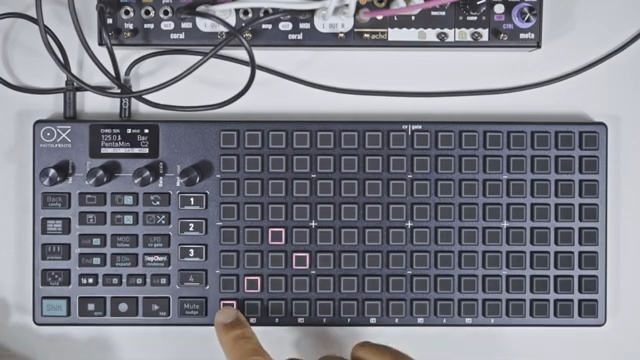
"You can also press Shift + hold a step to access the second layer of the step parameters."
© Screenshot/Quote: Oxiinstruments (YouTube)
Strum, Probability, and Retrig: Dynamic Chord Progressions
"Trigger probability or logic conditions for your steps, like playing a step once out of two times or two out of two."
© Screenshot/Quote: Oxiinstruments (YouTube)
The tutorial zooms in on how strum, trigger probability, and retrig settings can transform static chord progressions into evolving, dynamic sequences. Strum is shown as a way to break up block chords, introducing movement and a more organic feel. The directionality—ascending or descending—adds further nuance, and the effect is immediately audible in the demoed progression.
Trigger probability and retrig are presented as tools for injecting unpredictability and rhythmic interest. By setting steps to trigger only some of the time, or retriggering notes within a step, users can generate patterns that feel less mechanical and more musical. The video makes it clear that these features are not buried in submenus but are quickly accessible, supporting fast iteration and experimentation.
Performance Tools: Arpeggiators in Keyboard and Sequencer Views
Arpeggiators are a centerpiece of the OXI One’s performance toolkit, and the video methodically demonstrates their use in both keyboard and sequencer views. In keyboard view, enabling the arp is as simple as pressing play and toggling the ARP button, with further controls for octave range, gate length, rate, and accent. The hold function frees up your hands for more complex live manipulations, and the visual feedback on the grid keeps things transparent.
Switching to sequencer view, the arpeggiator takes its input from the programmed chord steps, allowing for even more intricate rhythmic patterns. The Euclidean generator parameters—pulse, repeat, and length—are showcased as powerful ways to shape the arp’s groove and density. The distinction between keyboard and sequencer arp modes is well-explained, with the video highlighting how each can serve different compositional and performance needs.
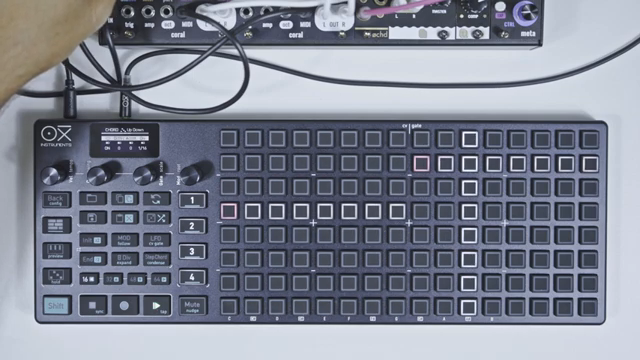
"It allows you to dial in further rhythms to your arp, using the parameter rotation of the Euclidean generator to spice up your arp rhythm."
© Screenshot/Quote: Oxiinstruments (YouTube)
Internal Modulation: Breathing Life into Sequences
The final segment dives into the OXI One’s internal modulation capabilities, a key differentiator for advanced users. The LFO is shown modulating chord spread, with destinations selected via encoder and immediate audible feedback. The mod lanes—multiple, assignable modulation tracks—are used to animate chord type, with the ability to set modulation depth and randomize values for evolving patterns.
Randomization is presented not as chaos, but as a performance tool: shift-random combos inject controlled unpredictability, while manual tweaking of modulation amounts allows for subtle or dramatic changes. The video encourages users to experiment with small parameter increments, observing how each tweak affects the musical outcome.
OXI Instruments closes with a call to exploration, positioning internal modulation as a gateway to sequences that are never static. The workflow is designed for both precision and happy accidents, with the OXI One’s architecture supporting deep, hands-on modulation without external editors or convoluted menu structures.
This article is also available in German. Read it here: https://synthmagazin.at/oxi-instruments-oxi-one-chord-mode-in-der-tiefe-sequencing-auf-neuem-niveau/
Watch on YouTube:
Latest articles
Watch on YouTube:
Visit the channel:
https://www.youtube.com/oxiinstruments
https://www.youtube.com/oxiinstruments
Links from oxiinstruments:
website: https://oxiinstruments.com
instagram: https://www.instagram.com/oxiinstruments
facebook: https://www.facebook.com/oxiinstruments/
support: https://oxiinstruments.com/support
Sponsored links:
If you purchase via these links, we may earn a small commission – at no extra cost to you. The link opens an Amazon keyword search, and results may vary depending on availability.
Oxi One
🔗 Check price on Amazon
🔗 Check price on Amazon