OXI Instruments, known for their forward-thinking hardware brains for hybrid setups, takes center stage with the E16—a MIDI controller designed to supercharge your creative workflow. In their latest video, OXI walks us through five standout features that promise to make the E16 more than just another MIDI box: from morphing snapshots and nested parameter destinations to real-time randomization and group control. With hands-on demonstrations using the Elektron Syntakt and Erica Synths Nightverb, the video is a deep dive into how digital performance tools can become truly expressive. If you’re after a controller that’s as much about evolving ideas as it is about precise control, this is a must-watch.
19. March 2026
LYRA
OXI Instruments E16: Five Workflow-Changing Features in Focus
E16: The Performance-First MIDI Brain
OXI Instruments positions the E16 as a MIDI controller built from the ground up to enhance both performance and workflow. The video opens with a clear intent: not just to showcase another MIDI box, but to highlight a tool that aims to be the centerpiece of a modern electronic setup. The presenter underscores ongoing development, emphasizing that new features are being added to keep the E16 at the forefront of performative control.
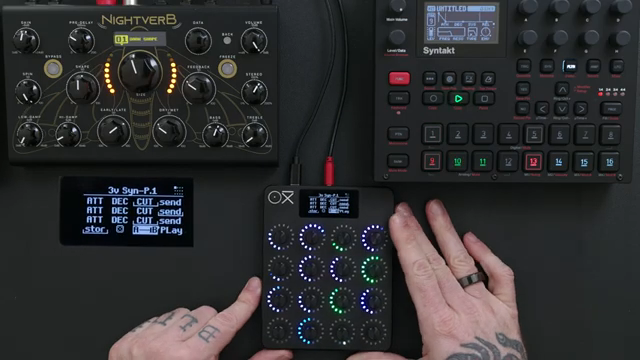
To demonstrate its capabilities, the E16 is paired with the Elektron Syntakt and Erica Synths Nightverb, forming a compact yet powerful rig. The setup is intentionally simple, focusing on how a controller like the E16 can elevate hands-on interaction with synths and effects. The E16’s interface is presented as a single-page control surface, where each row corresponds to a synth voice, making it easy to access and tweak key parameters without menu-diving or losing the creative thread.
Snapshot Morphing & Swap Destination: Deep Control, Fast Access
Among the E16’s defining features, Snapshot Morphing stands out for its ability to capture and seamlessly morph between two distinct parameter states. This isn’t just a static recall—users can interpolate between snapshots, creating evolving transitions that are visually cued on the hardware. The process is straightforward: hold and turn to capture states A and B, then glide between them for dynamic modulation.
Equally innovative is the Swap Destination function. By pressing an encoder, users can instantly switch its target parameter, effectively doubling the available controls per page. This nesting allows for a much denser mapping of CC destinations without overwhelming the interface. The video demonstrates how this is set up both via the companion app and directly on the device, keeping the workflow fluid whether you’re prepping in the studio or improvising live.
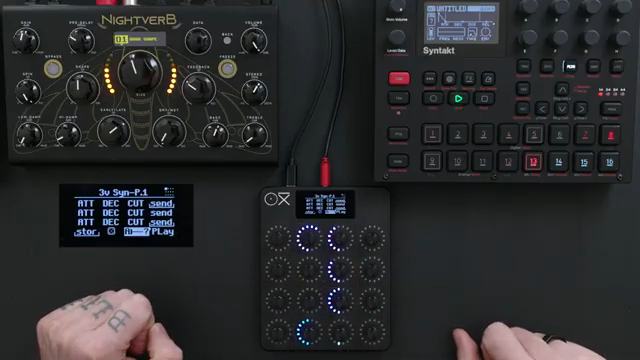
"With swap destination, you can press the encoder, and now this encoder controls another destination."
© Screenshot/Quote: Oxiinstruments (YouTube)
Randomization: Controlled Chaos Across Multiple Devices
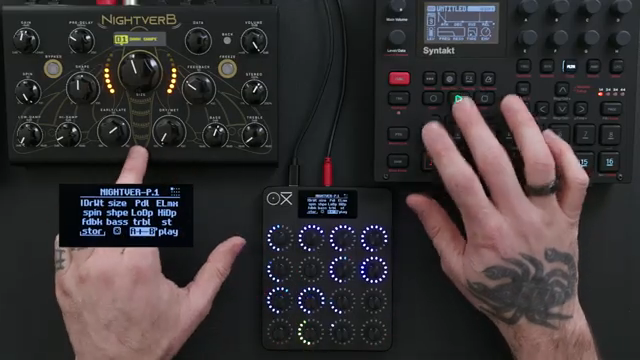
"Because you end up finding a combination of things that you would probably never get if you tweak."
© Screenshot/Quote: Oxiinstruments (YouTube)
Randomization on the E16 is more than a novelty—it’s a core creative tool. With a single press, users can inject variation into their sound design, whether tweaking synth parameters or mangling effects like the Nightverb. The amount of randomization is adjustable, allowing for anything from subtle shifts to wild transformations. Importantly, users can exclude specific parameters from being randomized, preserving critical controls like dry/wet balance while still exploring new sonic territory.
The E16’s randomization is shown working in tandem with both the Elektron Syntakt and the Erica Synths Nightverb, demonstrating its flexibility in hybrid setups. The ability to store favorite random results for instant recall further cements this as a performance-friendly feature. The addition of a slew timer means randomization can morph smoothly over time, not just snap abruptly, making it ideal for evolving textures and live improvisation.
Creative Workflows: Grouping, Recording, and Dynamic Scenes
The video’s second half is a showcase of how the E16’s features combine to support dynamic, real-world workflows. Grouping allows users to link multiple encoders, so a single movement can control several parameters—either in unison or in opposition. This is particularly useful for complex sound design or live tweaks, where coordinated changes are essential. The grouping logic is intuitive: hold a master encoder and select others to join the group, with options for positive or negative relationships.
Recording is another highlight, enabling the capture of knob movements in real time. Each encoder can have its own unsynced automation, resulting in organic, non-repetitive modulation that loops until overwritten. The process is simple: hold shift to arm recording, then move an encoder to capture its motion. This feature is especially valuable for performers who want to inject life and movement into static patterns without relying on external sequencers.
Finally, the E16’s scene system ties everything together. Users can set up pages for mixing, muting, and macro control, with clear visual feedback for what’s active, muted, or recorded. The workflow is designed to keep all essential controls at your fingertips, minimizing menu navigation and maximizing creative flow. OXI’s approach here is unapologetically hands-on, making the E16 a compelling option for anyone who values immediacy and expressive control in their setup.
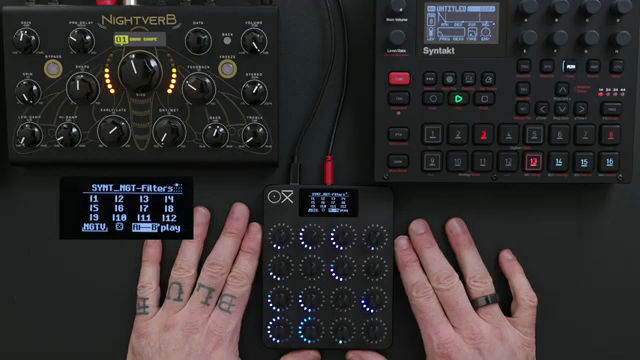
"Because you will have very organic movement."
© Screenshot/Quote: Oxiinstruments (YouTube)
This article is also available in German. Read it here: https://synthmagazin.at/oxi-instruments-e16-fuenf-workflow-veraendernde-features-im-fokus/
Watch on YouTube:
Latest articles
Watch on YouTube:
Visit the channel:
https://www.youtube.com/oxiinstruments
https://www.youtube.com/oxiinstruments
Links from oxiinstruments:
website: https://oxiinstruments.com
instagram: https://www.instagram.com/oxiinstruments
facebook: https://www.facebook.com/oxiinstruments/
support: https://oxiinstruments.com/support
Sponsored links:
If you purchase via these links, we may earn a small commission – at no extra cost to you. The link opens an Amazon keyword search, and results may vary depending on availability.
Elektron Syntakt
🔗 Check price on Amazon
🔗 Check price on Amazon
Erica Synths Nightverb
🔗 Check price on Amazon
🔗 Check price on Amazon
OXI E16
🔗 Check price on Amazon
🔗 Check price on Amazon