Moog Music’s Spectravox isn’t just another synth voice—it’s a spectral playground that blurs the line between processor and instrument. In this official Moog demo, we see Spectravox commandeered as a standalone synth voice, revealing its unique ten-filter architecture and flexible modulation options. The video walks through keyboard integration, filter sculpting, and modulation tricks, all with that classic Moog attention to sonic detail. For those who like their patches a bit left-of-centre, Spectravox offers a taste of the unexpected, with plenty of room for creative exploration.
18. May 2024
MILES
Moog Music’s Spectravox: A Filter Bank Voice with a Patchable Twist
Spectravox: Synth Voice or Sonic Processor?
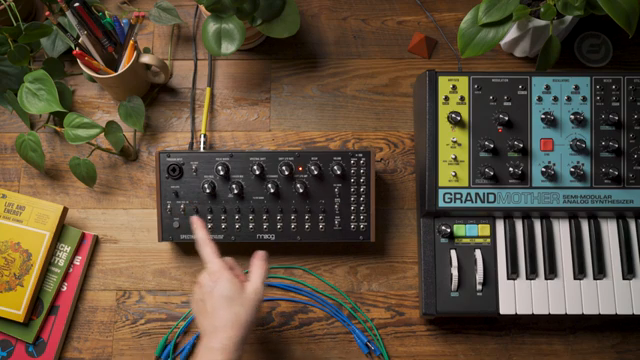
Spectravox is introduced as a hybrid entity, straddling the boundary between a traditional synthesizer voice and a signal processor. Moog positions it as a tool that can function as either, but in this video, the focus is firmly on its role as a standalone synth voice. This duality is central to Spectravox’s appeal, offering both classic and unconventional workflows in a single box.
The architecture shares DNA with classic Moog subtractive voices, but diverges in key areas. Instead of the usual single low-pass filter, Spectravox boasts a full filter bank, immediately setting it apart from the rest of the Moog stable. This approach invites users to think beyond standard patches and consider new ways to sculpt and animate their sound.
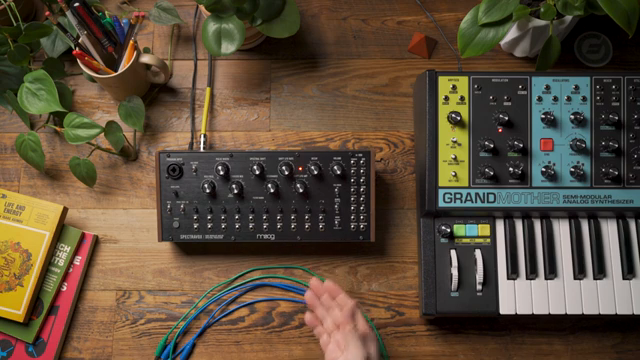
"Spectravox is unique in that it straddles the line between instrument and processor."
© Screenshot/Quote: Moogsynthesizers (YouTube)
Ten Filters: The Heart of Spectravox
"Rather than just having a low-pass filter, you actually have 10 filters."
© Screenshot/Quote: Moogsynthesizers (YouTube)
At the core of Spectravox lies its ten-filter array: eight bandpass filters, one high-pass, and one low-pass. This configuration enables a level of spectral shaping that’s rare in the Moog ecosystem, allowing for intricate tonal manipulation. The filters can be individually adjusted, opening up a palette of sonic possibilities well beyond the typical single-filter synth voice.
The envelope is decay-only, a design choice that keeps things snappy but may leave some wishing for more control. However, Moog notes that an external envelope can be patched in if needed, keeping the architecture flexible for more complex modular setups.
Keyboard Control: Grandmother as Spectravox’s Conductor
To demonstrate Spectravox as a playable synth, the video shows the Grandmother keyboard patched directly into Spectravox’s 1V/OCT and Trigger inputs. This setup transforms Spectravox into a responsive keyboard voice, with pitch and gate signals dictating oscillator frequency and envelope triggering. The process is straightforward, and any CV/gate-equipped keyboard could serve the same role.
With the Grandmother in ARP mode, Spectravox responds musically to keyboard input, making it easy to integrate into a live or studio rig. This external control highlights Spectravox’s flexibility and its potential as a centrepiece or satellite in a modular system.
Filtering Adventures: From Classic Sweeps to Comb and Notch
The demo dives into the filter bank’s creative potential, starting with a single filter band for a classic Moog-style sweep. With only the first filter open, Spectravox behaves much like a traditional low-pass voice, but the spectral shift control moves all ten filters in parallel, offering broader tonal movement than a standard cutoff knob.
Switching to the high-pass filter, the video demonstrates how the spectral shift can carve out low end, while combining high-pass and low-pass filters produces a sweeping notch effect reminiscent of phasers. The resonance control further accentuates these effects, allowing for dramatic sweeps and timbral shifts.
Stacking multiple bandpass filters introduces formant-like qualities and comb filtering, with all bands moving in parallel for complex, animated textures. Adding back the low-pass and high-pass filters expands the palette even further, showing off Spectravox’s ability to morph between classic and experimental filter behaviours.
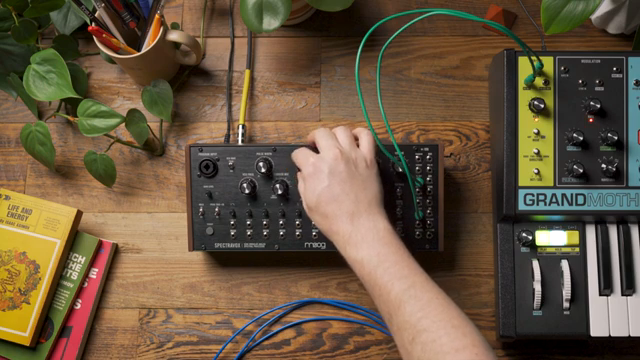
"It's like a very big notch filter that's sweeping the low-pass and high-pass at the same time."
© Screenshot/Quote: Moogsynthesizers (YouTube)
LFO Modulation: Tremolo, Spectral Motion, and Beyond
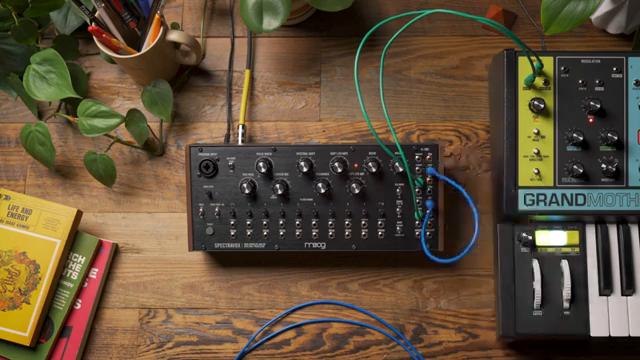
"Spectravox is actually quite a flexible and unique synthesizer voice, and great fun to include in your compositions when you're not using it to process an external signal."
© Screenshot/Quote: Moogsynthesizers (YouTube)
LFO modulation is front and centre in the latter part of the demo. By routing the onboard LFO to the spectral shift, sweeping effects can be automated, from slow, evolving movement to intense audio-rate modulation. Adjusting the LFO rate and amount provides a wide range of motion, from subtle animation to aggressive spectral warping.
The VCA CV input is another point of interest. Feeding the LFO here creates tremolo effects, with the amplitude of the envelope modulated for dynamic rhythmic patterns. The video notes that offsetting the LFO signal can refine the effect, reducing silences and enabling more nuanced amplitude modulation. These modulation tricks add depth and movement, making Spectravox a lively addition to any patch.
This article is also available in German. Read it here: https://synthmagazin.at/moog-music-spectravox-filterbank-voice-mit-patch-potenzial/
Watch on YouTube:
Latest articles
Watch on YouTube:
Visit the channel:
https://www.youtube.com/MoogSynthesizers
https://www.youtube.com/MoogSynthesizers
Links from MoogSynthesizers:
website: https://moogmusic.com
instagram: https://instagram.com/moogsynthesizers
facebook: https://www.facebook.com/moogmusicinc
twitter: https://twitter.com/moogmusicinc
Sponsored links:
If you purchase via these links, we may earn a small commission – at no extra cost to you. The link opens an Amazon keyword search, and results may vary depending on availability.
Moog Grandmother
🔗 Check price on Amazon
🔗 Check price on Amazon
Moog Spectravox
🔗 Check price on Amazon
🔗 Check price on Amazon