Moog Music’s latest firmware update for the Muse brings a game-changing twist to digital sequencing: per-timbre probability. In this official demo, Moog walks us through how the v1.4 update transforms Muse’s sequencer into a far more nuanced generative tool, letting users dial in unique probability behaviors for each timbre. The result? A workflow that encourages musical spontaneity, complex layering, and a genuinely improvisational partnership between composer and machine. We dig into how these new features shape the creative process, what’s actually demonstrated, and where the architecture invites deeper exploration.
28. May 2025
LYRA
Moog Music’s Muse v1.4: Per-Timbre Probability—A New Frontier for Generative Sequencing
Splitting Chance: The Promise of Per-Timbre Probability
Moog’s Muse, already a flexible digital sequencer, takes a bold step into generative territory with the introduction of per-timbre probability in firmware v1.4. This update isn’t just a minor tweak—it fundamentally changes how randomness and variation can be woven into a composition. By allowing each timbre to have its own probabilistic behavior, Muse empowers users to craft sequences that feel both intentional and alive.
The video opens with a practical demonstration: a patch from bank 11, featuring a monophonic bass on the lower keyboard and a polyphonic electric piano on the upper. The presenter highlights how the new system lets you set live record mode to per-timbre, ensuring that edits to one timbre don’t overwrite the other. This architectural decision is crucial for anyone looking to build complex, multi-layered arrangements without accidental cross-talk between parts.

"You can now split the probability behavior between timbres."
© Screenshot/Quote: Moogsynthesizers (YouTube)
Firmware v1.4: Deepening the Sequencer’s Creative Toolkit
The v1.4 firmware update doesn’t just add probability—it multiplies the ways you can interact with Muse’s sequencer. The demo walks through setting up a baseline for timbre A, using step entry and live record modes that respect the independence of each timbre. Notably, the update introduces a handy sequence-doubling function: by holding copy and hitting page right, users can instantly double sequence length, a boon for evolving patterns and extended arrangements.
Once the groundwork is laid, the video shows how to add melodic and harmonic content for timbre B, using both step and live recording. The workflow is streamlined, with clear visual feedback and menu navigation that stays out of the way. The ability to independently tweak each timbre’s sequence—without menu-diving or risk of overwriting—demonstrates a thoughtful approach to UI and performance-centric design.
Probability in Action: Generative Sequences with Character
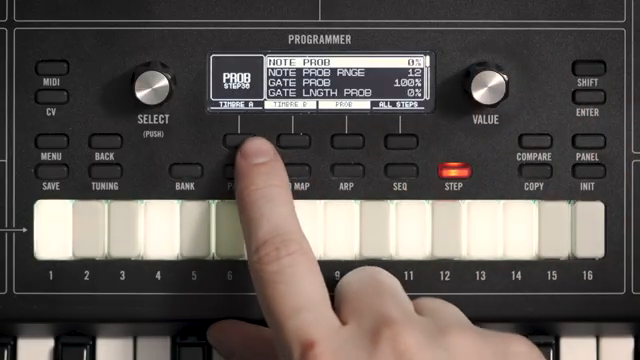
"We can now select to just edit the probability settings for timbre A and timbre B separately."
© Screenshot/Quote: Moogsynthesizers (YouTube)
With the sequences in place, the real magic begins in the probability menu. Muse now offers soft buttons to edit probability settings separately for each timbre—a subtle but powerful UI choice. For timbre A, the presenter opts for a high gate probability, ensuring the bassline remains mostly stable but with occasional rests. Timbre B, on the other hand, gets a low note probability and a wide note range, inviting the sequencer to introduce surprising melodic deviations within a defined scale.
Velocity probability adds yet another layer of nuance, allowing for dynamic variation in timbre B’s part. The result is a sequence that feels organic, with both timbres responding differently to the same underlying clock. This approach encourages users to think of Muse not just as a step recorder, but as an improvisational partner capable of injecting controlled chaos into a composition.
Layered Complexity: Harmonic Interplay and Sound Design Potential
The ability to set probability parameters per timbre opens the door to intricate layering and harmonic interplay. The demo illustrates how adjusting gate and note probabilities for each timbre can yield sequences that evolve independently yet remain musically coherent. By tweaking these settings, users can coax Muse into generating patterns that are rhythmically and harmonically rich, with each timbre contributing its own flavor of unpredictability.
This architectural flexibility is especially valuable for composers seeking to blur the line between programmed and generative music. Muse’s sequencer, as shown here, becomes a playground for experimentation—where the balance between control and surprise is always at the user’s fingertips. While the video focuses on preset-based tweaks and surface-level workflow, the underlying system hints at deep potential for live performance and studio exploration alike.

"We can really add some unique deviating behaviors between timbres in terms of how they react to the probability settings."
© Screenshot/Quote: Moogsynthesizers (YouTube)
This article is also available in German. Read it here: https://synthmagazin.at/moog-music-muse-v1-4-per-timbre-probability-eine-neue-aera-fuer-generatives-sequencing/
Watch on YouTube:
Latest articles
Watch on YouTube:
Visit the channel:
https://www.youtube.com/MoogSynthesizers
https://www.youtube.com/MoogSynthesizers
Links from MoogSynthesizers:
website: https://moogmusic.com
instagram: https://instagram.com/moogsynthesizers
facebook: https://www.facebook.com/moogmusicinc
twitter: https://twitter.com/moogmusicinc
Sponsored links:
If you purchase via these links, we may earn a small commission – at no extra cost to you. The link opens an Amazon keyword search, and results may vary depending on availability.
Moog Muse
🔗 Check price on Amazon
🔗 Check price on Amazon