Moog Music, the stalwart of analog synthesis, brings us a deep dive into the interconnectivity of their Messenger and DFAM instruments. In this official video, the Moog team demonstrates how patching these two devices together transforms them into a modular powerhouse, brimming with oscillators, filters, and envelopes. The focus is on practical signal routing, creative sequencing, and the exponential sonic possibilities unlocked by combining classic Moog circuits. For those who relish hands-on patching and modular exploration, this is a showcase of how two standalone synths can become a single, far more complex voice—no soldering iron required.
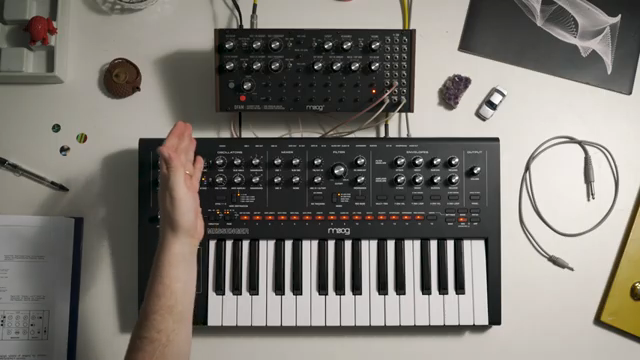
17. September 2025
MILES
Moog Music: Messenger and DFAM—Patch Cables Make Friends
Messenger Meets DFAM: The Modular Handshake
The video opens with Moog Music introducing Messenger as a versatile instrument whose true potential is amplified when paired with another device—in this case, the DFAM. The presenter sets the stage for a patching session that leans heavily on the rear-panel I/O, immediately signalling this is a demo for those who think in cables and voltages. Four connections are established between Messenger and DFAM, laying the groundwork for a system where each synth extends the other’s sonic reach. This approach is classic Moog: encouraging users to see their instruments not as isolated boxes, but as building blocks in a larger, evolving modular ecosystem.
Routing DFAM Through Messenger: A Sonic Fusion
The first patching move is to route DFAM’s audio output into Messenger’s external input, allowing DFAM’s raw voice to be sculpted by Messenger’s filter and VCA. This immediately opens up the palette: DFAM’s percussion and synth tones can now be filtered, enveloped, and shaped in new ways, effectively merging the two instruments into a single, more complex voice. The presenter highlights the gain available on Messenger’s external input, noting that it’s possible to push DFAM into pleasing distortion territory—a nod to those who like their Moog with a bit of grit.
With the audio path set, the video demonstrates how Messenger’s own oscillator can be layered or transposed to complement DFAM. The filter is left wide open initially, but the real fun begins as the presenter tweaks envelopes and introduces release, building up a patch that’s both harmonically rich and dynamically responsive. This section is a practical reminder that the sum of two synths, when patched thoughtfully, is far greater than their individual parts.
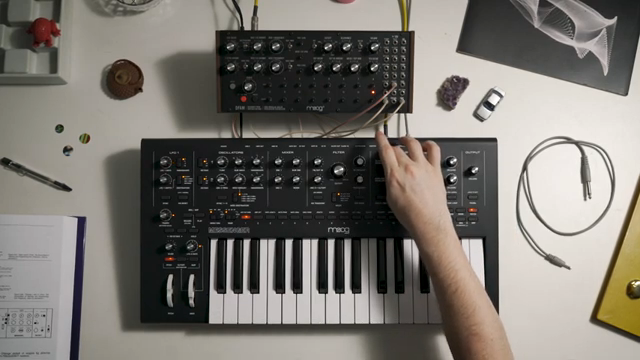
"This is going to allow us to route the audio from DFAM through the filter and VCA on Messenger."
© Screenshot/Quote: Moogsynthesizers (YouTube)
Clocking and Sequencing: Two Brains, One Groove
"The sequencer is not starting because it's actually waiting for clock from DFAM."
© Screenshot/Quote: Moogsynthesizers (YouTube)
Synchronisation is key in any modular setup, and here the DFAM’s trig out is patched to Messenger’s clock input, locking Messenger’s sequencer to DFAM’s tempo. This ensures both instruments step in time, allowing for tightly coordinated sequences. The video walks through arming Messenger’s sequencer so it waits for DFAM’s clock, then demonstrates starting both in perfect sync—a small detail, but crucial for live performance or complex studio patches.
The patching doesn’t stop at clock signals. The DFAM’s pitch row CV is routed to Messenger’s expression input, which is then assigned to modulate parameters like oscillator wave shape. This clever use of sequencer CV lanes means that DFAM’s step knobs can animate Messenger’s sound per-step, adding a layer of movement and complexity that would be difficult to achieve with either instrument alone.
Modulation and Manipulation: Morphing the Moog Soundscape
With the two synths locked together, the video dives into modulation tricks. Messenger’s keyboard sample and hold is set to modulate filter cutoff, injecting a touch of randomness and movement into the patch. The presenter then increases resonance and explores wave shaping on Messenger’s oscillator, using DFAM’s pitch row to push the pulse width to its limits—right up to the edge of silence. This interplay between sequencer CV and oscillator parameters yields evolving timbres and rhythmic shifts.
The demo continues with further layering: Messenger’s LFO is assigned to bring in oscillator 2, creating a dynamic blend that ebbs and flows within the mix. Envelopes on Messenger are used to gate DFAM, and filter modes like bandpass are explored for additional colour. Throughout, the presenter tweaks parameters in real time, showing how interconnected modulation sources can turn a simple patch into an intricate, living soundscape.
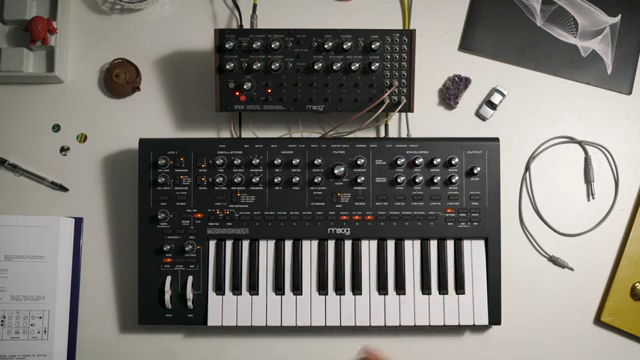
"It's giving us a little bit of random movement to the filter cutoff."
© Screenshot/Quote: Moogsynthesizers (YouTube)
The Modular Payoff: More Than the Sum of Its Parts
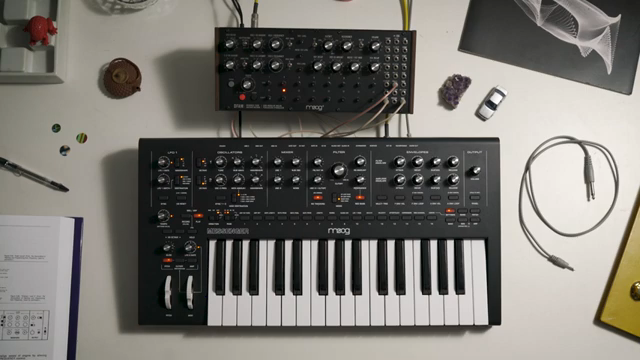
"The two instruments can become more than the sum of their parts."
© Screenshot/Quote: Moogsynthesizers (YouTube)
The video closes by underscoring the core message: modularity isn’t just about more gear, but about exponential growth in creative options. By patching Messenger and DFAM together, users unlock new sonic territories and performance techniques that neither instrument could achieve alone. Moog’s approach here is to highlight how thoughtful interconnectivity transforms a pair of synths into a flexible, expressive system—one that rewards experimentation and rewards those willing to get their hands on the patch cables.
This article is also available in German. Read it here: https://synthmagazin.at/moog-music-messenger-und-dfam-patchkabel-als-beste-freunde/
Watch on YouTube:
Watch on YouTube:
Visit the channel:
https://www.youtube.com/MoogSynthesizers
https://www.youtube.com/MoogSynthesizers
Links from MoogSynthesizers:
website: https://moogmusic.com
instagram: https://instagram.com/moogsynthesizers
facebook: https://www.facebook.com/moogmusicinc
twitter: https://twitter.com/moogmusicinc
Sponsored links:
If you purchase via these links, we may earn a small commission – at no extra cost to you. The link opens an Amazon keyword search, and results may vary depending on availability.
Moog DFAM
🔗 Check price on Amazon
🔗 Check price on Amazon
Moog Messenger
🔗 Check price on Amazon
🔗 Check price on Amazon