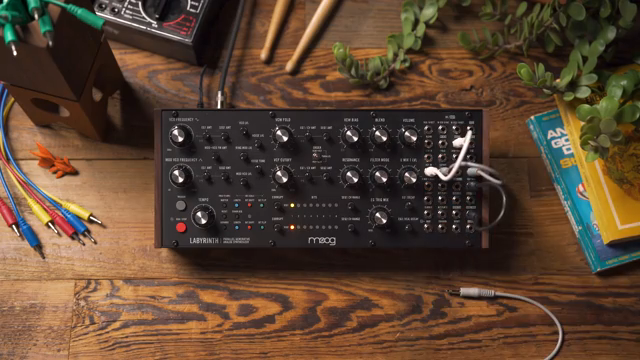
Moog Music’s Labyrinth steps out of the melodic maze and into the rhythmic arena in this official demo, showing off its talents as a flexible drum machine. The video walks us through separating signal paths, wrangling envelopes, and patching up everything from sine-driven kicks to brash, noise-filtered hi-hats. With sequencer tricks, evolving control voltages, and a healthy dose of generative chaos via the CORRUPT knob, Labyrinth reveals a knack for percussive sound design that goes well beyond the usual mono-synth fare. If you’re curious about how this Moog box can mutate into a two-channel drum machine, this is a patch-by-patch breakdown worth a close listen.
12. July 2024
MILES
Moog Music Labyrinth: Percussive Patching and Drum Machine Deconstruction
Breaking Out: Labyrinth as a Drum Machine
Moog Music’s Labyrinth isn’t just a melodic sequencer—it’s a surprisingly nimble drum machine when you start pulling apart its signal paths. The video opens by highlighting how Labyrinth’s architecture allows for duophonic behaviour, effectively splitting the voice path to create two independent percussive sounds. This separation is key to transforming the instrument from a standard synth into a two-channel drum machine, with each channel capable of being triggered and modulated independently.
By decoupling the sequencer triggers and envelopes, the demonstrator sets up a patch where each percussive voice can be sculpted on its own terms. The result is a flexible system that can mimic classic drum machine behaviour, but with the added unpredictability and hands-on control that modular users crave. The approach here is less about emulating a fixed box and more about opening up creative routing possibilities that invite experimentation.
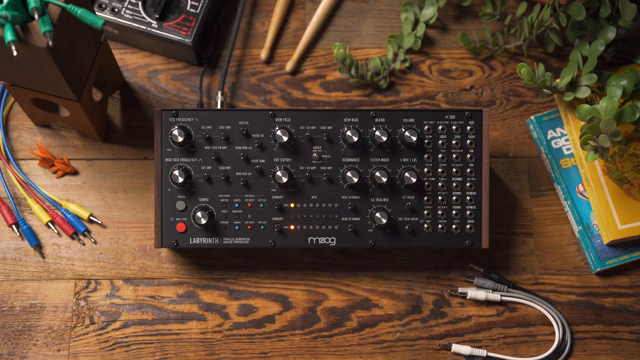
"Labyrinth is particularly well suited to percussion sounds because we can separate the voice path into more of a duophonic behavior to be able to get two independent sounds."
© Screenshot/Quote: Moogsynthesizers (YouTube)
Signal Path Surgery: Kicks, Hats, and Envelope Independence
"So now with this patching what I've done is made it so that EG2 is only going to get triggered by the bottom sequencer, and in the filter path, whereas EG1 is normally used for modulation of the filter on this attenuverter, now EG2 is going to replace it."
© Screenshot/Quote: Moogsynthesizers (YouTube)
The heart of the patch lies in separating the noise output and feeding it directly into the VCF, effectively cancelling the default mixer-to-filter routing. This means the filter path is now dedicated to noise, with the noise tone control still shaping the character before it hits the filter. EG2 is triggered exclusively by sequencer 2, and its output is patched to modulate the filter cutoff, giving full envelope control over the noise-based percussive voice.
Meanwhile, EG1 is assigned to the wavefolder’s VCA CV input, handling both modulation and amplitude for the main oscillator path. This sets the stage for classic kick drum synthesis: oscillator 1 runs into the mixer and wavefolder, with the mixer’s inherent clipping providing extra drive for punchier kicks. The video demonstrates how tweaking the envelope, mixer level, and wavefolder bias can yield a range of kick drum timbres, from subtle sine thumps to more aggressive, folded tones. The noise path, shaped by the band-pass filter, serves up hi-hat and snare-like textures, with filter mode and resonance offering further sculpting options.
Sequencer Sorcery: Evolving Rhythms and Timbral Shifts
Labyrinth’s sequencer is more than just a trigger source—it’s a generator of evolving control voltages that can be routed to modulate various parameters. By increasing the CV range on both sequencers, the demonstrator shows how each gate step can inject a random voltage, which can be directed to move the filter or wavefolder instead of just changing pitch. This introduces subtle or dramatic timbral shifts across the drum pattern, lending a generative quality to the groove.
The CORRUPT control takes things further, allowing the pattern to mutate in real time. Below 50%, CORRUPT adds movement without changing the underlying pattern; above 50%, it starts rewriting the sequence, resulting in constantly shifting rhythms and textures. This is classic Moog territory—inviting controlled chaos and happy accidents into the patch. The ability to independently adjust pattern lengths for each sequencer also opens the door to polymetric interplay, with patterns phasing against each other for extra rhythmic complexity.
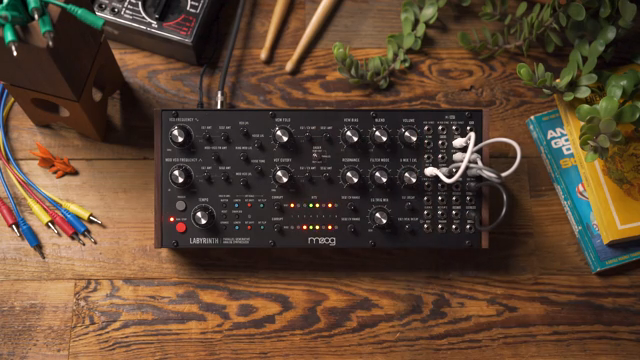
"So you can hear we get this movement that's persistent across multiple cycles where I can hear that this step five is getting folded a little bit harder than step one and step seven, but what I can do with the corrupt knobs is make the behavior a little bit more generative so that it moves on its own and it doesn't persist across cycles in quite the same way."
© Screenshot/Quote: Moogsynthesizers (YouTube)
Bit Shifting and Buffering: Rhythmic Rotation and Pattern Recall
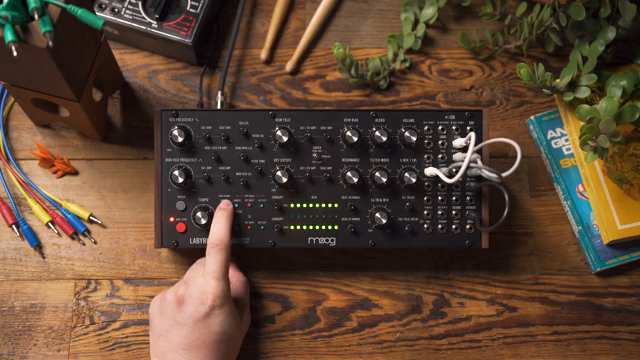
"when I hold it it's going to blink green eventually and that lets me know that the pattern that I have now is stored."
© Screenshot/Quote: Moogsynthesizers (YouTube)
Beyond the basics, Labyrinth’s BIT SHIFT controls allow for real-time rotation of patterns, letting users nudge notes around the sequence without reprogramming steps. This is a handy tool for evolving grooves on the fly, especially in a live or improvisational context. The demonstrator shows how shifting patterns can quickly lead to new rhythmic ideas, keeping the drum machine workflow fluid and interactive.
The BUFFER function rounds out the performance toolkit by enabling instant snapshot saving of patterns. Holding the buffer button stores the current state, so you can freely experiment with CORRUPT or other controls, then recall your favourite groove at a moment’s notice. This feature is particularly useful when letting Labyrinth wander into generative territory—if the machine stumbles onto gold, you can lock it in before the chaos takes over. The blend knob is also highlighted, offering quick balancing between percussive voices. Altogether, these features make Labyrinth a surprisingly deep and playful drum machine for modular-minded users.
This article is also available in German. Read it here: https://synthmagazin.at/moog-music-labyrinth-percussive-patching-und-drum-machine-dekonstruktion/
Watch on YouTube:
Latest articles
Watch on YouTube:
Visit the channel:
https://www.youtube.com/MoogSynthesizers
https://www.youtube.com/MoogSynthesizers
Links from MoogSynthesizers:
website: https://moogmusic.com
instagram: https://instagram.com/moogsynthesizers
facebook: https://www.facebook.com/moogmusicinc
twitter: https://twitter.com/moogmusicinc
Sponsored links:
If you purchase via these links, we may earn a small commission – at no extra cost to you. The link opens an Amazon keyword search, and results may vary depending on availability.
Moog Labyrinth
🔗 Check price on Amazon
🔗 Check price on Amazon