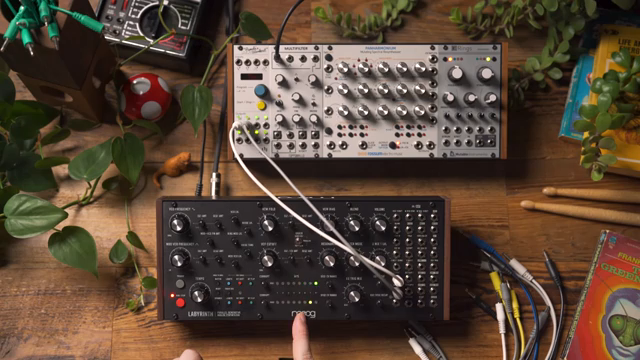
Moog Music’s Labyrinth isn’t just another acid box—it’s a modular playground for rhythmic experimentation. In this official Moog demo, the Labyrinth is paired with ALM’s Pamela’s New Workout to show how external clocks and modulation sources can transform its behaviour. By decoupling sequencers, flipping bits on the fly, and separating envelope control, the video dives deep into metallic, shifting drum patterns that sound like they’ve landed from another planet. Add a kick from a Topobrillo Multifilter and you’ve got a patch that’s as much about exploration as it is about groove. If you’re curious how Labyrinth fits into a Eurorack setup, this is a revealing look at its patchable personality.
12. July 2024
MILES
Moog Music Labyrinth: External Clocks, Alien Rhythms and Modular Mayhem
ALM Pamela's New Workout, Moog Labyrinth, Topobrillo Multifilter
Labyrinth Unleashed: External Modulation as a Creative Catalyst
Moog’s Labyrinth is introduced here not as a standalone groovebox, but as a modular instrument eager to interact with the rest of your rack. The video wastes no time in showing how pairing Labyrinth with an external clock and modulation source—specifically ALM’s Pamela’s New Workout—opens up a world of rhythmic possibilities. The focus is on using external signals to alter Labyrinth’s internal behaviour, moving beyond its stock patterns into more unpredictable territory.
By leveraging external modulation, Labyrinth transforms from a simple acid machine into a complex sound design tool. The demonstration hints at the module’s flexibility, showing how different clock and modulation sources can be used to generate ever-shifting, alien drum patterns. The approach is all about encouraging experimentation, making Labyrinth a compelling centrepiece for those who like their rhythms a bit left of centre.
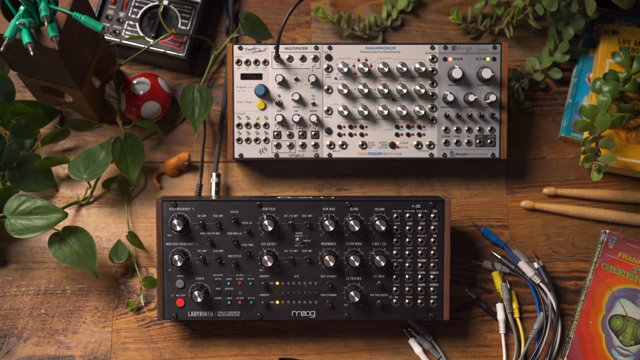
"We can alter Labyrinth's behavior using an external clock and modulation source."
© Screenshot/Quote: Moogsynthesizers (YouTube)
Independent Sequencers: Overlapping Rhythmic Worlds
"We're going to get a nice overlap where the two of them are shifting against each other as they play and continue to loop."
© Screenshot/Quote: Moogsynthesizers (YouTube)
The heart of the patch lies in clocking Labyrinth’s two sequencers independently. By sending separate Euclidean trigger patterns from Pamela’s New Workout into the Clock 1 and Clock 2 inputs, the video demonstrates how SEQ 1 and SEQ 2 can move at different rates. This decoupling results in overlapping, shifting patterns that never quite repeat, lending the output a sense of organic unpredictability.
The bit flipping inputs are then brought into play, with quarter note triggers from Pamela’s used to automate the on/off states of each sequencer’s steps. This approach is more controlled than using the onboard Corrupt knob, allowing for rhythmic patterns that evolve in a consistent yet non-repetitive way. The result is a patch that feels alive, with gates and accents morphing as the sequencers phase against each other.
Envelope Decoupling: Metallic Mayhem and Alien Percussion
A key trick shown in the video is the decoupling of Labyrinth’s envelope generators. By patching the sequencer outputs to trigger the envelopes independently, the VCA and filter paths can be animated separately. EG1 is assigned to the wavefolder’s VCA, while EG2 takes over filter cutoff duties, breaking the usual normalization and inviting more complex modulation.
This separation allows for a host of metallic, alien drum sounds. The ring modulator is dialled up, feeding both the folder and filter, while the filter is set to bandpass with high resonance for that classic acidic bite. The video methodically solos the folder and filter paths, highlighting their distinct characters before blending them back together. The result is a shifting landscape of percussive textures, from sharp metallic hits to squelchy, resonant filter sweeps.
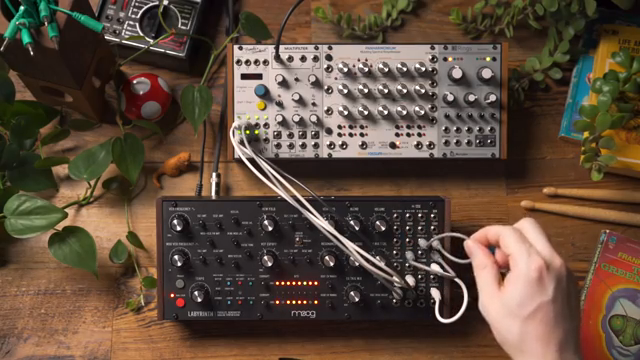
"Now I've separated these two paths so that EG one is controlling the VCA and the folding in the folder path, and EG two is controlling the filter and the filter's VCA in the filter path."
© Screenshot/Quote: Moogsynthesizers (YouTube)
Performance Modulation: Dynamic Blending and Texture Shaping
Performance tools come into play as the blend between folder and filter is automated using a stepped random modulation signal from Pamela’s. By patching this into Labyrinth’s blend input, the balance shifts dynamically on every 16th note, creating evolving timbres without manual intervention. This patching approach encourages hands-off exploration, letting the machine surprise the performer with new textures every bar. It’s a reminder that in modular, sometimes the most interesting results come from relinquishing a bit of control.
Kick Drum Anchors: Taming the Chaos with a Rhythmic Spine
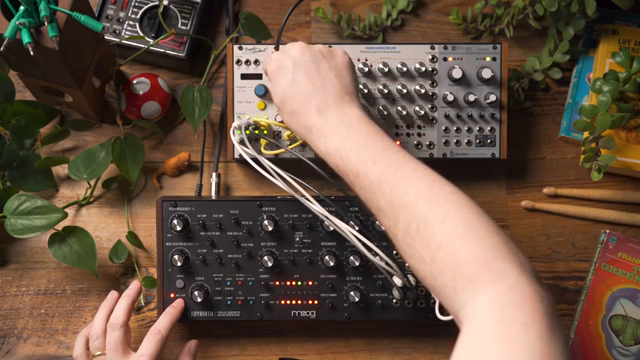
"By integrating an external modulation and clocking source, I'm able to greatly modify the way that Labyrinth works and can explore some really other worldly sounds."
© Screenshot/Quote: Moogsynthesizers (YouTube)
To ground Labyrinth’s irregular, shifting patterns, the video brings in a quarter note kick drum using the Topobrillo Multifilter. Pamela’s provides both the gate and envelope for pinging and modulating the filter, while resonance is cranked for a punchy, modular kick. This rhythmic anchor ties the patch together, letting Labyrinth’s alien textures dance around a steady pulse. The final mix showcases how external modulation, independent sequencing, and classic analog filtering can combine for a result that’s both experimental and musically coherent.
This article is also available in German. Read it here: https://synthmagazin.at/moog-music-labyrinth-externe-clocks-fremdartige-rhythmen-und-modular-chaos/
Watch on YouTube:
Latest articles
Watch on YouTube:
Visit the channel:
https://www.youtube.com/MoogSynthesizers
https://www.youtube.com/MoogSynthesizers
Links from MoogSynthesizers:
website: https://moogmusic.com
instagram: https://instagram.com/moogsynthesizers
facebook: https://www.facebook.com/moogmusicinc
twitter: https://twitter.com/moogmusicinc
Sponsored links:
If you purchase via these links, we may earn a small commission – at no extra cost to you. The link opens an Amazon keyword search, and results may vary depending on availability.
ALM Pamela's New Workout
🔗 Check price on Amazon
🔗 Check price on Amazon
Moog Labyrinth
🔗 Check price on Amazon
🔗 Check price on Amazon
Topobrillo Multifilter
🔗 Check price on Amazon
🔗 Check price on Amazon