Moog Music steps into the duophonic arena with Labyrinth, a semi-modular synth that promises more than just classic monophonic lines. In this official video, Moog demonstrates how to coax two independent melodic voices from Labyrinth’s dual sequencers, parallel signal paths, and clever utility mixer. The focus is on hands-on patching—tuning oscillators, splitting envelopes, and blending voices for rich counterpoint. For those who like their synths to pull double duty in a patch, this walkthrough reveals just how much flexibility is lurking behind Labyrinth’s panel. Let’s see how Moog’s approach to duophony stacks up in a real-world patching context.
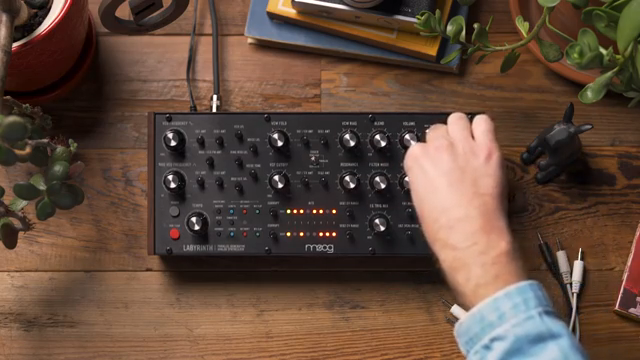
Two Voices, One Labyrinth: Duophony Unleashed
Moog introduces Labyrinth as a duophonic synthesizer, highlighting its ability to generate two independent melodic sequences from a single instrument. The video sets the stage by referencing Labyrinth’s dual sequencers, parallel signal paths, and two envelope generators—all essential ingredients for true duophonic operation.
This isn’t just a matter of stacking oscillators; the demo promises a methodical approach to splitting Labyrinth’s architecture into two distinct voices. By leveraging the instrument’s internal routing and patch bay, users are shown how to move beyond simple layering and into the realm of genuine counterpoint, where each voice can be programmed and articulated separately.
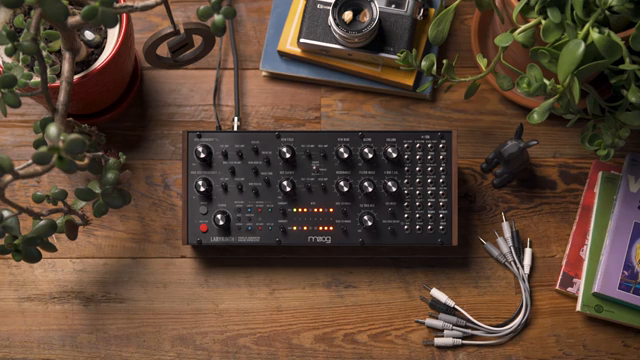
"How to create two independent voices from Labyrinth's two sequencers, parallel signal path, two envelope generators, and the utility mixer."
© Screenshot/Quote: Moogsynthesizers (YouTube)
Oscillators and Utility Mixer: Crafting Distinct Sound Paths
"Now we have one voice comprised of the VCO going through the wave folder, and a second voice comprised of the mod VCO going through the filter."
© Screenshot/Quote: Moogsynthesizers (YouTube)
The demonstration begins with tuning both the main VCO and the modulation VCO to the same root note, ensuring harmonic cohesion between the two voices. The process involves zeroing out sequencer voltages and using the trigger button to audition both oscillators simultaneously, a practical touch for those who want tight intervals or octave relationships.
Once tuned, the patching gets more granular. The main VCO is routed through the wave folder, while the mod VCO is sent to the utility mixer (U MIX), where it can be blended with noise. This mixed signal is then patched into the filter, effectively creating two separate signal chains: one classic and folded, the other filtered and optionally noisy. The video makes clear that this setup is all about flexibility in timbral sculpting.
Envelope Generators: Independent Control for Each Voice
A key step in achieving true duophony is decoupling the two envelope generators. The video demonstrates patching sequencer 2’s trigger output to envelope generator 2’s trigger input, so that each sequencer independently controls its own envelope. This separation allows for distinct articulation and dynamics on each voice.
Further, EG1 is patched to control the VCA in the wave folder path, while EG2 governs the VCA in the filter path. This means each voice not only has its own melodic line but also its own amplitude contour, opening up nuanced phrasing and interplay between the two parts. The result is a setup where both voices can be played and shaped independently, yet still blend harmoniously.
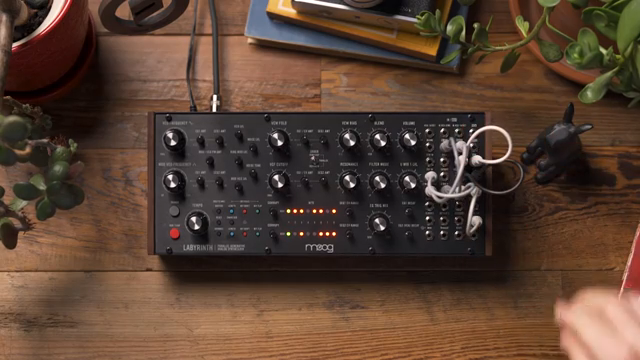
"So that the VCA on the filter path is controlled by EG2, and the VCA on the wave folder path is controlled by EG1."
© Screenshot/Quote: Moogsynthesizers (YouTube)
Blend Control: Layering and Morphing Between Voices
With both voices patched and envelopes assigned, the blend control becomes the central tool for mixing. The video shows how users can isolate either voice or blend them together, allowing for smooth transitions and layered textures. This is particularly handy for live tweaking or evolving arrangements.
The blend function isn’t just a volume crossfader—it’s a way to morph between two contrasting timbres and articulations. Whether you want a stark call-and-response or a lush, intertwined duet, the blend control gives you hands-on access to the full spectrum between the two voices. It’s a simple but effective way to animate a patch without repatching mid-performance.
Sequencers: Counterpoint and Polyrhythm in Practice
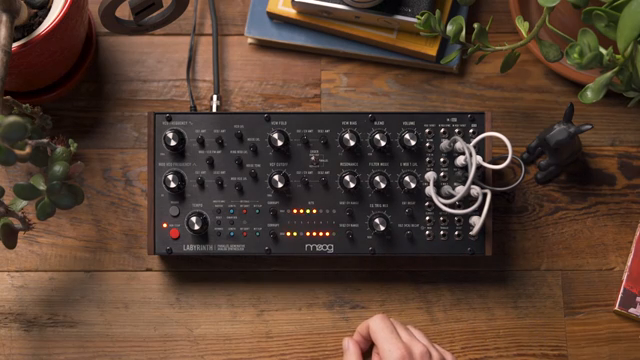
"We can even change the length of sequencer 1 to get polyrhythms, with sequencer 2 constantly rotating against sequencer 1."
© Screenshot/Quote: Moogsynthesizers (YouTube)
The video closes by putting Labyrinth’s dual sequencers through their paces. By raising the CV range and amount on sequencer 2, a moving melodic line is introduced while sequencer 1 holds steady. This creates instant melodic counterpoint, with both lines locked to the same key thanks to shared tuning and quantization.
For those craving rhythmic complexity, the demonstration tweaks the length of sequencer 1 to generate polyrhythms—one sequence cycling against the other. Noise is folded into the second voice for added texture, and the result is a dynamic, evolving interplay that showcases the compositional potential of Labyrinth’s duophonic architecture. It’s a reminder that, in the right hands, two sequencers can sound like a small ensemble.
This article is also available in German. Read it here: https://synthmagazin.at/moog-music-labyrinth-duophone-verkabelung-entschluesselt/
Watch on YouTube:
Latest articles
Watch on YouTube:
Visit the channel:
https://www.youtube.com/MoogSynthesizers
https://www.youtube.com/MoogSynthesizers
Links from MoogSynthesizers:
website: https://moogmusic.com
instagram: https://instagram.com/moogsynthesizers
facebook: https://www.facebook.com/moogmusicinc
twitter: https://twitter.com/moogmusicinc
Sponsored links:
If you purchase via these links, we may earn a small commission – at no extra cost to you. The link opens an Amazon keyword search, and results may vary depending on availability.
Moog Labyrinth
🔗 Check price on Amazon
🔗 Check price on Amazon