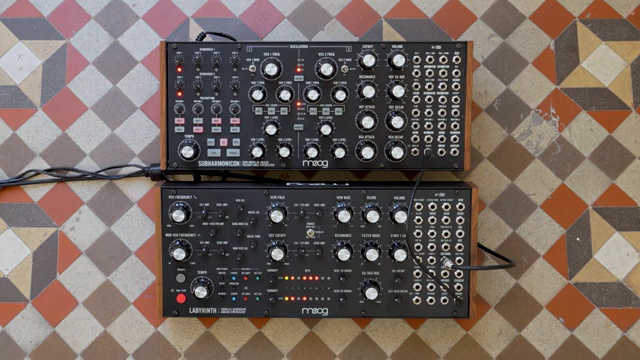
Moog Music’s latest official demo brings together two of their most intriguing sequencer-driven synths: the Labyrinth and the Subharmonicon. In this video, Moog demonstrates how these machines can be patched into a single, evolving instrument, showcasing the tangled interplay of their sequencers and the harmonic possibilities that emerge. With a focus on clock sync, utility mixing, quantization, and clever cross-patching, the presentation is a deep dive into polyrhythmic transpositions and generative melodic movement. For those who live for patch cables and shifting voltages, this is a showcase of modular synergy at its finest.
6. September 2025
MILES
Moog Music: Entwined Sequencers – Labyrinth Meets Subharmonicon
Sequencer Synergy: Labyrinth & Subharmonicon Entwined
Moog Music opens this demo by pairing the Labyrinth and Subharmonicon, two sequencer-rich synths, to explore the unique results of their combined sequencing powers. The focus is immediately on how their respective sequencers, when interconnected, can generate intricate transpositional behaviours that go well beyond what either instrument achieves alone. By syncing Labyrinth’s clock output to Subharmonicon’s clock input, the two machines are locked in step, setting the stage for a patch that’s all about interaction and mutual influence. The aim is clear: to harness these sequencers for a tangled, evolving melodic landscape that rewards creative routing.
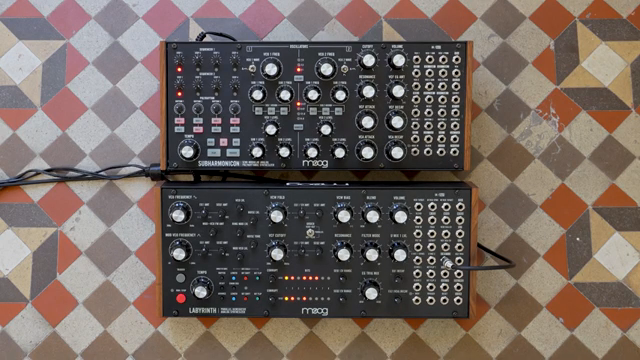
"Harness the power of their respective sequencers to create unique and tangled transpositional behavior."
© Screenshot/Quote: Moogsynthesizers (YouTube)
Mixing Voices: Utility Mixer as Patch Hub
"Using Labyrinth's utility mixer lets us create one cohesive instrument."
© Screenshot/Quote: Moogsynthesizers (YouTube)
Rather than simply running each synth through a standard mixer or interface, the video demonstrates how Labyrinth’s built-in utility mixer can be used to blend both instruments into a single, cohesive sound source. Labyrinth’s VCA output is patched to channel 1 of the utility mixer, while Subharmonicon’s VCA output feeds channel 2, allowing for precise control over the balance and interaction of both voices.
The summed output from the utility mixer is then sent directly to a digital recorder, effectively turning the two synths into a unified instrument. This approach not only simplifies the signal chain but also encourages a more integrated performance workflow, where the nuances of each synth can be shaped in tandem. The video also covers basic tuning and level-setting, ensuring both voices are harmonically aligned before the sequencing games begin.
Quantization Tricks: Octaves and Beyond
A key feature highlighted is the quantization available on Subharmonicon’s sequencers. With quantization set to 12-tone equal temperament, the step knobs can be restricted to output voltages corresponding to octave intervals, making it easy to dial in precise transpositions. The range of each step knob can be set to ±5, ±2, or ±1 octave, and the video demonstrates how setting the knobs to noon, fully clockwise, or fully counterclockwise yields 0V, +1V, or -1V respectively—translating directly to octave jumps.
This quantized approach allows for both sequencers on Subharmonicon to output simple octave transpositions, which can then be routed creatively. The demo shows how these outputs can be patched to control either Subharmonicon’s own oscillators or, more interestingly, to transpose sequences on Labyrinth, opening up a world of polyrhythmic and harmonic possibilities.
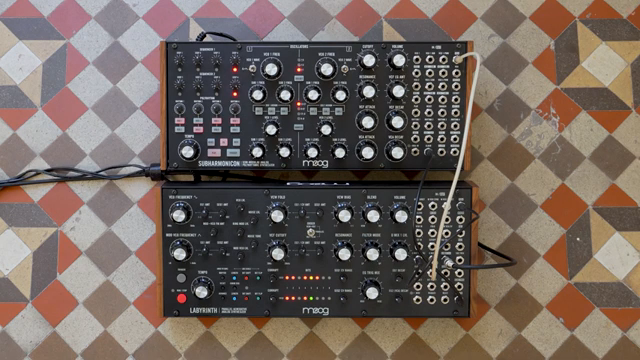
"The sequencers on Subharmonicon can be quantized."
© Screenshot/Quote: Moogsynthesizers (YouTube)
Cross-Patching for Polyrhythmic Complexity
The real magic emerges when the sequencers of both synths are cross-patched. Labyrinth’s sequencer 1 is routed to its own VCO, while Subharmonicon’s sequencer 2 is patched to the Labyrinth’s 1V/oct input, enabling octave transpositions of Labyrinth’s sequence. Conversely, Labyrinth’s sequencer 2 is sent to Subharmonicon’s VCO 1 CV input, letting Labyrinth drive melodic movement on Subharmonicon. This reciprocal setup means each synth is both sequencing and being sequenced, resulting in a dense web of melodic interplay.
Further complexity is introduced by patching Labyrinth’s sequencer 2 trigger output to Subharmonicon’s trigger input. By disengaging Subharmonicon’s EG button, notes are only triggered when enabled by Labyrinth’s sequencer, allowing for intricate polyrhythmic patterns. Adjusting polyrhythm settings on both devices shifts the rhythmic relationships, producing ever-evolving transpositions and counterpoint.
Generative Harmonics: The Sound of Tangled Patches
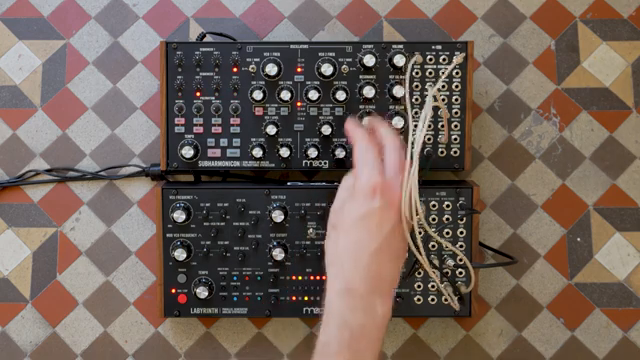
"Combining Labyrinth and Subharmonicon together can provide fascinating harmonic movement."
© Screenshot/Quote: Moogsynthesizers (YouTube)
The resulting soundscape is a testament to the depth achievable when Labyrinth’s generative sequencers interact with Subharmonicon’s quantized transpositions. The video demonstrates how, by moving beyond simple octave jumps and experimenting with different quantization scales and step settings, the system can yield rich harmonic movement and unexpected melodic twists. This patching approach transforms the two synths into a single, generative instrument capable of hours of contrapuntal exploration—an enticing prospect for anyone who enjoys getting lost in modular mazes.
This article is also available in German. Read it here: https://synthmagazin.at/moog-music-verschlungene-sequencer-labyrinth-trifft-subharmonicon/
Watch on YouTube:
Latest articles
Watch on YouTube:
Visit the channel:
https://www.youtube.com/MoogSynthesizers
https://www.youtube.com/MoogSynthesizers
Links from MoogSynthesizers:
website: https://moogmusic.com
instagram: https://instagram.com/moogsynthesizers
facebook: https://www.facebook.com/moogmusicinc
twitter: https://twitter.com/moogmusicinc
Sponsored links:
If you purchase via these links, we may earn a small commission – at no extra cost to you. The link opens an Amazon keyword search, and results may vary depending on availability.
Moog Labyrinth
🔗 Check price on Amazon
🔗 Check price on Amazon
Moog Subharmonicon
🔗 Check price on Amazon
🔗 Check price on Amazon