Ever tried coaxing creamy pads out of your modular rig and ended up with something drier than a sausage roll in the outback sun? Monotrail Tech Talk is here to flip that script with a duophonic patch trick that’s as clever as a magpie with a stolen chip. In this video, Monotrail ditches the polyphonic big guns and shows how a humble two-oscillator mono voice can bloom into pads lush enough to make your DAW jealous. If you reckon modular’s just for plucks and bleeps, mate, you’re in for a treat. Grab a cold one and get ready for a modular hack that’s cheap, cheerful, and bloody beautiful.
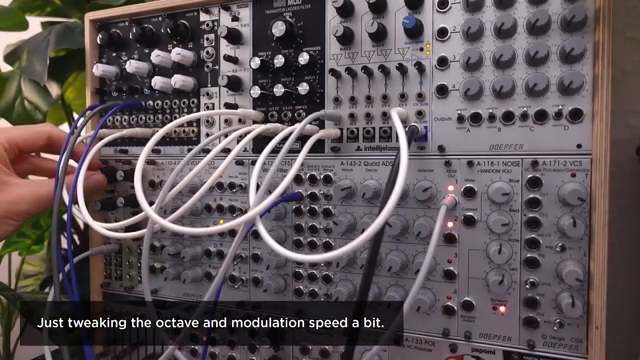
3. December 2025
TAS
Monotrail Tech Talk’s Cheater’s Pad Trick: Lush Sounds from Barebones Modulars
Duophonic Delight: Pads from Bare Bones
Let’s be honest, most folks reckon modular synths are about as friendly to pads as a BBQ is to tofu. But Monotrail Tech Talk flips the script, showing us how a basic two-oscillator mono voice can pump out pads that sound like they’ve been sunbathing in a reverb-soaked rainforest. The trick? It’s all about a simple duophonic patch—two oscillators, each getting their own sequence, sent through a mixer and low pass filter. No fancy poly modules, no wallet-busting clones, just good old-fashioned patching.
Instead of faffing about with a VCA, Monotrail keeps it raw, letting the oscillators sing straight through the filter. The only real difference from your standard mono setup is that each oscillator gets its own melodic line, creating instant two-note chords. Chuck in a sequencer to gate an envelope on the filter, dial in a slow attack and a splash of reverb, and suddenly you’ve got pads that’ll make your mates think you’ve smuggled in a vintage polysynth. Simple, cheeky, and effective—just how we like it.

"But what if I say you can use a regular two oscillator mono voice to make pads like this."
© Screenshot/Quote: Monotrailtechtalk (YouTube)
Movement & Texture: Breathing Life into Pads
"The idea is to add a bit of unpredictability and movement, making each wave of a pad slightly different."
© Screenshot/Quote: Monotrailtechtalk (YouTube)
Now, if your pads are sounding stiffer than a surfboard in a drought, it’s time to add some movement. Monotrail’s first move is to inject slow, subtle modulation—think LFOs or smooth random voltages—to the pitch or filter. This gives your pads a bit of drift, like a kangaroo bouncing through a field of wildflowers, making each note feel alive and unpredictable.
But why stop there? The real magic happens when you start modulating the modulators. That’s right—use an LFO to mess with another LFO’s speed, or let random voltages chase each other’s tails. Suddenly, your pads start breathing, shifting, and evolving with every bar. If you’ve got modules with wild CV options, now’s the time to let them off the leash. Shape modulation, wavetable sweeps, filter resonance—Monotrail shows it all, layering movement until the sound is as deep as a billabong after a storm.
And here’s the kicker: you don’t need a suitcase full of boutique modules. Even with basic gear, these tricks turn a plain patch into a living, shifting soundscape. The video’s full of clever patch ideas, but trust me, you’ll want to see and hear the subtle changes for yourself—words barely do it justice.
Rhythm: Pads with a Pulse
Pads aren’t just about floating in the sonic breeze—they need a heartbeat. Monotrail dives into rhythmic modulation, showing how simple envelopes and sequencer tricks can make your pads pulse, sway, and groove. By gating multiple ADSR envelopes from a sequencer or clock divider, you get evolving filter sweeps and dynamic volume changes that make your pads feel like they’re dancing at a bush doof.
It’s not just about slapping on a delay or reverb, either. By combining different envelope shapes—some snappy, some slow—and syncing them to various clock divisions, you can create pads that morph and move with the beat. Toss in a bit of delay for extra shimmer, and suddenly your modular’s pads are as lively as a Melbourne laneway on a Saturday night.
Noise, LFOs & Mod Sources: The Secret Sauce
If you want pads with character, you need to get messy—add noise, LFOs, and all sorts of modulation mischief. Monotrail’s not shy about using noise as both a sound source and a modulator. White noise in the mix adds airy texture, while dark noise modulating FM or pitch brings a gritty, unpredictable edge that’s as wild as a dust storm at a desert rave.
Audio-rate modulation is another ace up the sleeve. By routing a sine or saw wave through a VCA and using it to modulate the filter or FM input, you get textures that shimmer, wobble, and shift in ways that’ll make your ears do a double-take. And don’t forget panners, mixers, and bipolar LFOs—these tools let you swing, blend, and mangle your modulations until your pads are dripping with movement and depth.
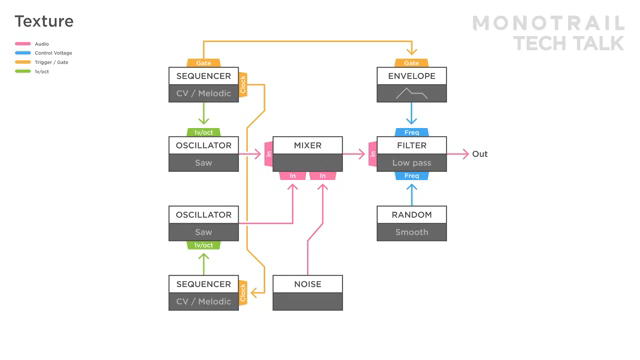
"but it's often more interesting to use noise as a modulation source."
© Screenshot/Quote: Monotrailtechtalk (YouTube)
Expand & Conquer: Scaling Up the Patch
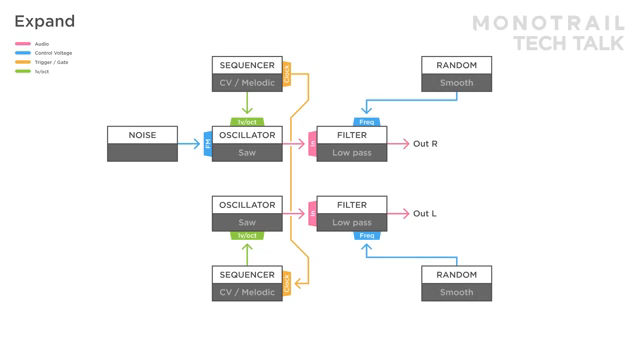
"if you use synced sequences with different divisions or patterns you can use two envelopes and create actual two-note polyphony."
© Screenshot/Quote: Monotrailtechtalk (YouTube)
Once you’ve nailed the basics, Monotrail shows how to scale up your patch for even more sonic mayhem. Add a third oscillator for thicker chords, or send each oscillator through its own filter for lush stereo spreads. Suddenly, what started as a humble duophonic patch turns into a modular monster, capable of pads that’ll fill any dancefloor or open-air rave.
You can sequence each oscillator separately, or let one drone on the root for extra weight. With separate envelopes and filters, each note can have its own shape and length—true modular polyphony, no fancy modules required. The possibilities are as endless as a summer road trip up the coast.
Of course, the real magic’s in the details—how the envelopes interact, how the modulations weave together, and how the whole patch comes alive when you start layering tricks from earlier in the video. If you want to see just how wild and expansive these pads can get, you’ll have to watch Monotrail work his patching magic firsthand.
This article is also available in German. Read it here: https://synthmagazin.at/monotrail-tech-talks-pad-schummelei-fette-klangteppiche-aus-minimal-modular/
Watch on YouTube:
Latest articles
Watch on YouTube:
Visit the channel:
https://www.youtube.com/MonotrailTechTalk
https://www.youtube.com/MonotrailTechTalk
Links from MonotrailTechTalk:
Patreon: https://patreon.com/monotrail
Instagram: https://instagram.com/monotrail/
Sponsored links:
If you purchase via these links, we may earn a small commission – at no extra cost to you. The link opens an Amazon keyword search, and results may vary depending on availability.
Eurorack Modular Synthesizer
🔗 Check price on Amazon
🔗 Check price on Amazon