Modor Music, the Belgian champions of digital hardware, have dropped a substantial firmware update for their DR-2 drum machine. OS013 isn’t just a bugfix—it’s a creative leap, adding dedicated bassline synth models and a raft of sequencing improvements. From MIDI track toggling to global accent tweaks and extended bar lengths, the DR-2 now stretches further into hybrid groovebox territory. We take a close look at what this update brings, how the new bassline engines behave, and what it all means for hands-on electronic music makers.
11. October 2024
MILES
Modor Music’s DR-2 OS013: Basslines and Beyond for the Digital Drum Machine
Firmware Evolution: Basslines Join the DR-2 Arsenal
The Modor DR-2, already a digital percussionist’s playground, receives a notable expansion with firmware OS013. This update is more than a handful of minor tweaks—it marks the arrival of dedicated bassline synthesis models, a first for the DR-2. Modor Music, never shy about pushing their hardware into new territory, now invites users to blend rhythm and melody within a single box.
While the DR-2 was originally conceived as a pure drum machine, the steady march of firmware upgrades has nudged it into hybrid territory. With OS013, the DR-2’s sound engine and sequencer gain new tricks, broadening its role in both live and studio setups. The video wastes no time in highlighting these fresh capabilities, setting the stage for a deep dive into what’s new.
"Especially that adds bassline synthesis."
© Screenshot/Quote: Modormusic (YouTube)
MIDI Track Control: Binary and Beyond
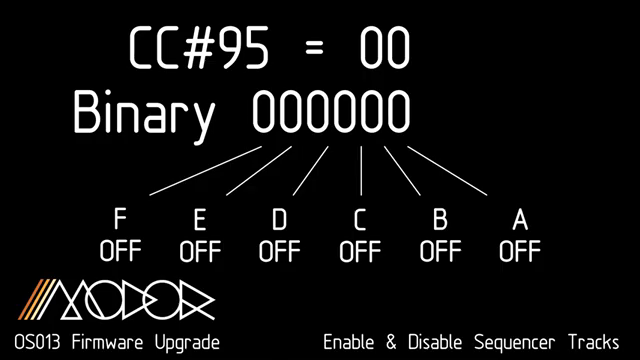
"A value of 38 means that instruments F, C and B are enabled."
© Screenshot/Quote: Modormusic (YouTube)
One of the more practical additions is the ability to enable or disable sequencer tracks via MIDI CC or MIDI notes. This opens up flexible remote control, whether you’re running the DR-2 from a DAW or a hardware sequencer.
For those who speak fluent binary, CC 95 lets you toggle tracks with a single value—handy if you’re into bitwise operations. For the rest of us, Modor has added a more approachable option: using MIDI notes in the C0–B0 octave to switch tracks on or off. This dual approach caters to both the code-savvy and the musically minded, making the DR-2 more adaptable in complex MIDI rigs.
Accents and Bar Lengths: Rhythmic Flexibility Unleashed
OS013 introduces a global accent level, allowing users to set the intensity of global accents independently from individual instrument accents. This means you can fine-tune the punch of your grooves, balancing the overall dynamic shape without fussing over each track. The DR-2’s approach to accent programming—holding the accent button for step accents or tapping it for global—remains, but now with more nuanced control.
Another welcome tweak is the ability to set longer bar lengths, breaking past the old 16-step ceiling. Whether you’re crafting odd meters like 5/4 or 7/4, or stretching out to 64-step marathon patterns, the DR-2 now accommodates more adventurous rhythmic structures. The workflow involves using the page buttons to access additional steps, and you can still reserve pages for variations or fill-ins. This flexibility is a boon for anyone building intricate patterns or polyrhythmic sequences.
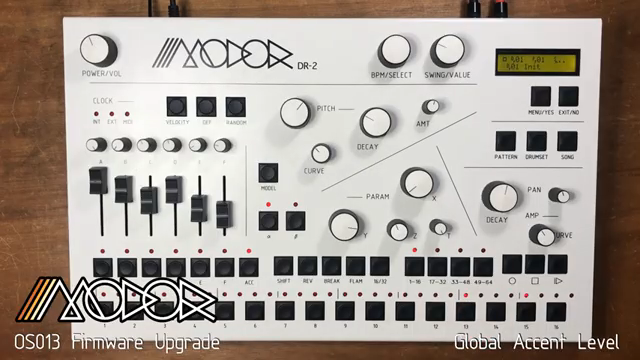
"The global accent level sets determines the intensity of these global accents alone, apart from the single instrument accents."
© Screenshot/Quote: Modormusic (YouTube)
Bassline Synthesis Models: Four Flavours of Low-End
The headline feature of OS013 is undoubtedly the addition of four dedicated bassline synth models. Modor Music has equipped the DR-2 with a subtractive saw synth, a square synth, a sine synth, and a two-operator FM synth. Each brings its own character: the saw and square models offer classic filtered bass textures, while the sine synth layers three oscillators an octave apart for extra weight and a touch of drive.
The FM synth, meanwhile, delivers metallic, percussive basses typical of digital FM. Notably, the transient click from the drum models is replaced by a portamento parameter, enabling slides and glides between notes. This shift in design reflects a move from percussive attack to melodic phrasing, making the DR-2’s basslines more expressive and playable in a sequence.
Pitch Locking and Melodic Fluidity
"The pitch parameter locks work relative to the root note, so that it becomes easy to transpose the baseline, by just turning the pitch knob or sending it a controller value."
© Screenshot/Quote: Modormusic (YouTube)
Parameter locking for pitch, first introduced in earlier firmware, now gets a melodic upgrade. Pitch locks are relative to the root note, so transposing an entire bassline is as simple as turning the pitch knob or sending a MIDI controller value. This makes it easy to experiment with key changes or dynamic modulations on the fly.
The addition of portamento further enhances melodic fluidity, allowing for smooth slides between notes—a staple of classic bassline programming. These improvements make the DR-2’s sequencer more than just a rhythm tool; it’s now a playground for melodic experimentation, blurring the lines between drum machine and groovebox.
This article is also available in German. Read it here: https://synthmagazin.at/modor-music-dr-2-os013-basslines-und-mehr-fuer-die-digitale-drum-machine/
Watch on YouTube:
Latest articles
Watch on YouTube:
Visit the channel:
https://www.youtube.com/ModorMusic
https://www.youtube.com/ModorMusic
Links from ModorMusic:
website: https://www.modormusic.com
instagram: https://www.instagram.com/modormusic
facebook: https://www.facebook.com/modormusic
Sponsored links:
If you purchase via these links, we may earn a small commission – at no extra cost to you. The link opens an Amazon keyword search, and results may vary depending on availability.
Modor DR-2
🔗 Check price on Amazon
🔗 Check price on Amazon