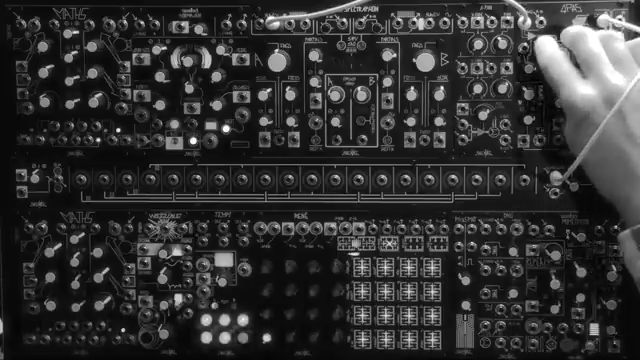
Make Noise, the Asheville-based modular mavericks, return with a spectral twist on drum synthesis. In this video, the official MAKEN0ISE channel demonstrates how to craft transients, drums, and percussive textures using the Spectraphon and Morphagene, with a healthy dose of creative signal routing and resynthesis. The process is less about recreating 808s and more about sculpting otherworldly, machine-interpreted hits—perfect for those who prefer their percussion with a side of spectral weirdness. Expect aggressive textures, clever modulation, and a workflow that encourages experimentation over convention.
28. November 2024
MILES
MAKEN0ISE Spectral DRUM MACHINE: Resynthesizing Percussion with Morphagene and Spectraphon
DXG, Maths, Mimeophon, Morphagene, QPAS, Spectraphon, X-PAN
Spectral Drum Machine: A New Take on Percussion
The video opens with a characteristically eerie Make Noise vibe, setting the stage for a journey into spectral percussion. The presenter introduces the concept of crafting transient and drum-like sounds using the ReSynthesizer and Morphagene, aiming to build a unique library of percussive events. This is not your standard drum machine fare—it’s about harnessing the modular ecosystem to generate and collect a palette of unconventional hits.
From the outset, it’s clear the focus is on process rather than preset. The Morphagene acts as a digital memory bank, capturing the evolving results of spectral manipulation. The approach is exploratory, inviting viewers to think beyond traditional drum synthesis and consider how resynthesis and sampling can yield a library of one-of-a-kind percussive material.

"We'd love to hear any method you'd recommend, if you'd be so kind as to put them in the comments below this video."
© Screenshot/Quote: Maken0Isemusic (YouTube)
Spectraphon Sound Generation: Aggression by Design
"Taking the mono low-pass output, stacks all four filters into one, which means it can overdrive and sound pretty aggressive."
© Screenshot/Quote: Maken0Isemusic (YouTube)
Diving into the patch, the video demonstrates using both sides of the Spectraphon to generate raw material. The sub outputs—particularly the sawtooth from side A—are routed through the QPAS filter, using its mono low-pass output to stack all four filters for a saturated, aggressive tone. This isn’t about subtlety; the overdriven filter path is chosen specifically for its punch and character.
The signal then feeds into the right side of the Spectraphon in SAM mode, resynthesizing and further colouring the sound. By patching the processed audio into the Morphagene, the presenter creates a feedback loop of spectral manipulation. Mixing even and odd outputs in the X-Pan yields a more nuanced stereo image, avoiding the hard-panned extremes often found in spectral processing. The result is a series of percussive timbres with a distinctly machine-like edge.
Performance Tools and Modulation: Manual Meets Modular
The workflow shifts to performance and modulation, with a focus on generating transient shapes that transcend simple manual sweeps. The touch gate from the Press Point is multed via the CV bus, triggering a Maths channel to create a short exponential decay—classic function generator territory. This envelope is then distributed to modulate the QPAS frequency and the Spectraphon’s slide control, injecting dynamic movement into each hit.
Further punch is achieved by sending an attenuated variable output to the Spectraphon’s pitch input, a tried-and-true technique for adding impact to drum sounds. The patching is hands-on but repeatable, allowing for on-demand creation of percussive events while retaining the organic unpredictability of modular synthesis. The result is a toolkit for sculpting spectral drums that feel both controlled and alive.

"This is a common way to add punch or impact to the beginning of a drum sound."
© Screenshot/Quote: Maken0Isemusic (YouTube)
Morphagene: Recording and Reshaping Sonic Variations

"This makes the record button and input record into a new splice rather than overdubbing."
© Screenshot/Quote: Maken0Isemusic (YouTube)
Attention turns to the Morphagene, where the process of capturing and organizing percussive variations is methodically illustrated. By configuring the Morphagene to record into new splices rather than overdubbing, the presenter ensures each transient event is neatly segmented for later recall. A multed gate signal automates the recording process, syncing the creation of each sound with its capture.
Once a reel of splices is assembled, the Morphagene’s end-of-splice gate is patched to the shift input, enabling automatic cycling through the library of hits. This approach transforms the Morphagene into a spectral drum sampler, capable of rapid-fire playback and further manipulation. The workflow is modular at heart: flexible, hands-on, and ripe for creative abuse.
Community and Further Resynthesis: The Patch Never Ends
The video closes with a nod to the open-ended nature of modular sound design. After resynthesizing the freshly recorded drums by routing Morphagene outputs back into the Spectraphon, and adding further processing via Mimeophon and DXG, the presenter encourages viewers to share their own resynthesis techniques. It’s a reminder that in the Make Noise ethos, every patch is an invitation to experiment—and the best results often come from pushing beyond the obvious.
This article is also available in German. Read it here: https://synthmagazin.at/maken0ise-spectral-drum-machine-perkussive-resynthese-mit-morphagene-und-spectraphon/
Watch on YouTube:
Latest articles
Watch on YouTube:
Visit the channel:
https://www.youtube.com/MAKEN0ISEMUSIC
https://www.youtube.com/MAKEN0ISEMUSIC
Links from MAKEN0ISEMUSIC:
website: https://www.makenoisemusic.com
instagram: https://www.instagram.com/makenoisemusic
twitter: https://twitter.com/makenoisemusic
facebook: https://www.facebook.com/makenoiseco
Sponsored links:
If you purchase via these links, we may earn a small commission – at no extra cost to you. The link opens an Amazon keyword search, and results may vary depending on availability.
Maths
🔗 Check price on Amazon
🔗 Check price on Amazon
Mimeophon
🔗 Check price on Amazon
🔗 Check price on Amazon
Morphagene
🔗 Check price on Amazon
🔗 Check price on Amazon
QPAS
🔗 Check price on Amazon
🔗 Check price on Amazon
Spectraphon
🔗 Check price on Amazon
🔗 Check price on Amazon
X-PAN
🔗 Check price on Amazon
🔗 Check price on Amazon